Hi, what do you want to do?






EngageNY
Exponential Growth—U.S. Population and World Population
Show how exponential growth can look linear. Pupils come to understand the importance of looking at the entire picture as they compare the US population to the world population. Initially, the populations look linear with the same rate...

Curated OER
The World Population: Logistic Model
Students explore the various uses of the logistic function. Students use the internet to collect world population data and find a logistic model for their data and use their chosen model to predict future populations.

Curated OER
Math Today - World Population Milestones
Students use the data from USA TODAY Snapshot "World population milestones" to explore and explain the trends in the world population.

Curated OER
In the Billions and Linear Modeling
Your learners analyze population data to discern if it best fits a linear scenario. The idea of change by equal differences over equal intervals is enforced in this real-life task.

Curated OER
In the Billions and Exponential Modeling
Modeling population growth gives learners an opportunity to experiment with real data. Comparing the growth rates in this real-life task strengthens learners' understanding that exponential functions change by equal factors over equal...

Kenan Fellows
Attack of the Aphids!
Insects threaten the food production industry, and aphids are one of the big players! Analyzing data of aphid populations gives insight into their behaviors. Learners model the population data of an uninhibited population with an...

Curated OER
How Many Is Too Many?
Students explore the population explosion. They view a video depicting the exponential growth of human population. Students research the internet to project future population data. They perform hands-on, multimedia activities to study...

Annenberg Foundation
Skeeters Are Overrunning the World
Skeeters are used to model linear and exponential population growth in a wonderfully organized lesson plan including teachers' and students' notes, an assignment, graphs, tables, and equations. Filled with constant deep-reaching...

Beyond Benign
The Big Melt: Arctic Ice Caps
Are the Arctic ice caps really melting out of existence? Junior climatologists examine the statistics of ice decline through four math-based lessons. Each activity incorporates data, climate information, and environmental impact into an...
Texas Instruments
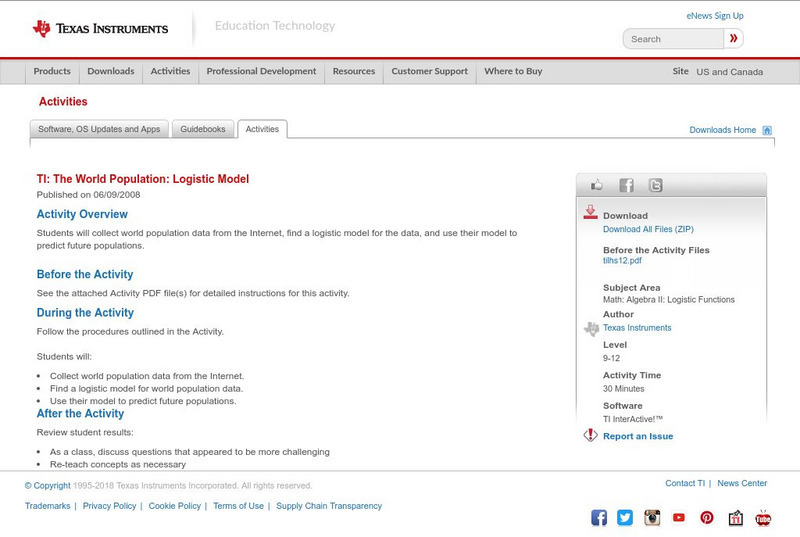
Texas Instruments: The World Population: Logistic Model
Students will collect world population data from the Internet, find a logistic model for the data, and use their model to predict future populations.

Illustrative Mathematics
Illustrative Mathematics: F Le in the Billions and Exponential Modeling
For this task, learners examine world population data from 1804 to 2012 and investigate whether an exponential function is appropriate for modeling the relationship between the world population and the year. Aligns with F-LE.A.1.c.
Texas Instruments
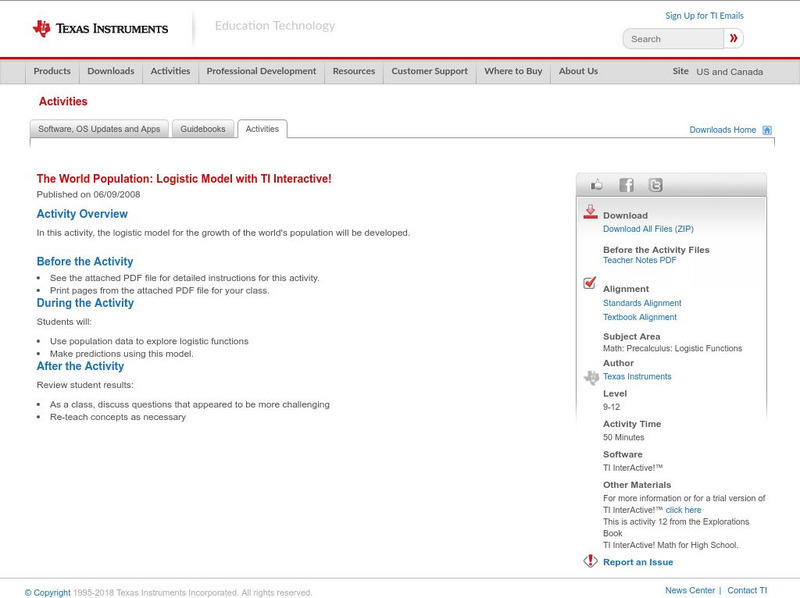
Texas Instruments: The World Population: Logistic Model With Ti Interactive!
In this activity, the logistic model for the growth of the world's population will be developed.

Texas Instruments
Texas Instruments: The World Population: Linear and Exponential Models
The population of the world has grown rapidly over the last century. In this activity, several models for the growth of the world's population will be developed. The validity of each in predicting past, current, and future populations...
University of Saskatchewan (Canada)
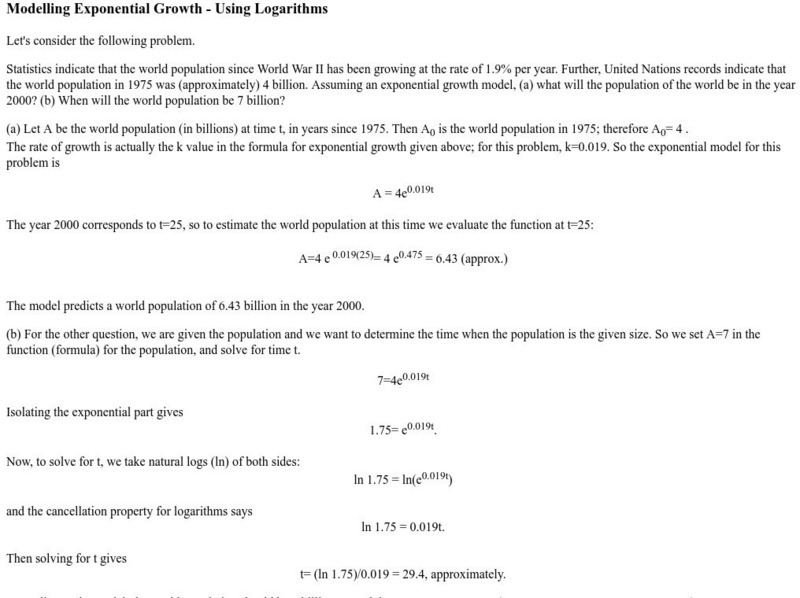
University of Saskatchewan: Modelling Natural Growth
This site shows how to model exponential growth. The site walks the student through an example problem using logarithms to find the exponential growth of the theoretical world population.