Hi, what do you want to do?






University of California
You Are What You Eat: Testing for Organic Compounds in Foods
We have all heard that we are what you eat, but what are we eating? An informative lesson opens with a discussion of the foods pupils have recently eaten. Then, young scientists perform four experiments on seven...

Curated OER
Periodic Table of Fun
Are you looking to put the fun back in the fundamentals of chemistry? Why not have groups create their own periodic tables of something (animals, food, music groups, etc.) practicing the organizational strategies used in the periodic...

Worchester Polytechnic Institute
Interactive Laboratory Activities for Secondary Education
Do you think the lab smells like rotten eggs? Sorry to hear about your sulfering. A set of five experiments covers many different topics including seasons, gravity, food, precipitation, and photosynthesis. Though not presented as a...

It's About Time
Organic Substances
Host an exciting lab in which learners burn fruit rinds to better understand hydrocarbons. A reading passage and analysis questions wrap up the lesson.

American Chemical Society
Chromatography - Color Clues
Here's an activity that will change how one sees color. Pupils try out an experiment on chromatography where they place a drop of food coloring on a coffee filter, add several drops of water, and watch the colors spread and separate....

Curated OER
Real-World Projects: Challenges from the Polymer Industry
Two scenarios are presented for chemistry detectives to decipher. Both require the use of an infrared spectrometer and focus on the examination of polymer materials. In the first, lumps in polyethylene bottles are analyzed. In the...

Perkins School for the Blind
Polyatomic Ion Bingo
If your class is learning about polyatomic ions and needs a fun way to study those chemicals, then a bingo game might be right up your alley. This bingo game is intended to boost memorization skills, specifically the names of tricky...

American Chemical Society
Liquids - Clearly Unique
Bring chemistry to life for scholars as they perform two tests to examine the unique properties of three liquids. Classroom investigators make observations, develop basic lab skills, and follow step-by-step instructions to compare water,...

Teach Engineering
All Fats Are Not Created Equal
Apply robotics to connect physical properties to chemical properties. Future engineers use robots to determine the melting points of various fats and oils. The robots can do this by measuring the translucency of the fats as they heat up.

Howard Hughes Medical Institute
The Making of the Fittest: Got Lactase? The Co-evolution of Genes and Culture
Got milk? Only two cultures have had it long enough to develop the tolerance of lactose as an adult. Learn how the responsible genes evolved along with the cultures that have been consuming milk. This rich film is supplied with a few...

It's About Time
Identifying Matter
High schoolers test wood splints that have been soaked in mystery solutions to identify the different colors it produces when lit. The lesson concludes with a reading passage and analysis questions.

Teach Engineering
Edible Algae Models
Sometimes it's okay to eat your science experiment. A hands-on activity has pupils create models for algae to learn about its cellular structure. The best part of the experiment? The resulting juice-filled gels are edible—yum!

Exploratorium
Your Sense of Taste
A simple and sweet activity shows students how important smell is in interpreting flavor. Pairs of pupils hold their noses and eat Life Savers®, only to find that they can't identify the flavors until they let go. You will appreciate...

Teach Engineering
Basically Acidic Ink
If you don't want to drink red cabbage juice, here's another use for it—a decoder! Using vinegar and ammonia-based window cleaning liquids as invisible inks, scholars create designs in the second lesson of the series. Red cabbage juice...

National Nanotechnology Infrastructure Network
Can Small Pollutants Harm Aquatic Organisms?
Nanoparticles have toxic effects on plant and animal life—even though you can't see them. The second lesson of a two-part series has young scientists conduct an experiment that exposes plant and animals to nanoparticle pollutants. They...
Royal Society of Chemistry
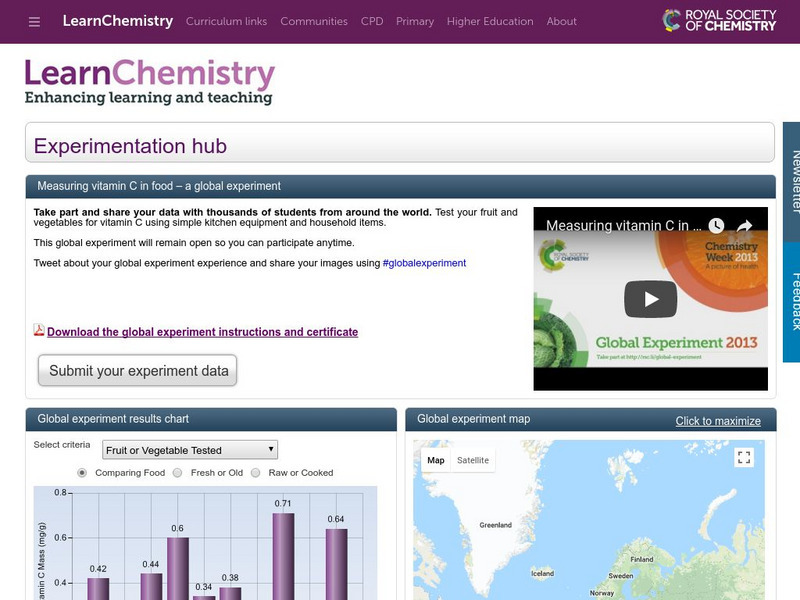
Royal Society of Chemistry: Experimentation Hub: Measuring Vitamin C in Food
A chance to complete an experiment with students around the world! This experiment requires students to test how much vitamin C is in certain foods. Once students receive their results, they post their findings to the page to compare to...
Science Buddies
Science Buddies: How Blue Is Your Sports Drink?
Do you read the list of ingredients in foods and drinks before you buy them at the grocery store? If you do, you may have noticed that many of the items that are blue in color have the same dye, called FD&C blue 1. In this chemistry...
Science Buddies
Science Buddies: Can Baking Soda Substitute for Baking Powder in a Recipe?
There's nothing quite like the smell of fresh-baked muffins for breakfast on a Saturday morning. If you're into baking, you might want to try this insightful project that lets you witness the chemistry behind making muffins. You'll get...
Science Buddies
Science Buddies: Determining Iodide Content of Salt
In this week long "kitchen chemistry" project you will use chemicals from the supermarket to test for the presence of iodine and iodide in salt. These are common micronutrients added to some preparations of table salt. A materials list,...
Science Buddies
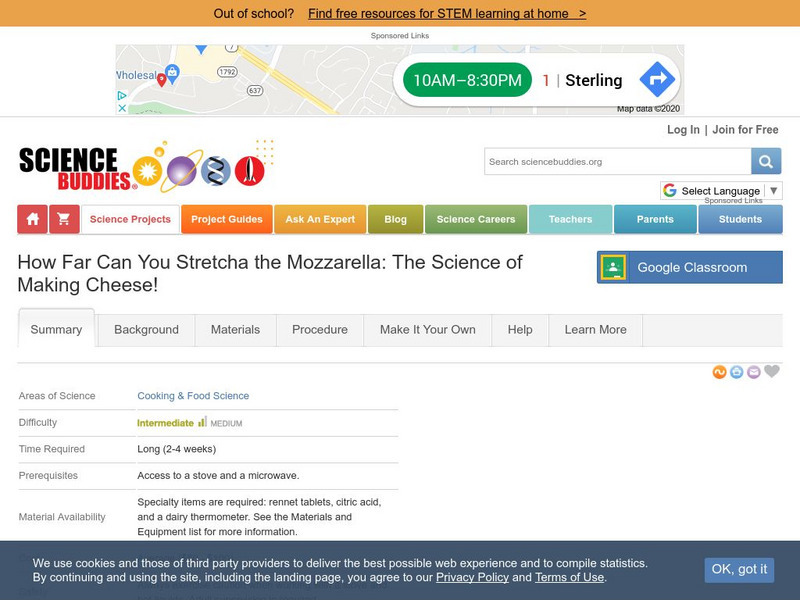
Science Buddies: The Science of Making Cheese!
Oooey gooey cheese - yum. Who doesn't like a slice of warm pizza straight from the oven? There's nothing quite like a slice of pizza and a glass of milk, so what makes pizza so great? The cheese. But did you know that making cheese is...
Texas Instruments
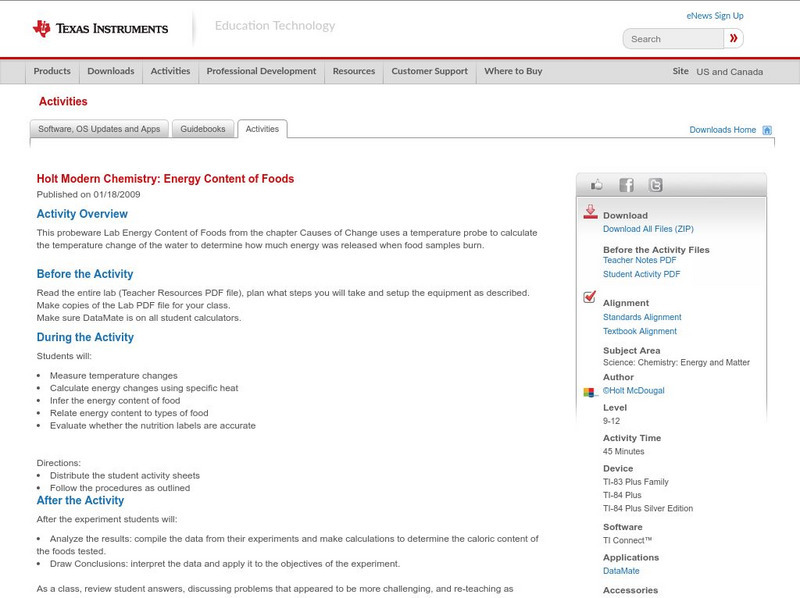
Texas Instruments: Holt Modern Chemistry: Energy Content of Foods
This probeware Lab Energy Content of Foods from the chapter Causes of Change uses a temperature probe to calculate the temperature change of the water to determine how much energy was released when food samples burn.
![Maryland Science Center: Caramel Chemistry [Pdf] Activity](https://static.lp.lexp.cloud/images/attachment_defaults/resource/large/FPO-knovation.png "Maryland Science Center: Caramel Chemistry [Pdf] Activity")
Maryland Science Center
Maryland Science Center: Caramel Chemistry [Pdf]
This activity demonstrates the Maillard Reaction, which explains how browning and flavor develop when something is cooked.
Dartmouth College
Dartmouth College: Chem Lab: Spectra of Conjugated Dyes & Beer's Law
In the first part of this lab, you will measure the absorption spectra of two conjugated dyes and compare the results to the theoretical predictions of a particle-in-a-box model. In the second part of the experiment, you will identify...
Science Buddies
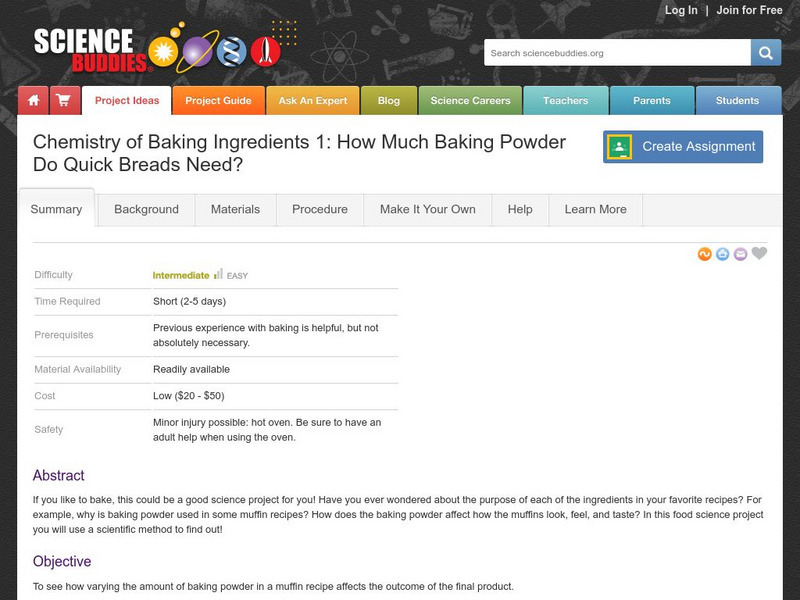
Science Buddies: How Much Baking Powder Do Quick Breads Need?
If you like to bake, this could be a good project for you. There is a purpose for each of the ingredients in your recipes, but not everyone is always aware of what that purpose may be. Though this lab takes multiple days, you will...
Other popular searches
- 4th Grade Food Chemistry
- Food Chemistry Pdf
- Food Chemistry Quiz
- Food Chemistry Pancakes
- Food Chemistry Protein
- Food Chemistry Detection
- Food Chemistry Mcq
- Food Chemistry Pd
- Food Chemistry Cakes
- Food Chemistry Protien
- Food Chemistry Mc
- Food Chemistry Pancackes