Hi, what do you want to do?





University of South Florida
Fcat: Spaghetti Bridges: Teacher Notes
Students build bridges and test their strength to collect data and write an equation. The concept of slope is explored in this activity.

Other
Desmos: Linear Bundle
A collection of activities where students investigate linear equations. Activities involve an exploration of the lines in a polygraph and the vocabulary needed to describe them accurately; the slope in graphs; lines in different...

Texas Education Agency
Texas Gateway: Solving Quadratic Equations Using Graphs
Given a quadratic equation, the student will use graphical methods to solve the equation.
Texas A&M University
Wtamu Virtual Math Lab: College Algebra: Domain, Range, Vertical Line Test
A detailed tutorial on functions covering the following topics: finding the domain and range of a function, using the vertical line test, determining whether a function is even, odd, or neither, and applying the greatest integer function...
Texas Education Agency
Texas Gateway: Analyzing Graphs of Quadratic Functions
Given the graph of a situation represented by a quadratic function, the student will analyze the graph and draw conclusions.
TeachEngineering
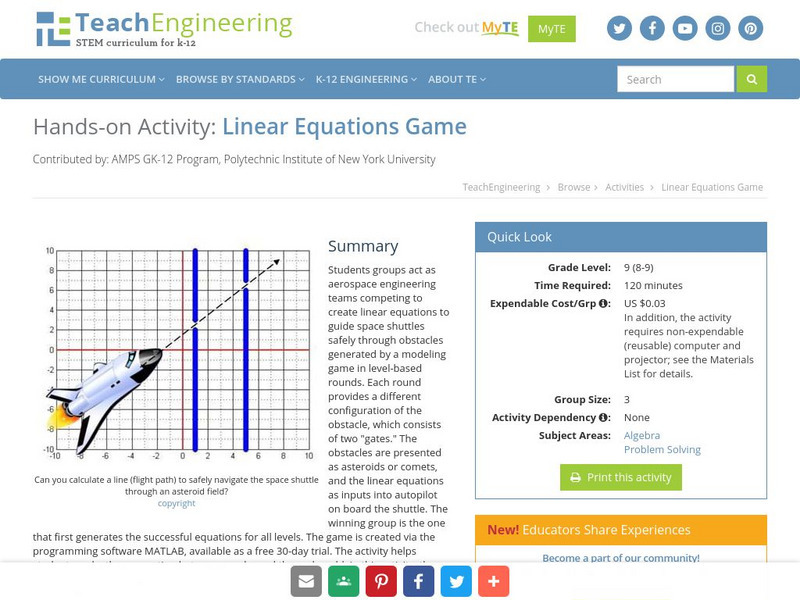
Teach Engineering: Linear Equations Game
Students groups act as aerospace engineering teams competing to create linear equations to guide space shuttles safely through obstacles generated by a modeling game in level-based rounds. Each round provides a different configuration of...
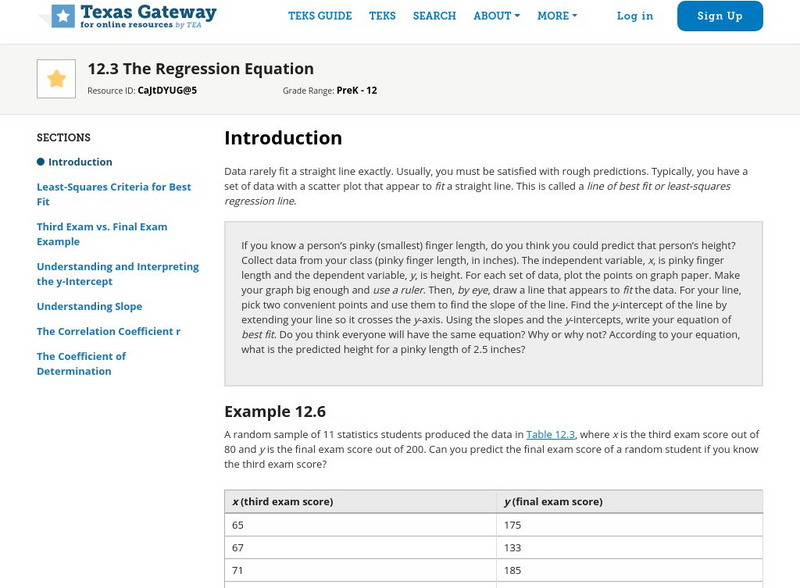
Texas Education Agency
Texas Gateway: Tea Statistics: The Regression Equation
A tutorial on how to find the line of best fit or least-squares regression line for a set of data in a scatter plot using different methods and calculations.

Texas Instruments
Texas Instruments: The Standard Form of a Quadratic Equation
In this activity, students explore the standard form of a quadratic equation, y = ax 2 + bx + c. They explore how the x-intercepts (zeros), y-intercept, and vertex are related to the graph of the standard form of a quadratic function.

Texas Instruments
Texas Instruments: Step Up
Students learn to use measurements on a real model to develop the concept of slope and linear functions. They use a calculator to explore changing the slopes and Y- intercepts in the slope intercept form Y = MX + B.

CK-12 Foundation
Ck 12: Algebra: Quadratic Functions and Their Graphs
[Free Registration/Login may be required to access all resource tools.] This lesson covers how to find the x-intercepts, vertex, axis of symmetry, and y-intercept of a parabola.

Concord Consortium
Seeing Math: Function Analyzer
The Function Analyzer allows learners to see the connections among three representations of a function: symbolic, area, and graphic. In addition, by allowing learners to change the value of four elements of a function - the coefficient...
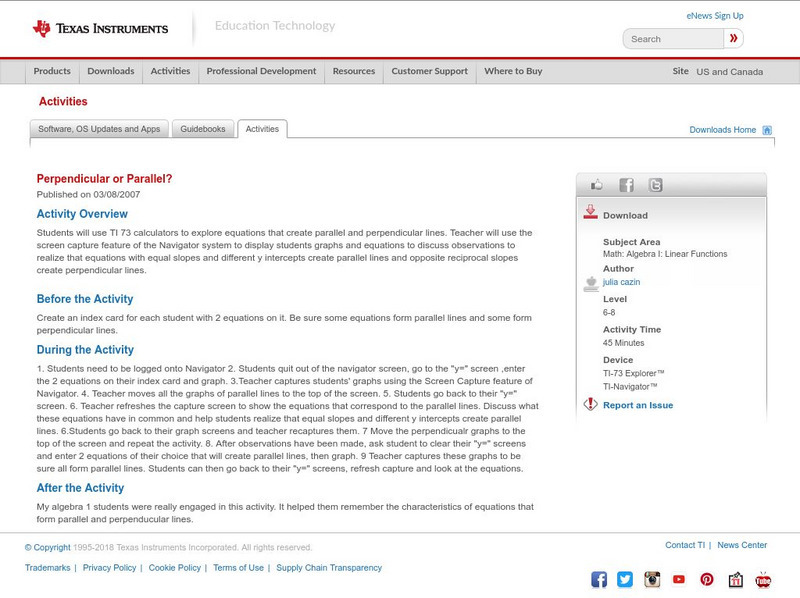
Texas Instruments
Texas Instruments: Perpendicular or Parallel?
Students can use TI 73 calculators to explore equations that create parallel and perpendicular lines. Teacher will use the screen capture feature of the Navigator system to display students graphs and equations to discuss observations to...
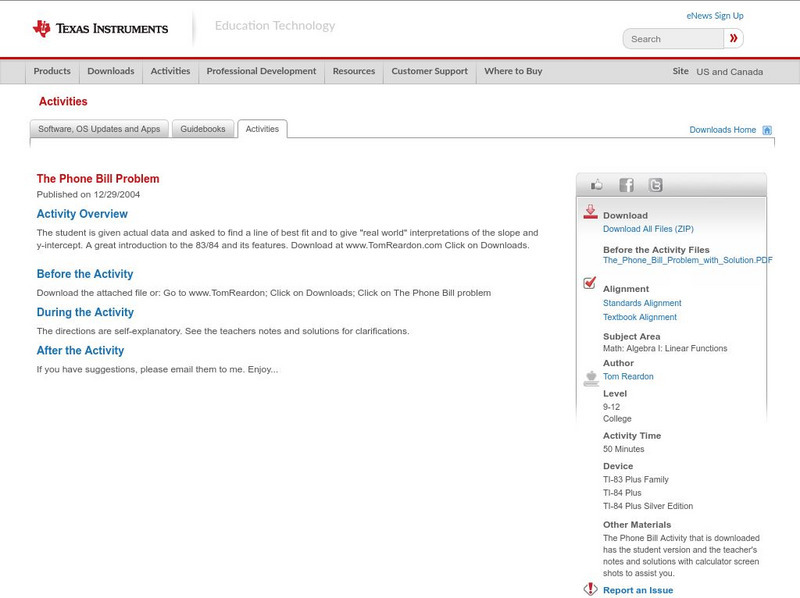
Texas Instruments
Texas Instruments: The Phone Bill Problem
The student is given actual data and asked to find a line of best fit and to give "real world" interpretations of the slope and y-intercept. A great introduction to the 83/84 and its features.
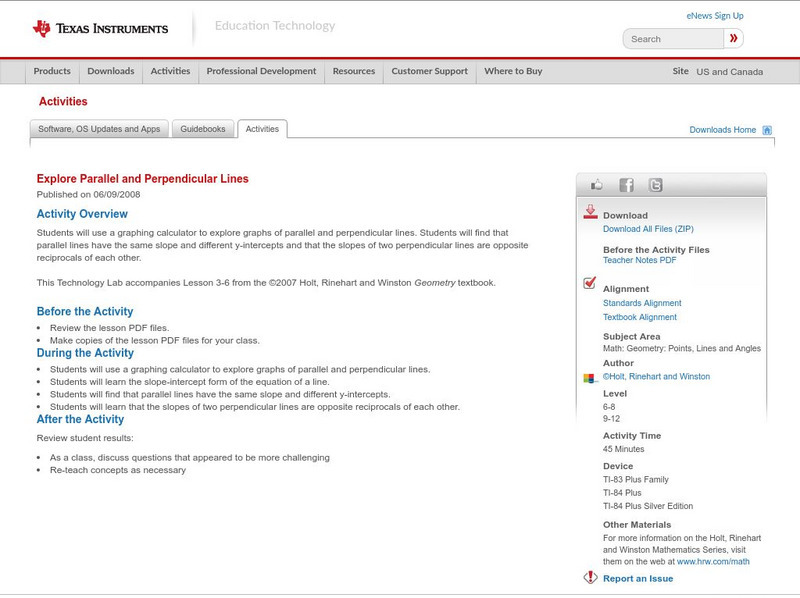
Texas Instruments
Texas Instruments: Explore Parallel and Perpendicular Lines
Students can use a graphing calculator to explore graphs of parallel and perpendicular lines. Students will find that parallel lines have the same slope and different y-intercepts and that the slopes of two perpendicular lines are...

Mangahigh
Mangahigh: Algebra: Recognize the Equations of Common Curves
Students recognize and know the sketches of quadratics, cubics and recipricols including the shape of positive and negative functions and the interpretation of their y-intercepts.
CK-12 Foundation
Ck 12: Algebra: Forms of Linear Equations
[Free Registration/Login may be required to access all resource tools.] Write linear equations in standard form and find the slope and y-intercept of such lines.

Khan Academy
Khan Academy: Features of Quadratic Functions: Strategy
Identify the form of a quadratic function that immediately reveals a given feature of that function. Features in question are the y-intercept of the graph, the zeroes ("roots") of the function, and the vertex of the parabola. Students...
CK-12 Foundation
Ck 12: Analysis: Graphs of Polynomials Using Zeros
[Free Registration/Login may be required to access all resource tools.] In this lesson students use ''X'' and ''Y'' intercepts to graph polynomials of 3rd degree or higher. Students examine guided notes, review guided practice, watch...
Council for Economic Education
Econ Ed Link: Taxes and Income
Use this interactive graph to gain an understanding of how taxes increase as your income goes up. The y-intercept line shows the base tax amount for no income.

Alabama Learning Exchange
Alex: Math Is Functional
This lesson is a technology-based activity in which students extend graphing of linear functions to the use of spreadsheet software. After students have become proficient in constructing a table of values, students are able to...

Khan Academy
Khan Academy: Features of Quadratic Functions: Strategy
Identify the form of a quadratic function that immediately reveals a given feature of that function. Features in question are the y-intercept of the graph, the zeroes ('roots') of the function, and the vertex of the parabola.
PBS
Pbs: Modeling the Linear Relationship Between Fahrenheit and Celsius
Explore the relationship between degrees Fahrenheit and degrees Celsius. This video focuses on developing an expression to model the relationship between the temperature scales using a line graph to calculate slope and the y intercept.
Northeast Parallel Architectures Center, Syracuse University
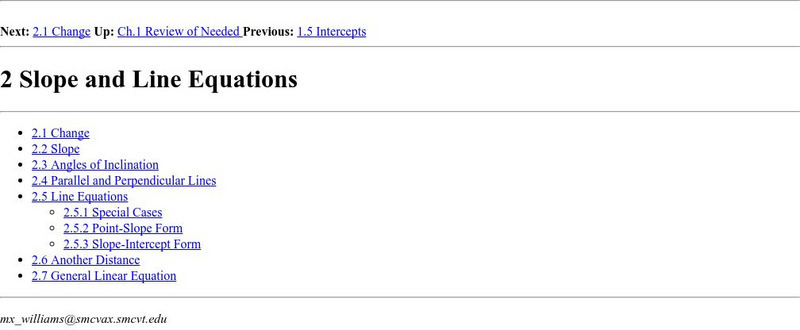
Npac Reu Program: Slope & Line Equations
This site from the Northeast Parallel Architectures Center, Syracuse University has a very substantial discussion of math topics slope & line equations. The outline form is quite useful if you need to zero in on one aspect of...
Purple Math
Purplemath: Graphing Quadratic Functions: Introduction
The most basic quadratic is y = x2. The general technique for graphing quadratics is the same as for graphing linear equations. The quadratics graph as curvy lines (called "parabolas"), rather than the straight lines generated by linear...
Other popular searches
- X and Y Intercepts
- Finding X and Y Intercepts
- X and Y Intercepts
- Slopes and Y Intercepts
- X & Y Intercepts
- X and Y Intercepts
- Slope and Y Intercepts
- Graph Using X and Y Intercepts
- Finding the X and Y Intercepts
- X Y Intercepts Graphing
- Slope and Y Intercepts
- X Y Intercepts