Hi, what do you want to do?






Royal Society of Chemistry
Electrolysis Using a Microscale Hoffman Apparatus—Microscale Chemistry
Get big results out of a small-scale lab! Young chemists observe the electrolysis of sodium sulfate using a microscale experiment. A colorful indicator solution combined with the production of gas bubbles yields a variety of observations...

American Chemical Society
The Energy of Evaporation
Do all liquids evaporate at the same rate? Young scientists observe the evaporation rate of three different liquids. They measure the time, the temperature, and the change in energy. After comparing the chemical formulas, scholars...

Integrated Physics and Chemistry
Law of Conservation of Matter
Does mass change during a chemical reaction? Demonstrate the Law of Conservation of Matter while encouraging class members to be creative with a two-part lesson. First, learners use Alka-Seltzer® tablets and water to demonstrate the...

American Chemical Society
Exothermic, Endothermic, and Chemical Change
Scientists can't observe bonds breaking or forming, so how do they distinguish between exothermic and endothermic reactions? Young scholars complete two experiments to do just that. They monitor temperature change and calculate the...

University of Georgia
What's So Special about Bottled Drinking Water?
Is artesian water designed to be better, or is it just from wells similar to those in the city of Artesium? This experiment looks at many different types of bottled waters, including artesian. Using a soap mixture, scholars test to see...

Pingry School
Mole Relationship in a Chemical Reaction
What do budding scientists know about moles and reactions? Using an attention-grabbing lab experiment, young scholars collect data to apply the law of conservation of mass to predict the mass of gaseous products. They examine several...

Royal Society of Chemistry
Mass Changes in Chemical Reactions—Microscale Chemistry
What better way is there to introduce conservation of mass than a few simple experiments? Young chemists conduct two chemical reactions, take the masses of reactants and products, then compare their results to determine...

Serendip
Is Yeast Alive?
Through two investigations, life science learners determine whether or not yeast is alive. They perform tests for metabolism by providing sugar and observing if gas is produced as a byproduct. They incubate some of the sample for at...

Royal Society of Chemistry
Chemistry Masterclass—Chemistry Outreach
Immerse your chemistry class in the world of organic chemistry! Science scholars isolate acetaminophen from an over-the-counter sample during an intense and interesting lab. Groups use many different separation and analysis techniques to...

American Chemical Society
Combustion and Burning
On Earth, a candle flame points up, but on the International Space Station, it forms a sphere. Young scientists practice their skills by recording observations before, during, and after a candle burns. Chemical and physical...

Royal Society of Chemistry
A Giant Silver Mirror Experiment
Mirror, mirror, on the wall ... who's the best chemistry teacher of them all? You'll get the vote for certain after your class completes the Silver Mirror experiment! Partnered pupils use Tollen's reagent and glucose to silverplate a...

Pingry School
Flame Tests
Light a fire in your pupils! Scholars conduct a flame test and observe the emission spectra of several different salts in an enlightening hands-on investigation. They use their observations to make comparisons and conclusions about the...

Royal Society of Chemistry
A Microscale Acid-Base Titration
Watch as acids and bases put smiles on their faces. Young chemists learn the concept of acid-base titration firsthand in a microscale experiment. Working groups collaborate, titrate, then use their data to determine the concentration of...

Royal Society of Chemistry
A Cartesian Diver—Classic Chemistry Experiments
Sometimes the simplest experiments leave the biggest impression! Introduce young chemists to the Cartesian Diver by having them make one of their own. Use the Diver to further their study of liquids and gases, as well as compression.

Royal Society of Chemistry
Green Plastics—Chemistry Outreach
How do green plastics reduce waste and environmental pollution? Budding scientists create and test a variety of compounds used in green plastics during an insightful experiment. Beginning with startling statistics and ending with...

University of Georgia
Would Your Cat Eat This Stuff?
Processed foods use inorganic compounds for flavoring and preservation. This take-home laboratory challenges scholars to find 20 different compounds identified on the labels of foods to list on their data collection sheet. The activity...
Other
British Columbia Institute of Technology: Extraction of Dna
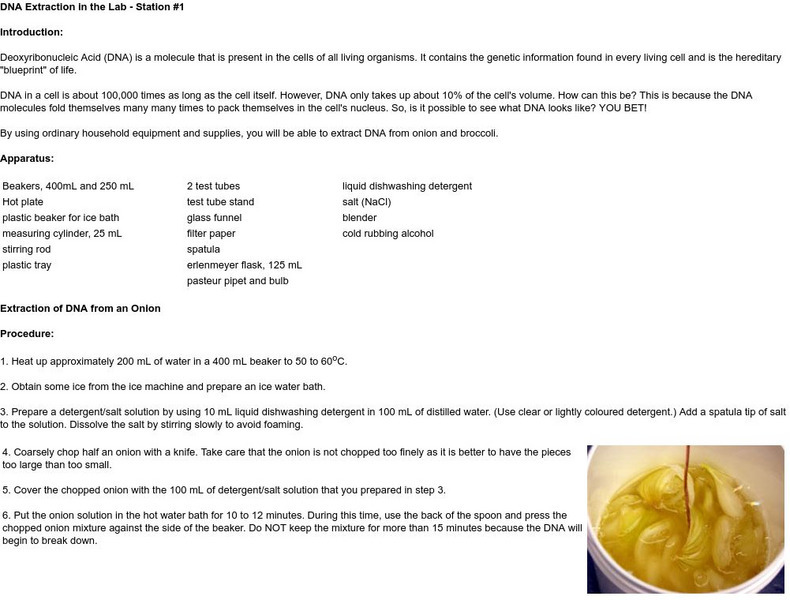
A lab experiment to extract DNA from an onion using household equipment. Procedure includes both videos and pictures.