Hi, what do you want to do?






Curated OER
Salem Witch Trials
Students consider the implications of the Salem Witch Trials. In this literature lesson, students read Arthur Miller's The Crucible and compare the witch trials to McCarthyism of the 1950's. Students rewrite scenes from the play...

National Endowment for the Humanities
Understanding the Salem Witch Trials
Students describe some of the important elements of life in Puritan New England. They create a timeline of the events of the Salem Witch Trials. They work in groups to explore the concept of multiple interpretations of history.

Curated OER
Religious Intolerance and the Salem Witch Trials
Students describe the basic beliefs of the Puritan religion; identify the principle figures in the Salem Witch Trials;explain the events that led to the mass hysteria suffered by the town; analyze the First Amendment; and examine...

Curated OER
Which of You Is A Witch?
Students gain comprehensive background knowledge of the Salem witch trials in preparation for reading Arthur Miller's The Crucible. They participate in a role-play activity designed to simulate a modern day witch-hunt.

Curated OER
Who was affected by North American Colonization and How?
Conduct research on various aspects of American Colonization and explore how different groups were affected, including those involved in the Salem Witch Trials. Your class will read books, write journals, participate in class discussion,...

Curated OER
The Breaking of Charity
The danger of mob mentality is on display in The Crucible by Arthur Miller. Get your class thinking with some challenging quickwrite questions, then assign characters from the play to be read aloud altogether. Links to worksheets...

Curated OER
The Salem Witchcraft Trials
Learners research the Salem Witchcraft Trials and conduct a mock trial.

Curated OER
Uncovering The Truth
Students investigate the social and religious contexts that surrounded the Salem Witch Trials. The research is guided using the worksheets included in the lesson plan. The culminating assignment is writing an editorial of personal...

Curated OER
Salem Witch Trials
Fifth graders examine the Salem Witch Trials. They discover that differences should be celebrated and judgements should not be made on appearances alone. They use multiple sources to gather their information.

Curated OER
Colonial America
Eleventh graders study the Salem Witch Trials and the different theories for the hysteria. In this American History channel, 11th graders explore primary source documents to understand the stories of various people involved in the...

Curated OER
The Crucible: Hysteria, Witches and Death
Eleventh graders explore the historical events of the Salem witch trials. After completing research and reading a play on the witch trials, 11th graders compare and contrast the historical facts to the fictional play. In groups, students...

Curated OER
Evolving Views about Minority Rights in the United States
Tenth graders compare and contrast majority and minority outlooks on issues. In this social justice lesson, 10th graders research majority and minority values regarding the Salem Witch Trials, Plessy v. Ferguson, the McCarthy hearings,...

Curated OER
Dramatizing History in Arthur Miller's The Crucible
Students study the effect of history on fictional or dramatic works of art by reading, Arthur Miller's, The Crucible. They examine the ties between a nation's history and culture with the literature it produces.

National Endowment for the Humanities
Nathaniel Hawthorne and Literary Humor
Young scholars examine Nathaniel Hawthorne's style of humor and compare it to other humorists. They discuss the purpose of literary humor and determine how it develops characters and plots in stories. They analyze the use of different...

Curated OER
Collective Behavior and Social Movements
In this collective behavior and social movements worksheet, students match 15 vocabulary terms to the appropriate descriptions and answer 6 multiple choice questions regarding the 2 sociology topics.

Curated OER
Colonial America
Students read the novel, The Witch of Blackbird Pond. In groups, they conduct research using the Internet, encyclopedias, and books to gather information on an assigned colony. The projects are presented to the rest of the class.

Curated OER
Have I Got a Graphic Organizer for You
Use Inspiration software to create webs. You have to create discussion topics (none are provided here), but learners will enjoy working with pairs and technology.
Stanford University
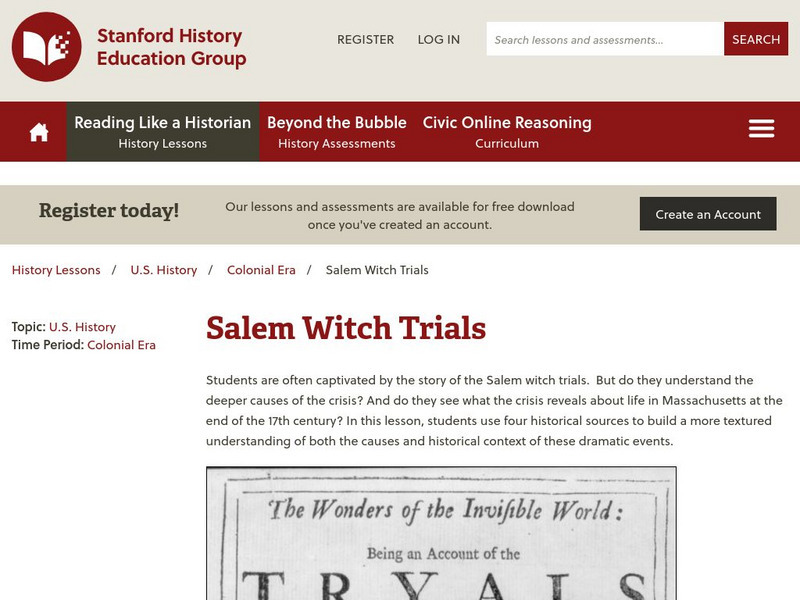
Sheg: Document Based History: Reading Like a Historian: Salem Witch Trials
[Free Registration/Login Required] Students read primary source documents to solve a problem surrounding a historical question. This document-based inquiry lesson plan allows students to use four historical sources to build a more...
National Endowment for the Humanities
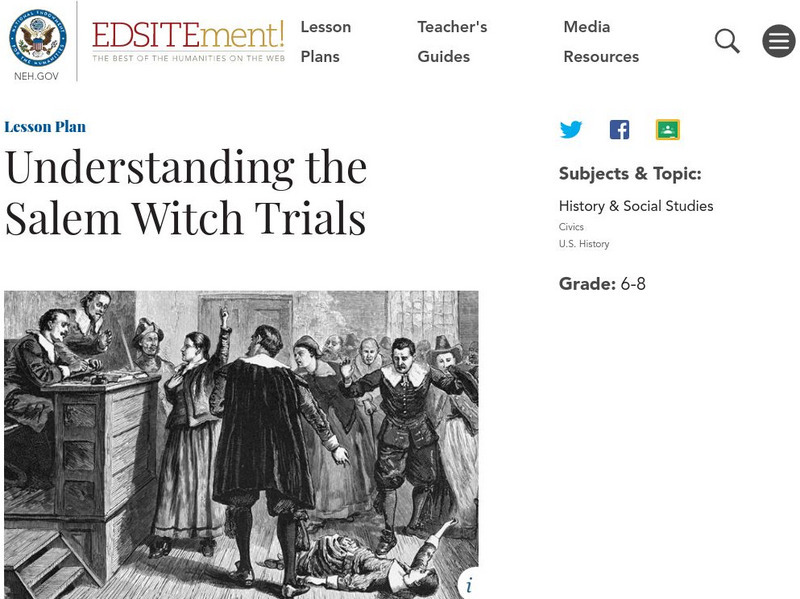
Neh: Edsit Ement: Understanding the Salem Witch Trials
In this lesson plan, middle schoolers will consider "Understanding the Salem Witch Trials." The plan includes worksheets and other student materials that can be found under the resource tab.

Ohio State University
Osu History Teaching Institute: Witchcraft in Salem
Students will examine the Salem witchcraft trials through primary and secondary sources with an emphasis on different viewpoints of the trials.
Huntington Library
Huntington Library: Religious Dissent [Pdf]
This lesson supplements one on the "Settlement of the Plymouth and Massachusetts Bay Colonies of New England." It looks at religious dissent and intolerance among the Puritans in the Massachusetts Bay Colony. Students look at Roger...

Alabama Learning Exchange
Alex: Report the Trials: Salem Hysteria
Students will act as a radio/TV reporter informing the public of the hysteria of the 1692 Salem Witch Trials. Within partners/groups, students will create a podcast/vodcast connecting Puritan life and culture with the events in Salem.
Success Link
Success Link: Witches' Brew: Mixing the 1950s and 1690s in a Crucible
Use this lesson plan as an introduction to a study of the play, The Crucible,to help students discover the link between the supposed topic of the play and the political situation in the United States when the play was written.