Hi, what do you want to do?





TeachEngineering
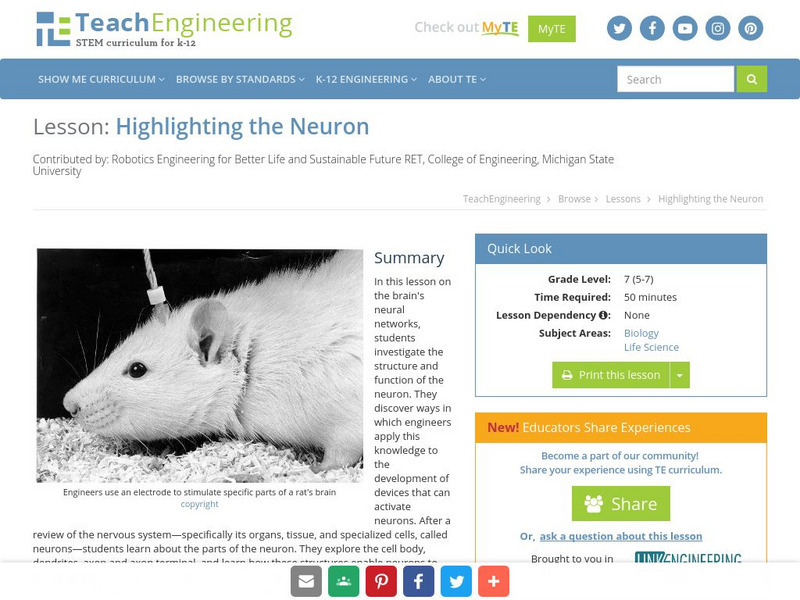
Teach Engineering: Highlighting the Neuron
In this lesson on the brain's neural networks, students investigate the structure and function of the neuron. They discover ways in which engineers apply this knowledge to the development of devices that can activate neurons. Includes...
BioEd Online
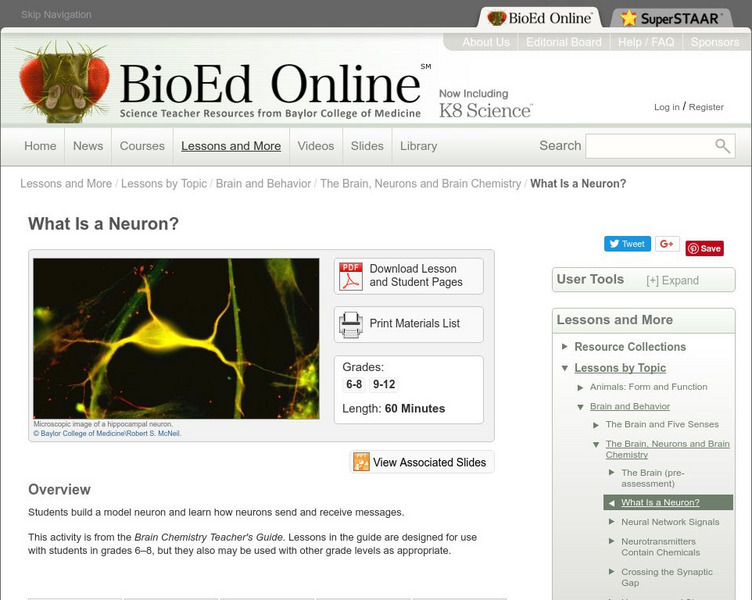
Bio Ed Online: What Is a Neuron?
Messages within the brain and the rest of the nervous system are sent very rapidly. These messages are conducted by cells called neurons. Neurons are specialized to receive and transmit message and neurons are connected in networks. In...

BioEd Online
Bio Ed Online: Crossing the Synaptic Gap
Neurotransmitters can either stimulate the next neuron to send a signal or inhibit that neuron from sending a signal. Certain chemicals change the way signals are sent and received. For this lesson students will understand this concept...
OpenStax
Open Stax: Anatomy & Physiology: The Action Potential
Students will learn the components of the membrane that establish the resting membrane potential, and find out the changes that occur to the membrane that result in the action potential.

BSCS Science Learning
Bscs: Drug Abuse and the Adolescent Brain
This module focuses on the science that explains the effects that drugs have on the brain and, by extension, a person's thoughts, feelings, and behaviors. Specifically, it focuses on the adolescent brain. Adolescents may be more...

BioEd Online
Bio Ed Online: Food for the Brain
The brain needs many different kinds of raw materials from food and ecommended serving sizes are often smaller than the size actually served or the amounts people eat. In this lesson young scholars are introduced to this concept by...
Frontiers Media
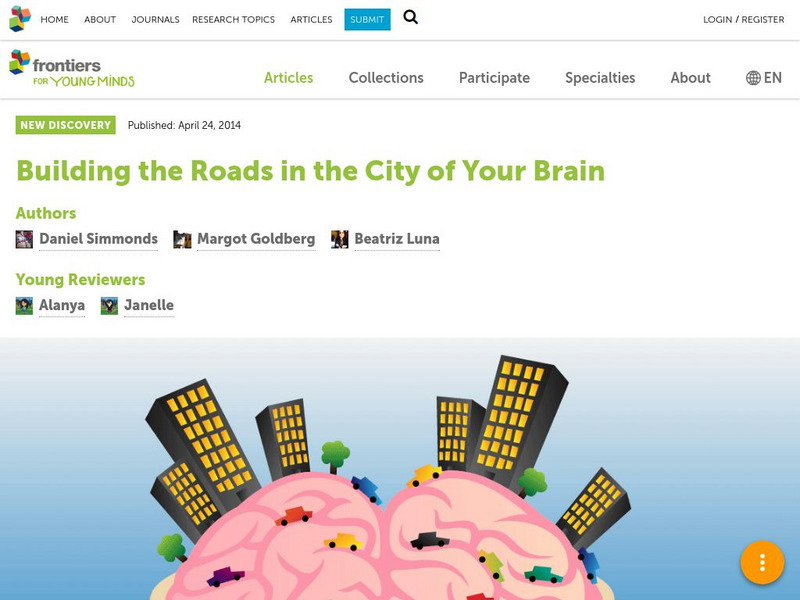
Frontiers: Building the Roads in the City of Your Brain
"Are you ready to go into the spaceship? Remember to stay very still!" This is what you hear before the bed you are lying down on starts to slide into a long, tube shaped machine. You can almost imagine that it really is a spaceship, and...

Khan Academy
Khan Academy: Could Complete Darkness Be the Cure for Amblyopia?
Read a passage about using darkness to cure Amblyopia (Lazy Eye) and answer the follow-up questions.

Khan Academy
Khan Academy: Action Potential Velocity
Brain cells called neurons send information and instructions throughout the brain and body. The information is sent via electro-chemical signals known as action potentials that travel down the length of the neuron. These neurons are then...

BioEd Online
Bio Ed Online: Neurotransmitters Contain Chemicals
Nervous system signals are transmitted electrically along individual neurons, but neurons are separated from each other by a tiny gap. Chemical messengers called neurotransmitters cross the gap between neurons. Neurotransmitters fit into...
BioEd Online
Bio Ed Online: Neural Network Signals
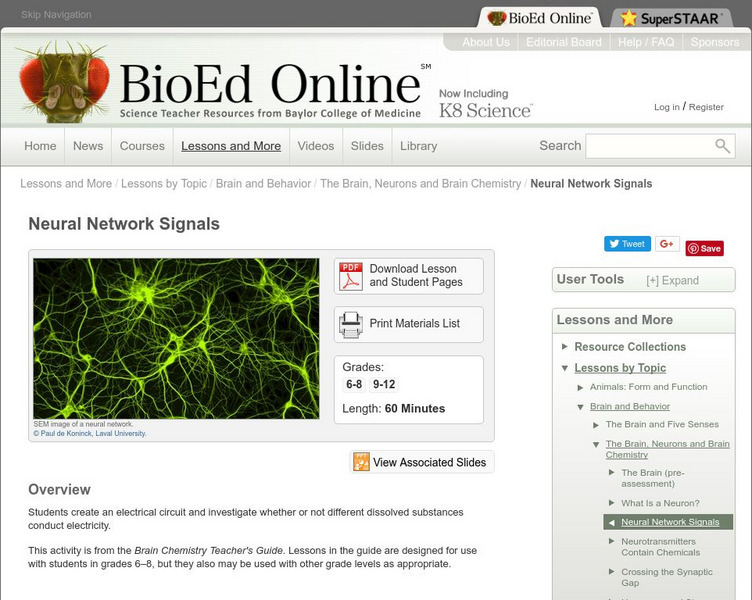
Nervous system messages are sent as electrical signals along the length of axons and dissolved salts are important for electrical signaling in cells. In this lesson students are introduced to this concept by creating an electrical...
National Science Foundation
National Science Foundation: Optogenetics
In this full-color image, a neuron is expressing the light-gated cation channel channelrhodopsin-2 (small green shapes), and is being illuminated by a focused beam of blue light (coming from the top).
Other
Tiem: Synapse Transmission
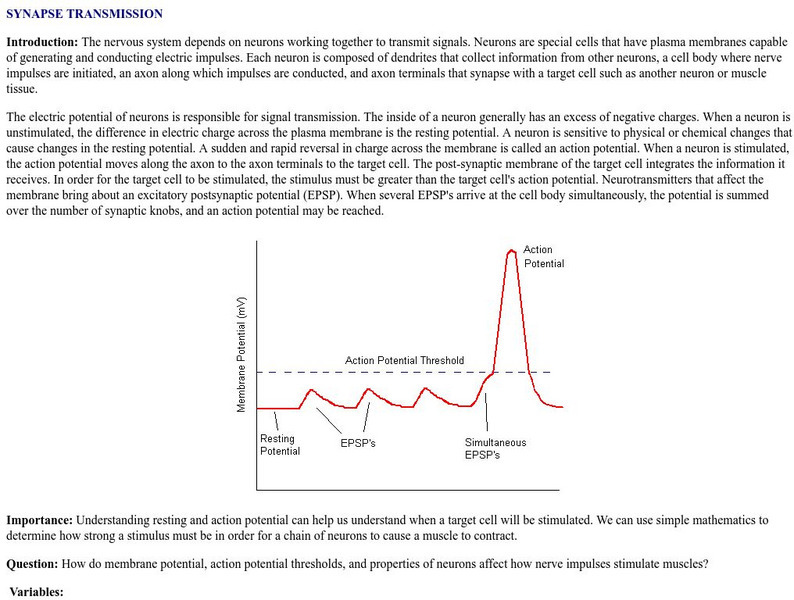
A good description of the process of transmission across the synapse in nerve cells.
Famous Scientists
Famous Scientists: Charles Sherrington
Learn about Charles Sherrington, the Nobel Prize winner in Physiology or Medicine for his work on the functions of neurons.

Khan Academy
Khan Academy: A Virus Which Affects Mouse Muscles
Prepare for the MCAT by reading this passage and answering questions based on the given table about how different viral doses affect behavioral or electrical abnormalities in mice.

TED Talks
Ted: Ted Ed: What Percentage of Your Brain Do You Use?
Two thirds of the population believes a myth that has been propagated for over a century: that we use only 10% of our brains. Hardly! Our neuron-dense brains have evolved to use the least amount of energy while carrying the most...