Hi, what do you want to do?





NASA
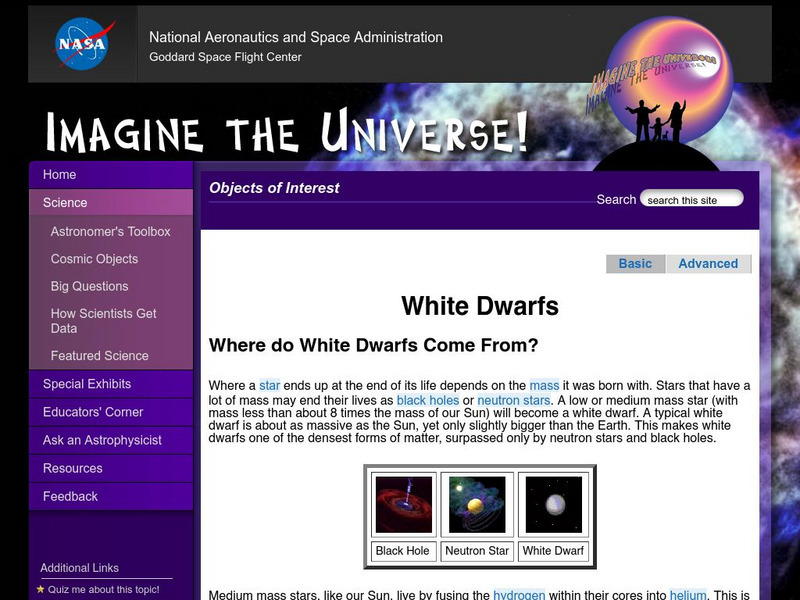
Nasa: Imagine the Universe: White Dwarfs
Brief description of white dwarfs with respect to their position in the life cycle of stars, the density of white dwarfs, the emissions of white dwarfs, and the temperatures associated with them.

Utah State Office of Education
Utah State Office of Education: How Did the Universe and Solar System Develop?
Explore this unit to learn how the universe began. Through illustrations, videos, and classroom activities, gain an understanding of how stars help with the formation of elements.

E-learning for Kids
E Learning for Kids: Science: Antarctica/ What Are the Different Parts of the Universe?
In this lesson, students learn about objects in the universe, including constellations, planets, meteors, asteroids, and comets.
Smithsonian Institution
Smithsonian Learning Lab: The Universe, an Introduction
Start with the questions all students ask: How big is the universe, how far away are the planets and stars, how did they form and when, how do they move and why? Build on their natural curiosity. The Smithsonian, in cooperation with...

Khan Academy
Khan Academy: Gallery: How Did Our Understanding of the Universe Change?
Understand how our view of cosmology has evolved by looking through different views of the Universe and zoom in on the light from distant stars on this site.

PBS
Pbs Learning Media: Space: Bringing the Universe to the Classroom: Collection
Learn to identify and predict daily patterns of motion of the Sun, Moon, and stars across the sky with various media, including an interactive storyboard featuring the beloved characters from PEEP and the Big Wide World. For a printable...
University of Illinois
University of Illinois: Stars and Constellations: Neutron Stars and Pulsars
This resource provides a brief description of the relationship between a neutron star and a pulsar. It details the pulsing rate and death of a pulsar.
National Endowment for the Humanities
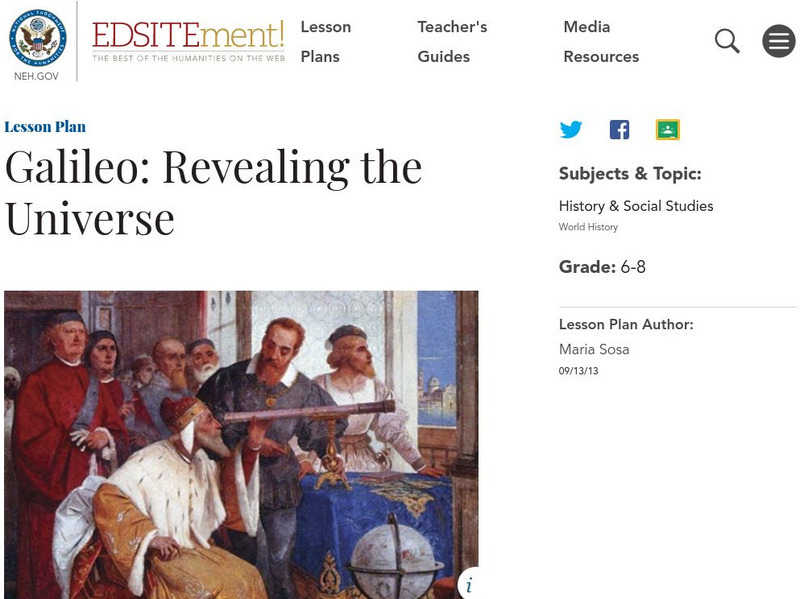
Neh: Edsit Ement: Galileo: Revealing the Universe
In this lesson plan, students will consider "Galileo: Revealing the Universe." The plan includes worksheets and other student materials that can be found under the resource tab.
Scholastic
Scholastic: Study Jams! Science: Our Solar System: The Universe
A video and a short multiple-choice quiz on the Universe and what it is made up of.
NASA
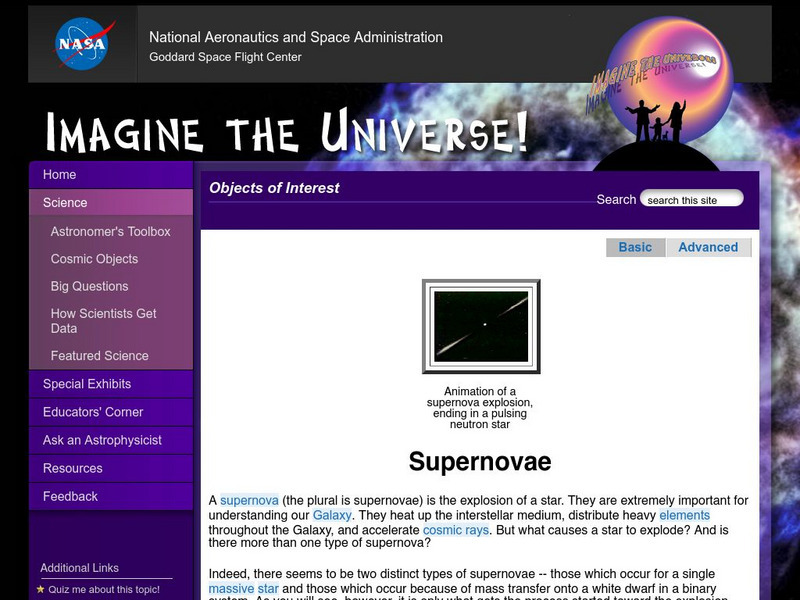
Nasa: Imagine the Universe: Supernovae (Basic)
A detailed description of a supernova developing from a single massive star. There is a quiz, related links, animation, lesson plans, and an FAQ sheet available also.
NASA
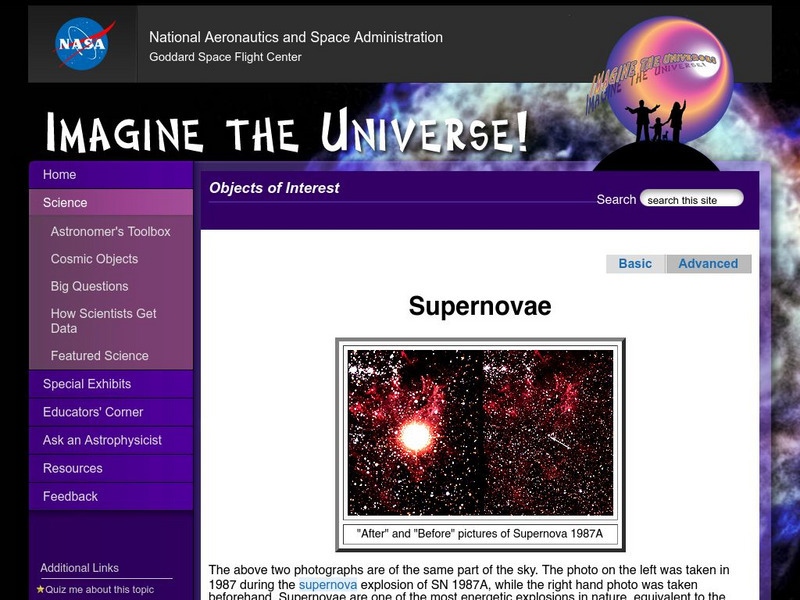
Nasa: Imagine the Universe: Supernovae (Advanced)
Supernovae are divided into two basic physical types, including a description of supernova types and how they are classified based on the existence of hydrogen spectral lines. Definitions of key terms are provided.
NASA
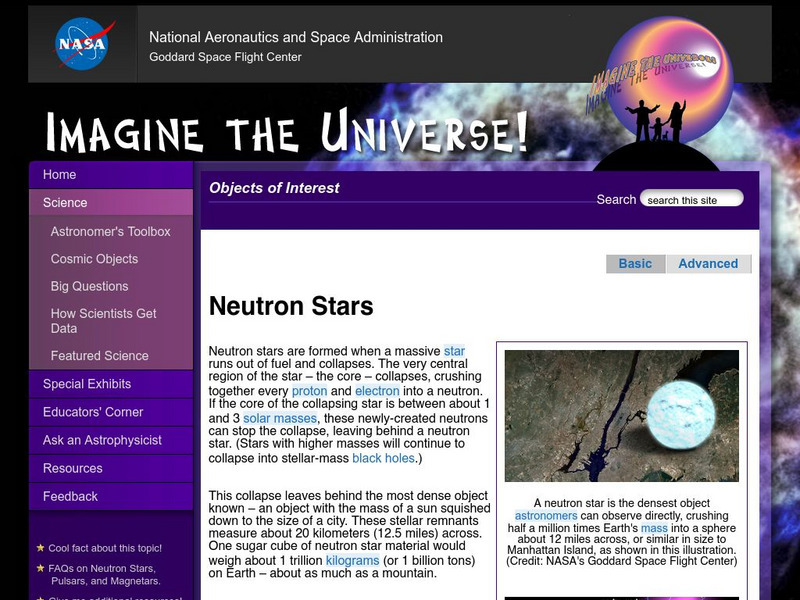
Nasa: Imagine the Universe: Neutron Stars and Pulsars
Discover what neutron stars and pulsars are and view pictures of them. Includes links to additional resources and lesson plans.
NASA
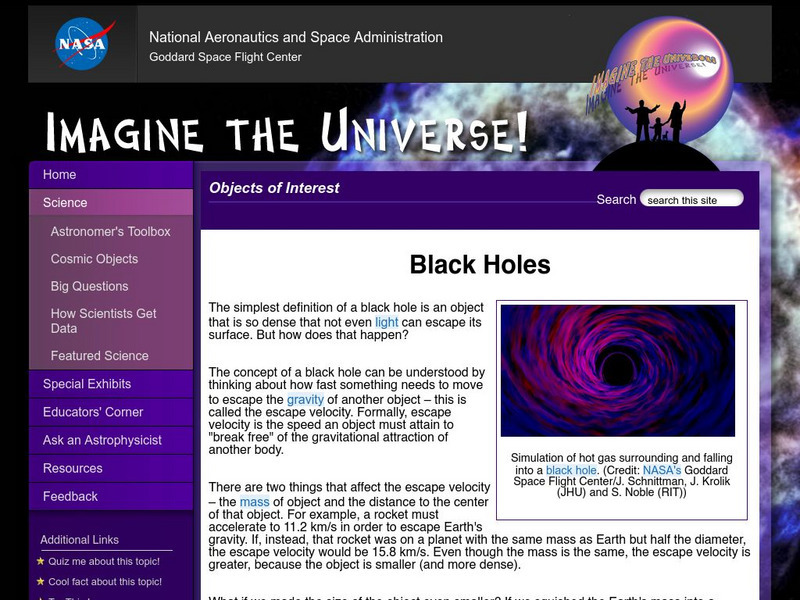
Nasa: Imagine the Universe: Black Holes
Learn what black holes are and the myths that surround them.
University of Texas at Austin
The University of Texas Mc Donald Observatory: Stars and Galaxies
Do galaxies collide? Apply concepts of scale to grasp the distances between stars and galaxies.
University of Texas at Austin
The University of Texas Mc Donald Observatory: Venus
Discover interesting facts about Venus, the hottest planet and the second planet from the Sun.
NASA
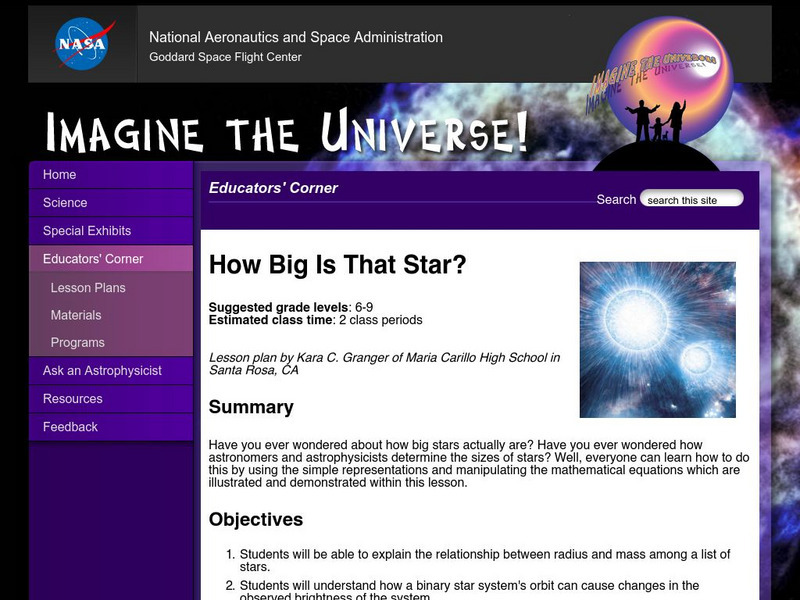
Nasa: Imagine the Universe: How Big Is That Star
This 2-5 day lesson plan investigates the diameter, radius and mass among several stars in order to understand stellar behavior, particularly in a binary system.
American Museum of Natural History
American Museum of Natural History: Carl Sagan and the Quest for Life in the Universe
A brief biography of American astronomer and science advocate Carl Sagan.
Mocomi & Anibrain Digital Technologies
Mocomi: How Big Is the Universe?
Provides facts about the Universe, Jupiter, the Milky Way Galaxy, and Superclusters.

TED Talks
Ted: Ted Ed: What Is the Universe Made Of?
The atoms around you have existed for billions of years- and most originated in the flaming, gaseous core of a star. Dennis Wildfogel tells the captivating tale of these atoms' long journeys from the Big Bang to the molecules they form...

Khan Academy
Khan Academy: Infographic: Chemical Abundances: The Universe
An infograph showing you what chemicals are found in our universe.
PBS
Pbs Teachers: Life's Big Questions: How Did the Universe Begin?
Investigate the Big Bang Theory of the origin of the universe by researching the light spectrum and the actions of light waves. Create models that illustrate red shift in a moving star and the expansion of the universe.
NASA
Nasa: Image Science Center: Ask the Space Scientist
A NASA scientist, Dr. Sten Odenwald, answers many students' questions. Topics include planets, galaxies, black holes, the origin of the universe, and common misconceptions about space.
University of Texas at Austin
The University of Texas Mc Donald Observatory: Color of Stars
Students observe colors in the flame of a burning candle to explore connections between matter, light, color, and temperature, the basic concepts of matter and energy.

Other
An Atlas of the Universe
What does the universe look like? This website offers visitors a collection of images that serve as an "atlas" of our universe. See multiple charts showing the Earth's distance from the Sun and other stars, find helpful terms in a...