Hi, what do you want to do?





Science Buddies
Science Buddies: A Puzzling Parallax
Did you know that ancient astronomers could measure the distance to other stars? They could also distinguish between stars and planets. How could they do that without modern technology of telescopes? See if you can discover the link...
Science Buddies
Science Buddies: Craters and Meteorites
Have you ever heard that the moon is made of cheese? Even though the craters on the surface of the moon resemble holes in Swiss cheese, we know that this common myth is not true. Find out how craters are formed and why they are different...
Smithsonian Institution
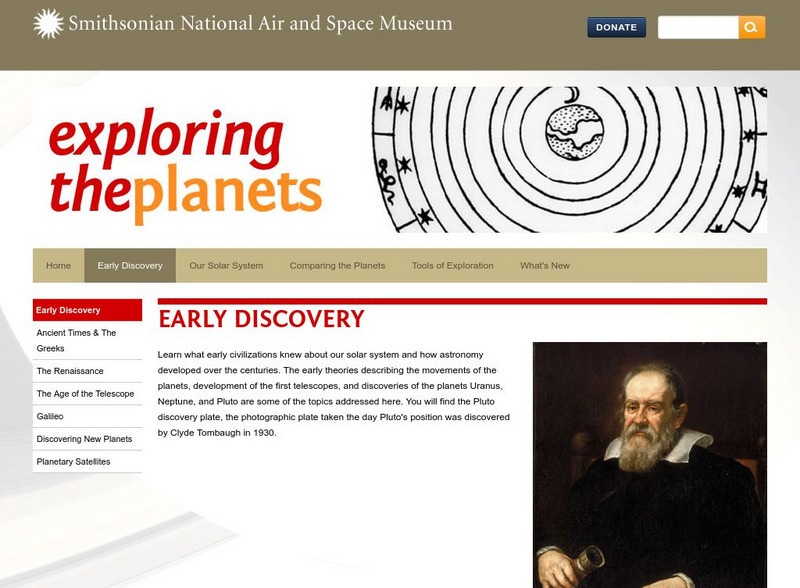
National Air and Space Museum: Exploring the Planets: Early Discovery
This section of the exhibition gives the history of the discovery and study of space starting with the Greeks and Romans through to the early 1900's.
Cosmos 4 kids
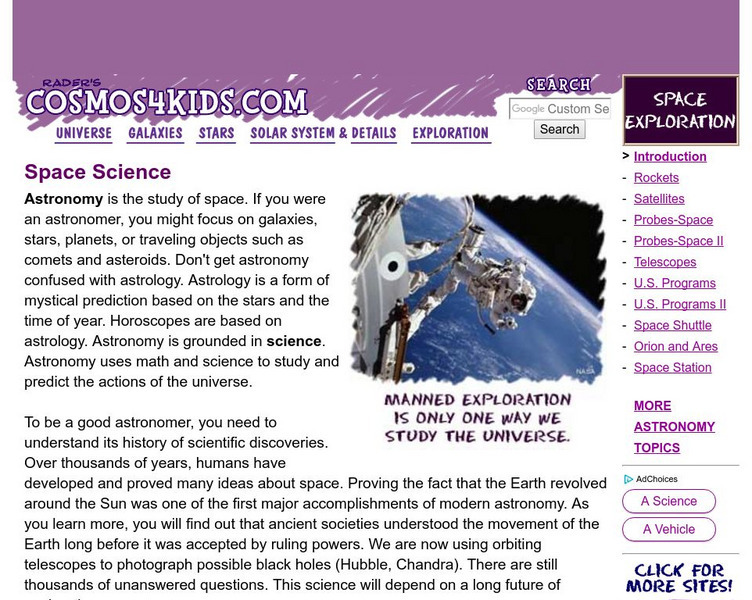
Cosmos4 kids.com: Exploration
Space can be explored in many different ways. Read about space exploration and click on the topics on the right margin to find out how man finds out about his universe.

Smithsonian Institution
National Air and Space Museum: Exploring the Planets: Ancient Times & the Greeks
In ancient times only five planets were known: Mercury, Venus, Mars, Jupiter, and Saturn. Learn about Greek astronomer Ptolemy's theory for the solar system that was to survive for fourteen centuries.
Discovery Education
Discovery Education: Classroom Planetarium
Create a classroom model of the solar system while teaching about relative size of all the planets, and each planet's distance from the sun.
NASA
Nasa: Imagine the Universe: Supernovae (Basic)
A detailed description of a supernova developing from a single massive star. There is a quiz, related links, animation, lesson plans, and an FAQ sheet available also.