Hi, what do you want to do?






University of Virginia
Illustrating Uncle Tom's Cabin
Historical illustrations reveal more than what they are meant to portray. After reading Harriet Beecher Stowe's Uncle Tom's Cabin, high schoolers view a series of illustrations, movie posters, photographs, and book covers that exemplify...

PBS
Pbs Learning Media: Primary Source Set: The Colonies: Motivations and Realities
A collection of primary sources to explore the motivations and realities behind life in the American colonies.
University of Nebraska
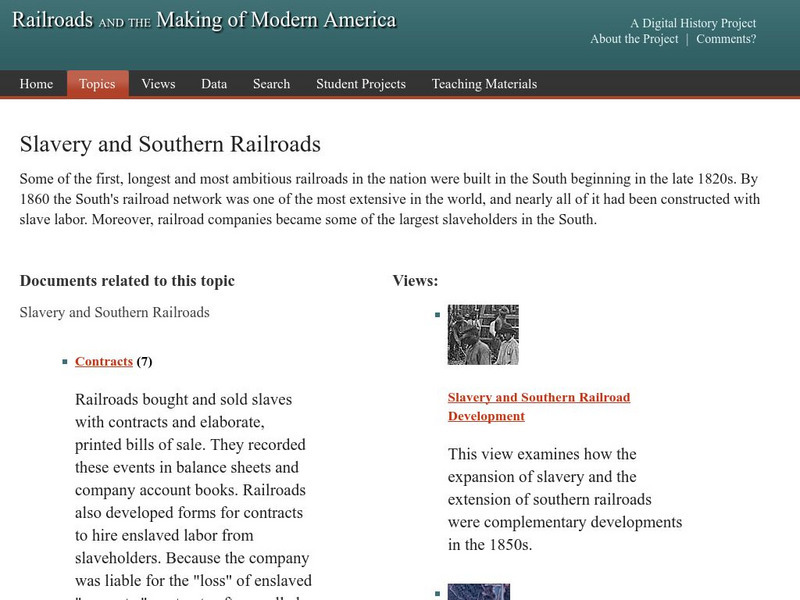
Railroads and the Making of Modern America: Slavery and Southern Railroads
Primary source materials that focus on how the railroad companies supported the slavery system through slave labor, slave ownership, and as a transportation system for the slave market in the South. Content includes contracts, company...
Library of Congress
Loc: Slaves and the Courts
Slaves and the Courts, 1740-1860 contains just over a hundred pamphlets and books (published between 1772 and 1889) concerning the difficult and troubling experiences of African and African-American slaves in the American colonies and...
Other
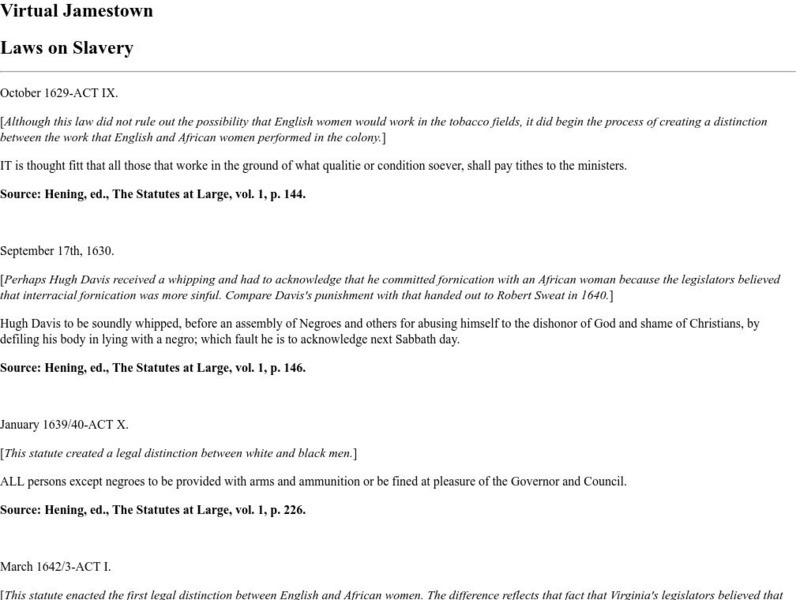
Virtual Jamestown: Laws on Slavery
This site provides the original text of Virginia colonial laws concerning different aspects of slavery for Africans, Native Americans, and indentured servants.
Other
Book Review: Becoming America:the Revolution Before 1776
A detailed review by James T. Kloppenberg, constructively criticizing the author's (Jon Butler) thesis that ties between colonial religion and politics are exaggerated.
PBS
Pbs: Africans in America: Angelina Grimke Weld's Speech at Pennsylvania Hall
The text of a speech given by abolitionist Angelina Grimke Weld on May 17, 1838.
Hanover College
Hanover College: Slave Narrative of Olaudah Equiano Vol. 1
The complete text of a famous slave narrative from the late 18th century (1789), it tells the story on how Equiano is captured in Africa, transported to the Americas and his experiences as a slave. It provides rich details about the...
National Humanities Center
National Humanities Center: Toolbox Library: William Seward, Triumph of Nationalism: America, 1815 1850
The National Humanities Center present a reading guide that links to a speech in the Senate by William Seward, one that expresses moral outrage over the compromises allowing the expansion of slavery.

National Humanities Center
National Humanities Center: Toolbox Library: America in 1850: Henry Clay: Review of the Debate on the Compromise Bills
Henry Clay's speech in the Senate in support of the Compromise of 1850 and the importance of preserving the Union.
Digital Public Library of America
Dpla: The American Abolitionist Movement
The resources in this set highlight the people and political acts that were central to the abolitionist movement.
National Humanities Center
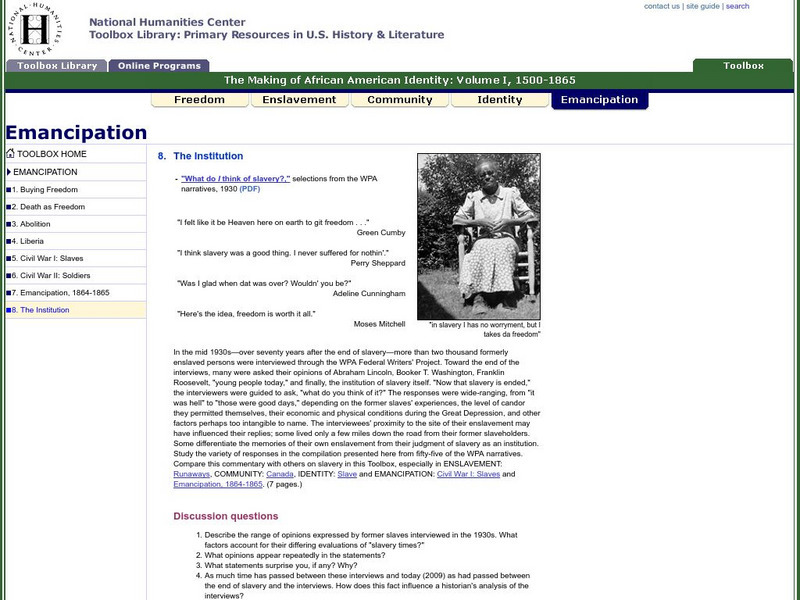
National Humanities Center: Toolbox Library: The Institution, Making of African American Identity: V. 1
Interviews from the 1930s that reflect on African Americans' experience of the institution of slavery. A narrative with firsthands accounts is linked within this resource.
National Humanities Center
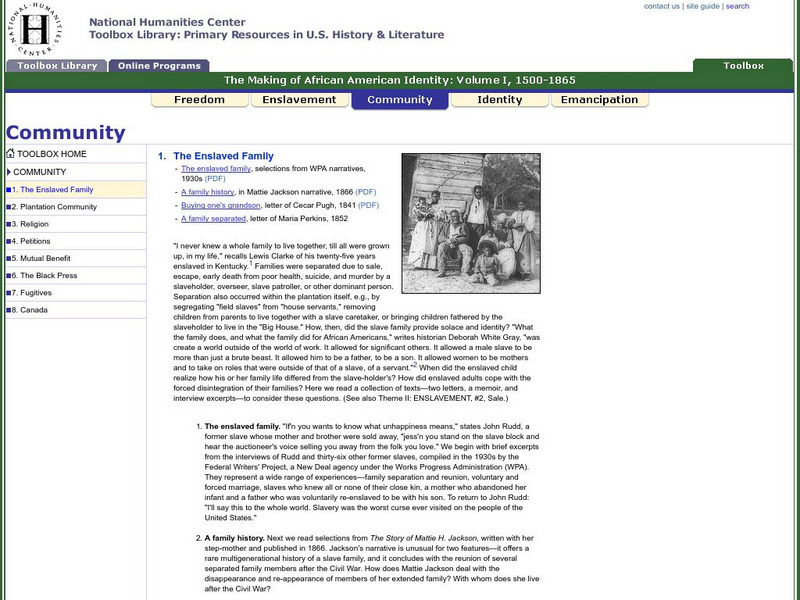
National Humanities Center: Toolbox Library: The Enslaved Family, Making of African American Identity: Vol. 1
This site offers two letters and a memoir from the mid-nineteenth century, and interviews from the early-twentieth century, about the importance and the roles of enslaved families.
PBS
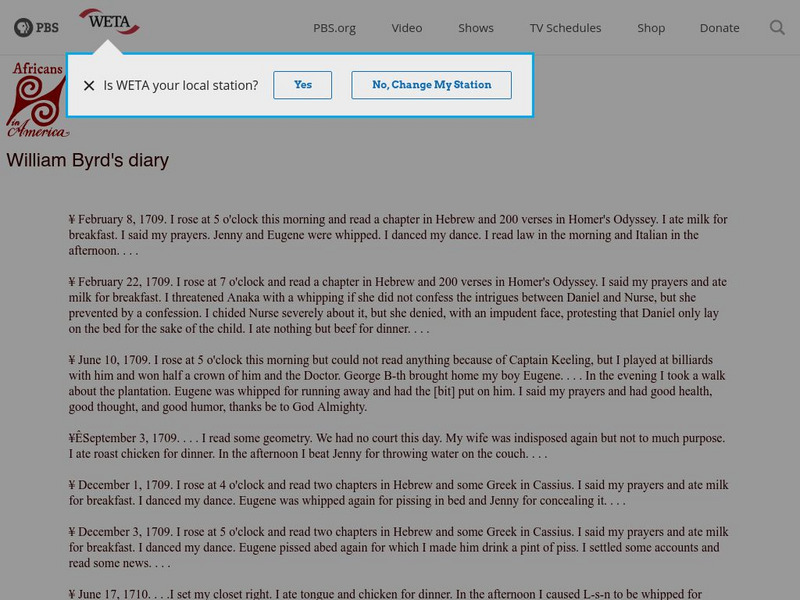
Africans in America: William Byrd's Diary
Excerpts from "The Secret Diary of William Byrd" in which, among other things, he describes slaves as piece of property.
PBS
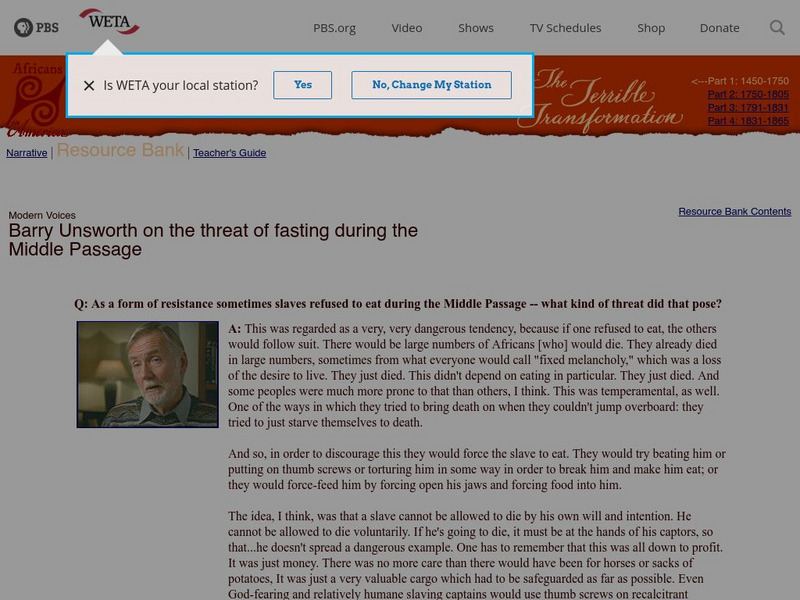
Pbs: Cet: Africans in America: The Threat of Fasting During the Middle Passage
Description of how slaves tried to starve themselves to death on slave ships as a form of resistance, and how the slave traders forced them to eat so they would not lose money. Click on Teacher's Guide for teaching resources.
PBS
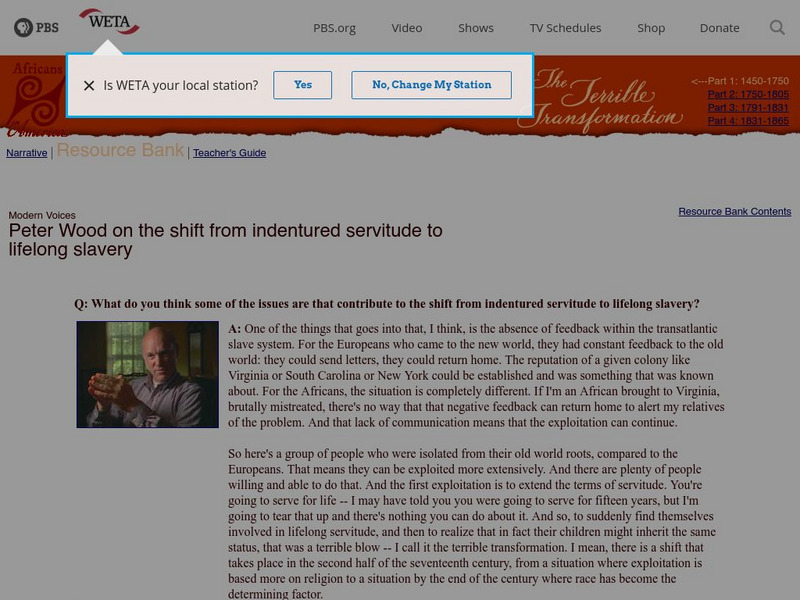
Pbs: Africans in America: Shift From Indentured Servitude to Lifelong Slavery
This discussion by Prof. Peter Wood of Duke University explores what may have allowed the shift from indentured servitude to lifelong slavery for Africans and their children. Click on Teacher's Guide for teacher resources.
PBS
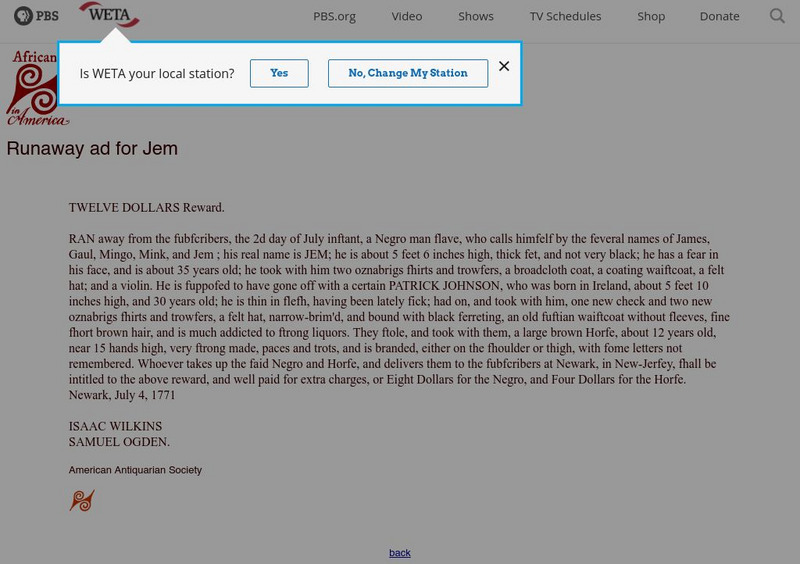
Africans in America: Runaway Slave Ad From Colonial New Jersey
Here from PBS is the original text of a runaway slave ad for a slave named Jem. His owner in Newark, New Jersey describes him and offers a reward.
National Humanities Center
National Humanities Center: Toolbox Library: Labor, Making of African American Identity: V. 1
Selections of original accounts either written during slavery or recorded in the 1930s that depict work as a plantation laborer, house servant, shipyard worker or boatman.
National Humanities Center
National Humanities Center: Toolbox Library: Driver, Making of African American Identity: V. 1
Unusual letters from black slave drivers, and in one case, letters in reply from the white slave owner, about crops, labor, and conditions on plantations in the mid-1850s.
National Humanities Center
National Humanities Center: Toolbox Library: Africans Ii, American Beginnings: 1492 1690
Three illustrations and five documents about slave codes, master-slave power dynamics, and free blacks within French and Spanish settlements of the Caribbean.
National Humanities Center
National Humanities Center: Toolbox Library: Africans I, American Beginnings: 1492 1690
Four accounts of the complex power relationships between slaves and slave holders within English colonies in Barbados, Virginia and Pennsylvania, as well as documents about slave revolts and anti-slavery agitation.
Digital Public Library of America
Dpla: Cotton Gin and the Expansion of Slavery
The sources in this primary set document the invention of the cotton gin and the expansion of slavery. Includes teaching guide.
Digital Public Library of America
Dpla: Beloved by Toni Morrison
Beloved is a novel inspired by the true story of Margaret Garner, who escaped with her family from slavery in Kentucky to freedom in Ohio in 1856.
National Humanities Center
National Humanities Center: Toolbox Library: Making of African American Identity: Free Born
A journal, an autobiography, and selections from narratives about the conditions experienced by free-born African Americans in the nineteenth century. They ask such questions as: How did African Americans construct identity in antebellum...