Hi, what do you want to do?






Curated OER
Earth's Recyclers
Students work together in groups to report on different topics related to decomposition. They answer questions and share their answers with the class. They discuss any topic that is unclear.

Curated OER
Populations – The Survival of the Fittest (Part 1)
Students explain in their own words why organisms live together. In this biology lesson, students model what happens to organisms if their environment changes. They explain the importance of evolution.


Curated OER
Ecology
In this ecology worksheet students complete a crossword puzzle that incorporates all of the ecological vocabulary in the word puzzle.

Curated OER
How We See Things
Students investigate how mirrors reflect light. In this reflection lesson, students draw the path of the light reflected from a mirror. Students construct a list of objects that are light sources.

Curated OER
Using Electricity
Students name appliances that use electricity. They construct a simple electrical circuit. They predict whether a circuit work. They name components of an electrical circuit.

Curated OER
Changing circuits
Young scholars identify that there are conventional symbols to represent the components in circuits. Students use these symbols to draw diagrams of circuits. They are reminded that electric circuits can be drawn in diagrams using...

Curated OER
Changing Circuits
Learners observe an on-line activity to review the basics of electrical circuitry, then research answers to related questions on-line.In this lesson on changing components in a series circuit, students discover how different components...

Curated OER
How We See Things
Students explain that when a beam of light is reflected from its surface, it changes direction. In this virtual science experiment lesson plan, students complete an activity that requires them to investigate how flat mirrors reflect...

Curated OER
Nature's Recyclers
Students create environments to demonstrate how earthworms interact with their surroundings.

Curated OER
Micro-organisms
Learners examine how micro-organisms are living organisms that are often too small to be seen. They explain that micro-organisms may be beneficial or harmful.

Curated OER
How We See Things
Students explain that mirrors reflect light. They examine how when a beam of light is reflected from a surface, its direction changes.

Curated OER
Changing Circuits
Students participate in an online lesson to explain how to make bulbs brighter or dimmer in a series circuit by changing the number or type of components.

Curated OER
Mushroom Prints
Students create a mushroom spore design on paper while studying the facts on fungi.

Curated OER
Plant Reproduction
In this plant reproduction worksheet, students complete a crossword puzzle with 36 questions. They identify the different plant reproductive features.

Curated OER
Ecology Vocabulary Exercise: Wetlands
In this ecology vocabulary exercise: wetlands worksheet, students read the definitions of 8 words, then categorize a species found in a wetland in their region. This page has numerous links to helpful web resources.

Curated OER
Super Scientists Code
In this science worksheet, students use the key code on the right to unscramble each of the scientists. They also match each of the scientists found to their correct description.
Other
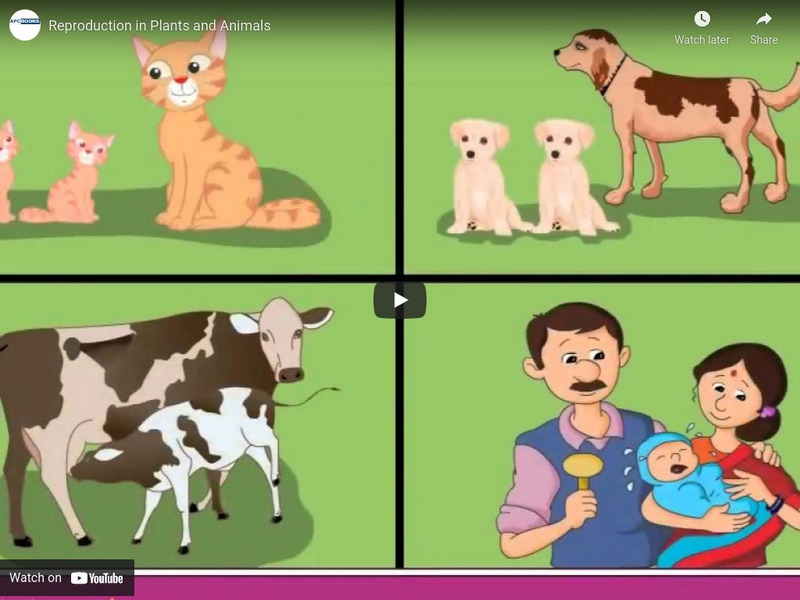
Reproduction in Plants and Animals
Reproduction in Plants and Animals. The ability to produce more organism similar to themselves is a very important characteristic of all living organisms. The process by which they do so is known as reproduction. [0:21]
Utah Education Network
Uen: Themepark: Cycles
This is a large collection of resources on cycles of nature and the Earth. There is a constant exchange of the elements between air, earth, water, plants, and animals. Most biological processes wind up back where they started. These...
SMART Technologies
Smart: Life Cycles of Plants and Animals
This lesson activity helps students learn that things change over time and how both plants and animals change in their life cycles. They will demonstrate what they've learned on a Venn diagram and a t-chart.

Channel 4 Learning
Channel 4 Learning: Science Essentials: Life Cycles
Learn about the life cycles of plants and animals then demonstrate what you know with activities, a quiz, and related resources.
Wisc-Online
Wisc Online: Lifecycles of Animals and Plants
This segment covers the lifecycles of various plants and animals. Illustrations begin with the production of a gamete and describe the processes that occur throughout the lifespan of living creatures.
Science Education Resource Center at Carleton College
Serc: Phenology and Weatherguide Calendar
An activity where students observe the grounds around their school to study the plant and animal life cycle. Students will make a map of the school to keep track of their observations. Students will also compare their phenology calendar...

Alabama Learning Exchange
Alex: What Is Alive?
This lesson is the opening lesson for a unit of study entitled "Why Doesn't A Caterpillar Grow Up To Be An Oak Tree?" during which students take a look at life cycles of plants and animals. This lesson will encourage students to explore...