Hi, what do you want to do?





PBS
Pbs Learning Media: Observe Images of Different Climate Zones
Interact with this world map from McDougal Littell/TERC to highlight different climate zones and see a photograph of each one. Ten climate zones are represented, including tundra, desert, humid subtropical, and others.

PBS
Pbs Learning Media: Civil Rights Activist, Fannie Lou Hamer
A profile of the life and leadership of Fannie Lou Hamer, a civil rights activist best known for her stirring testimony at the 1964 Democratic National Convention.

PBS
Pbs Learning Media: Birth of a Supernova, Type Ii
In this interactive activity from NOVA Online, learn about a type of exploding star a Type II supernova that is so large it has a mass 10 times greater than the mass of our Sun.
PBS
Pbs Learning Media: Journey Into Dna
Travel deep into the human body to see exactly where your DNA resides. From the NOVA: Cracking the Code of Life Web site.
PBS
Pbs Learning Media: Global Warming: Graphs Tell the Story
Examine these graphs from the NOVA/ FRONTLINE Web site to see dramatic increases in the temperature of Earth's surface and greenhouse gases in the atmosphere.
PBS
Pbs Learning Media: Life's Greatest Miracle: Stem Cell Debate
This essay from NOVA: "Life's Greatest Miracle" explores the debate over the use of embryonic stem cells in scientific research.
PBS
Pbs Learning Media: Forgotten Inventors
This illustrated feature from the American Experience Web site highlights the frequently forgotten inventors of several useful, innovative technologies.
PBS
Pbs Learning Media: Nature Versus Nurture Revisited
Which dictates our existence? Is it our genetic makeup or the environment we grow up in? Kevin Davies offers an update on this long-standing debate, from the NOVA: "Cracking the Code of Life" Web site.
PBS
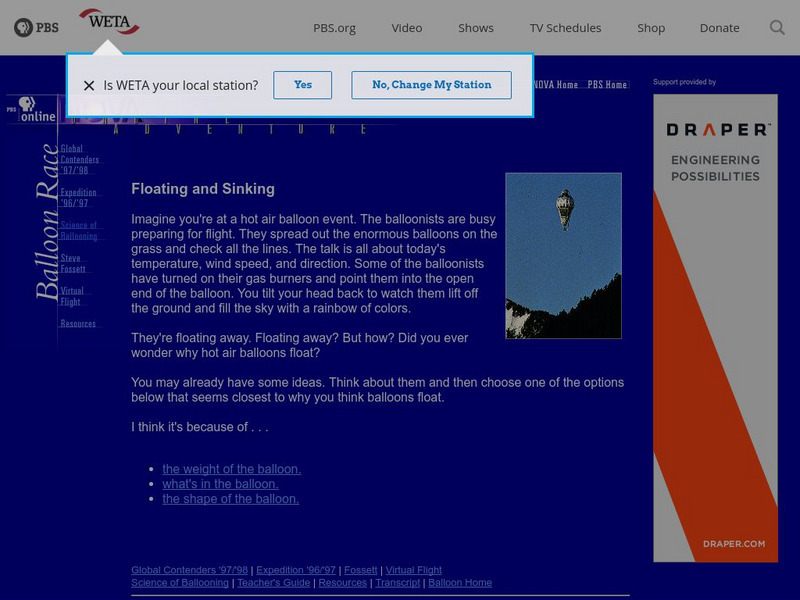
Pbs Learning Media: Floating and Sinking: Hot Air Balloons
Why do hot air balloons float? This resource from the NOVA Web site offers a series of interactive activities that illustrates the physics of hot air balloons.
PBS
Pbs Learning Media: How Cancer Grows
Follow the growth of a carcinoma from initial mutation to widespread metastasis in this feature from the NOVA: "Cancer Warrior" Web site.
PBS
Pbs Learning Media: Sex and the Single Guppy
Play in our streams and see how exhibitionism has an evolutionary payoff in this simulation of John Endler's famous experiment. Includes background information and discussion questions.
PBS
Pbs Learning Media: Observing Refraction of Light
This video segment adapted from Shedding Light on Science illustrates how light changes speed, and thus direction, in a process known as refraction. Includes background reading and discussion questions. [2:05]
PBS
Pbs Learning Media: Deforestation in Bolivia
This visualization adapted from NASA features two satellite images from 1984 and 2000 that show the dramatic deforestation of the Bolivian rainforest. Includes background reading material and discussion questions.
PBS
Pbs Learning Media: The Atom
In this interactive activity from ChemThink, students will take a closer look at atomic structure, properties, and behaviors. Includes background reading material and discussion questions.
PBS
Pbs Learning Media: The Sense of Taste
This video segment explores the sense of taste in humans -- why we have it, and what happens when we lose it. Footage from NOVA: "Mystery of the Senses: Taste." Includes background reading material and discussion questions. [4:18]
PBS
Pbs Learning Media: Centripetal Force: Roller Coaster Loops
This video segment explains centripetal force and illustrates how roller coasters rely on it to give you a thrilling ride. Includes background reading material and discussion questions. [4:40]
PBS
Pbs Learning Media: Farming the Desert: Geography of the Sahel
This lesson is provided to introduce students to the geography and people of the Sahel region and to have them discover the challenges and conflicts faced by the inhabitants. They learn about desertification and what farmers are doing to...
PBS
Pbs Learning Media: Coastal Geological Processes
This interactive resource adapted from the National Park Service describes the many forces that affect shorelines, including tides, weathering, erosion, and deposition. Includes background reading handout and discussion questions.
PBS
Pbs Learning Media: Circular Motion
In this interactive activity featuring videos adapted from the Rutgers PAER Group, students will observe examples of circular motion. Students will then find a common reason why the objects and people presented move in a circle. Includes...
PBS
Pbs Learning Media: Momentum
In this interactive activity adapted from Wake Forest University, students will observe the effect of mass on velocity and momentum in elastic and inelastic collisions. Includes background reading, a student handout, and discussion...
PBS
Pbs Learning Media: Great Ocean Conveyor Belt: Part I
This image from GRID-Arendal depicts the major circulation pattern of the ocean, illustrating interactions between temperature, salinity, and depth. Includes a background reading handout and several discussion questions.
PBS
Pbs Learning Media: Ohm's Law
In this interactive simulation of Ohm's law, adapted from the University of Colorado's Physics Education Technology project, students will adjust the voltage and resistance in a circuit, and observe how this affects the flow of current....
PBS
Pbs Learning Media: Glaciers
Featuring images of glacier formations, this interactive resource adapted from the National Park Service explains what glaciers are, where they are found, how they form, and how they move.
PBS
Pbs Learning Media: The Nitrogen Cycle
Nitrogen, one of the most abundant elements in the universe, is essential to life. This interactive activity adapted from the University of Alberta provides an overview of the nitrogen cycle. Includes background reading handout and...