Hi, what do you want to do?






University of Waikato
Build a Marine Food Web
Dive into a lesson on marine ecosystem interactions. Individuals learn about and devise a marine food web. The resource provides organism cards and pupils use article resources to discover interactions before modeling them in a food web.

Ask a Biologist
It’s a Plankton Eat Plankton World
For as small as they are, plankton sure play an enormous role in maintaining marine ecosystems. Dive into an investigation of these tiny organisms with a hands-on life science activity in which children cut out pictures of sea...

Howard Hughes Medical Institute
Ocean Acidification
Human impacts on the environment can sometimes be difficult to measure, especially under water! An activity centered on ocean acidification gives science scholars the opportunity to examine the effects of carbon dioxide on marine life....

Curated OER
Ecosystems
A critical look into the structure and function of ecosystems is here for young learners as a series of lessons and worksheet activities. Topics covered include land-based and marine ecosystems, connections to the water cycle, food...

National Geographic
National Geographic: Marine Food Webs
For this lesson, students learn about marine food webs and pyramids, and how energy flows through a marine ecosystem. They then research a marine organism and its role in a marine food web. The class pools their information to create a...
Museum of Science
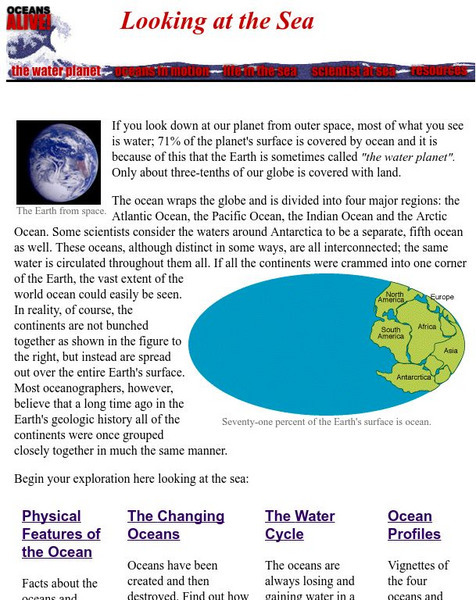
Museum of Science: Looking at the Sea
There are 5 parts to this resource. You can click on the water planet, oceans in motion, life in the sea, scientists at sea and resources. There are also activities for teachers.
Science Buddies
Science Buddies: Harmful Algal Blooms in the Chesapeake Bay
Harmful algal blooms occur when algae, which form the base of the ocean food web, grow in massive numbers and produce toxic or harmful effects on people, fish, shellfish, marine mammals, and birds. In this project you will learn how to...