Hi, what do you want to do?






Curated OER
Ocean Life
Students explore the topics of ocean water salinity, ocean life zones, marine life classification, and ocean food chains. They observe demonstrations, conduct experiments, complete quizzes and handouts, and analyze key vocabulary.

Curated OER
Ecosystems
A critical look into the structure and function of ecosystems is here for young learners as a series of lessons and worksheet activities. Topics covered include land-based and marine ecosystems, connections to the water cycle, food...

University of Southern California
Human Impact on the Sea
How far does the human hand reach? Five interactive lessons lead classes through a unit exploring the human impact on ocean resources, pollution, and even extinction. Learners discover how their decisions affect the ocean...

University of Southern California
What Lives In The Ocean?
One of the most diverse environments on Earth is the ocean. Young scientists explore the living things found in the ocean during an exciting seven-lesson unit. Their study includes organisms from plankton to invertebrates...

Curated OER
Oceans
Students complete a unit of activities to learn about ocean life as well as improve their math and measurement skills. In this ocean life and math skills lesson, students complete 8 lessons to learn about ocean life and complete...

Curated OER
Sustainability and Extinction
Galapagos Penguins are the only penguins on earth that live north of the equator (in the wild). In this last lesson plan a discussion on how the Galapagos islands developed their populations and diversity sparks the introduction. Two...

University of Southern California
What Is The Ocean?
Go on a tour of the ocean through the lens of a scientist. Learners read maps of the ocean floor, study tide behavior, examine wave motion, and analyze components of soil. Each lesson incorporates a hands-on component.
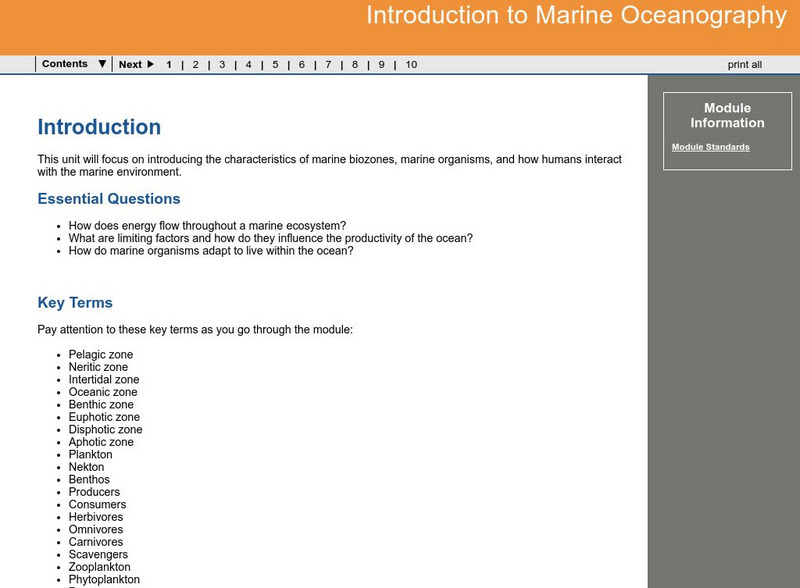
Georgia Department of Education
Ga Virtual Learning: Introduction to Marine Oceanography
Students learn about marine biozones, marine organisms, and how humans interact with the marine environment.
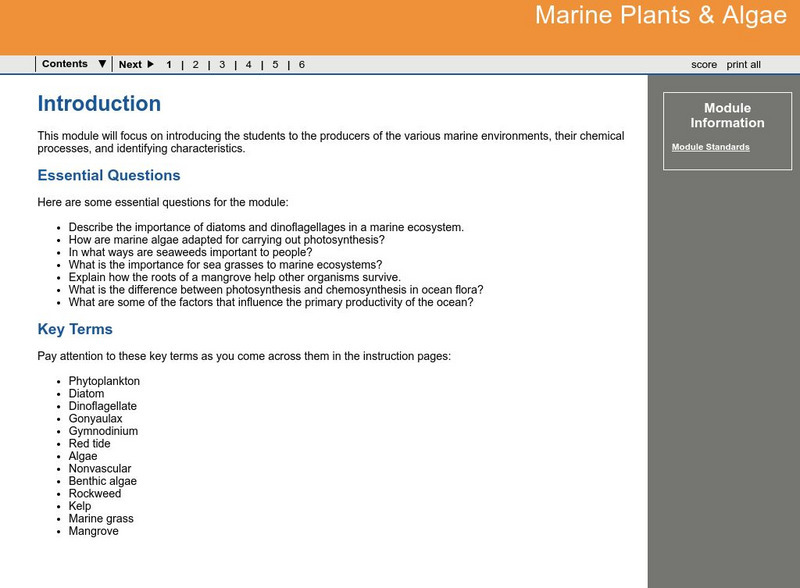
Georgia Department of Education
Ga Virtual Learning: Marine Plants & Algae
Students are introduced to the producers of the various marine environments, their chemical processes, and identifying characteristics.
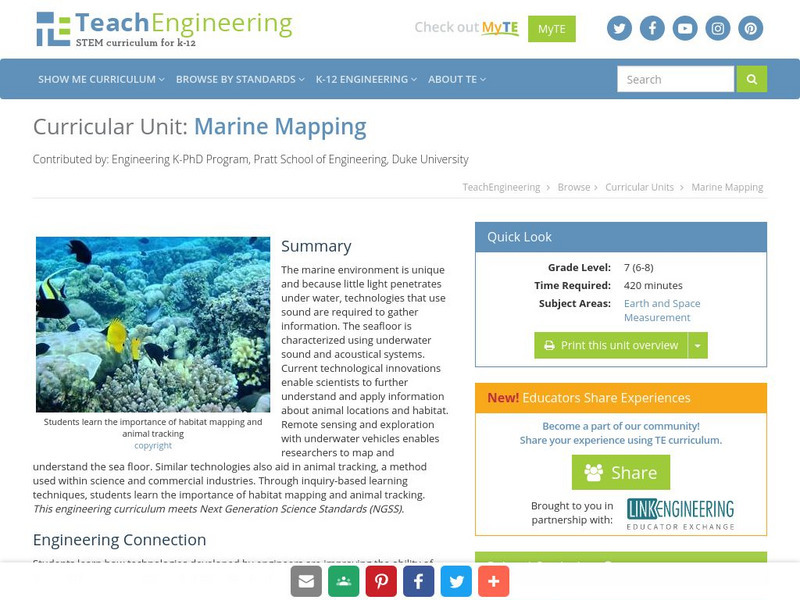
TeachEngineering
Teach Engineering: Marine Mapping
The marine environment is unique and requires technologies that can use sound to gather information since there is little light underwater. The seafloor is characterized using underwater sound and acoustical systems. Current...
Other
Rutgers Marine & Coastal Sciences: Cool Classroom
Students and teachers can explore the work of marine scientists and observe the ocean from their computers. Learn about Rutgers Coastal Ocean Observation Laboratory, discover why oceanography is important, and see what life is like in...
Tramline
Tramline, Inc.: Virtual Ocean Field Trip
In this enchanting site, students will learn basic principles about oceans and will be introduced to an assortment of sea life, both plant and animal. Other interesting ocean links can be found on the teacher resource section of this link.

Georgia Department of Education
Ga Virtual Learning: Coastal Ecosystems
Students are introduced to the various marine environments, their unique formations, origin and identifying characteristics.
CK-12 Foundation
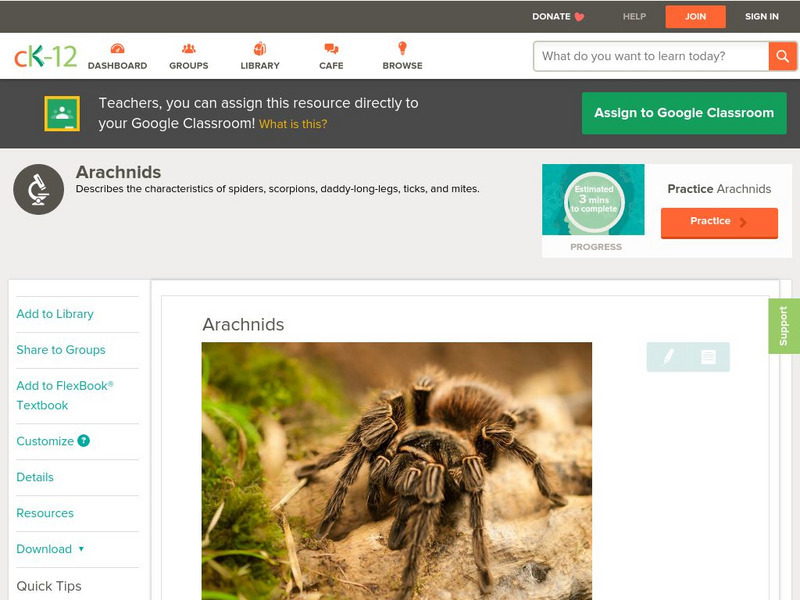
Ck 12: Life Science: Arachnids
[Free Registration/Login may be required to access all resource tools.] Arachnids are a class of joint-legged invertebrates in the subphylum Chelicerata. They live mainly on land but are also found in freshwater and in all marine...

E-learning for Kids
E Learning for Kids: Science: Australia: How Do Environments Affect Living Things?
Noah lives near the Great Barrier Reef. Go explore this diverse habitat with him.

San Diego State University
San Diego State University: Researching Research
This comprehensive unit site from the San Diego State University is geared towards seventh grade math and science students. "Students will chose a research project currently in progress and research it using traditional techniques, the...
American Geosciences Institute
American Geosciences Institute: Oceans
Seven hands-on lessons module in which students explore oceans. Inquiry-based investigations include properties of seawater, ocean water and currents, and features of the ocean floor.

The Wild Classroom
The Wild Classroom: Biomes of the World: Coastal Ocean Biome
Learn about the coastal ecosystem. Find out about plants, animals, adaptations, and conservation efforts.
The Wild Classroom
The Wild Classroom: Biomes of the World: Oceanic Pelagic Biome
Learn about the oceanic pelagic ecosystem. Find out about plants, animals, adaptations, and conservation efforts.

The Wild Classroom
The Wild Classroom: Biomes of the World: Intertidal Zone
Learn about the intertidal ecosystem. Find out about plants, animals, adaptations, and conservation efforts.
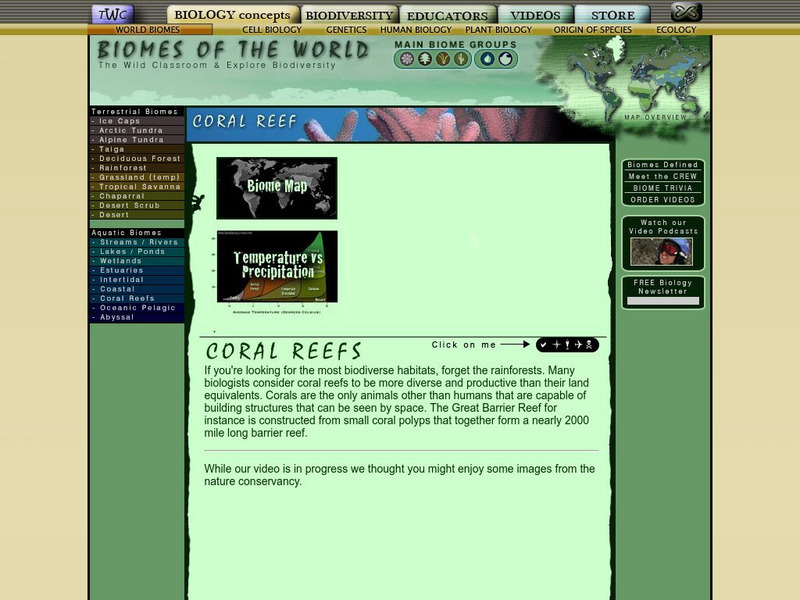
The Wild Classroom
The Wild Classroom: Biomes of the World: Coral Reef Biome
Learn about the coral reef ecosystem. Find out about plants, animals, adaptations, and conservation efforts.