Hi, what do you want to do?





California State University
Csun: Nature of Science
This California State University Northridge essay on the "Nature of Science, the Scientific Method, and Measurement" includes a historical perspective.

University of Florida
Florida Museum of Natural History: Kitchen Science
This guide focuses on everyday substances and how we can change their properties by adding heat or cold, physically manipulating them, or mixing them together.

Science Struck
Science Struck: List of Famous Physicists
A list of famous physicists with some biographical information and mention of their accomplishments. Includes separate list of physicists who won the Nobel Prize.
National High Magnetic Field Laboratory
Magnet Academy: Timeline of Electricity and Magnetism: 1960 1979
Computers evolve into PCs, researchers discover one new subatomic particle after another and the space age gives our psyches and science a new context.
National High Magnetic Field Laboratory
Magnet Academy: Timeline of Electricity and Magnetism: 1830 1839
The first telegraphs are constructed and Michael Faraday produces much of his brilliant and enduring research into electricity and magnetism, inventing the first primitive transformer and generator.
National High Magnetic Field Laboratory
Magnet Academy: Timeline of Electricity and Magnetism: 1820 1829
Hans Christian Orsted's accidental discovery that an electrical current moves a compass needle rocks the scientific world; a spate of experiments follows, immediately leading to the first electromagnet and electric motor.
National High Magnetic Field Laboratory
Magnet Academy: Timeline of Electricity and Magnetism: 1775 1799
Scientists take important steps toward a fuller understanding of electricity, as well as some fruitful missteps, including an elaborate but incorrect theory on animal magnetism that sets the stage for a groundbreaking invention.
National High Magnetic Field Laboratory
Magnet Academy: Timeline of Electricity and Magnetism: 1700 1749
Aided by tools such as static electricity machines and Leyden jars, scientists continue their experiments into the fundamentals of magnetism and electricity.
National High Magnetic Field Laboratory
Magnet Academy: Timeline of Electricity and Magnetism: 1910 1929
Scientists' understanding of the structure of the atom and of its component particles grows, the phone and radio become common, and the modern television is born.
Stanford University
Stanford Encyclopedia of Philosophy: Anaxagoras
Discusses the life of Anaxagoras of Clazomenae, his ideas about the metaphysical, the physical, the cosmos, and human intelligence, and the impact he had on later intellectuals. He is especially remembered for having been the first to...
National High Magnetic Field Laboratory
Magnet Academy: Timeline of Electricity and Magnetism: 1890 1899
Scientists discover and probe x-rays and radioactivity, while inventors compete to build the first radio.
National High Magnetic Field Laboratory
Magnet Academy: Timeline of Electricity and Magnetism: 1870 1879
The telephone and first practical incandescent light bulb are invented while the word "electron" enters the scientific lexicon.
National High Magnetic Field Laboratory
Magnet Academy: Timeline of Electricity and Magnetism: 1800 1819
Alessandro Volta invents the first primitive battery, discovering that electricity can be generated through chemical processes; scientists quickly seize on the new tool to invent electric lighting. Meanwhile, a profound insight into the...
National High Magnetic Field Laboratory
Magnet Academy: Timeline of Electricity and Magnetism: 1930 1939
New tools such as special microscopes and the cyclotron take research to higher levels, while average citizens enjoy novel amenities such as the FM radio.
Science Struck
Science Struck: What Is the Higgs Boson Particle?
A detailed explanation of the Higgs Boson particle and the science of particle physics. Discusses the history of the search for this particle, the ongoing research with the Large Hadron Collider at CERN in Europe, and what is known so...
National High Magnetic Field Laboratory
Magnet Academy: Gerd Binnig
Gerd Binnig co-developed the scanning tunneling microscope (STM) with Heinrich Rohrer. The STM allowed scientists entry into the atomic world in a new way and was a major advance in the field of nanotechnology. For their achievement,...
National High Magnetic Field Laboratory
Magnet Academy: Jack Kilby
The integrated circuit fueled the rise of microelectronics in the latter half of the twentieth century and paved the way for the Information Age. An American engineer, Jack Kilby, invented the integrated circuit in 1958, shortly after he...
National High Magnetic Field Laboratory
Magnet Academy: Heike Kamerlingh Onnes
Heike Kamerlingh Onnes was a Dutch physicist who first observed the phenomenon of superconductivity while carrying out pioneering work in the field of cryogenics. An important step on the way to this discovery was his success in...
National High Magnetic Field Laboratory
Magnet Academy: Isidor Isaac Rabi
Isidor Isaac Rabi won the Nobel Prize in Physics in 1944 for his development of a technique for measuring the magnetic characteristics of atomic nuclei. Rabi's technique was based on the resonance principle first described by Irish...
National High Magnetic Field Laboratory
Magnet Academy: Heinrich Friedrich Emil Lenz
At the turn of the 19th century, scientists were beginning to gain a rudimentary understanding of electricity and magnetism, but they knew almost nothing about the relationship between the two. Baltic German physicist Heinrich Lenz took...
American Museum of Natural History
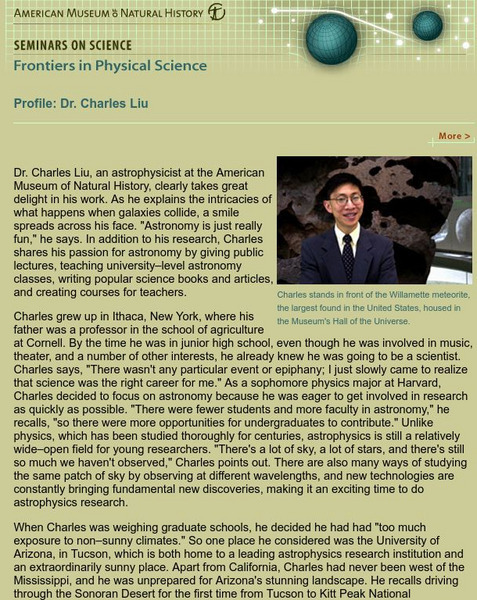
American Museum of Natural History: Profile: Dr. Charles Liu
A biography of Dr. Charles Liu, an astrophysicist at the American Museum of Natural History focused on his drive to become an astrophysicist.

National High Magnetic Field Laboratory
Magnet Academy: Jean Charles Athanase Peltier (1785 1845)
Although he didn't start studying physics until he retired from the clock-making business at age 30, French native Jean Peltier made immense contributions to science that still reverberate today. Even with the primitive tools available...
University of California
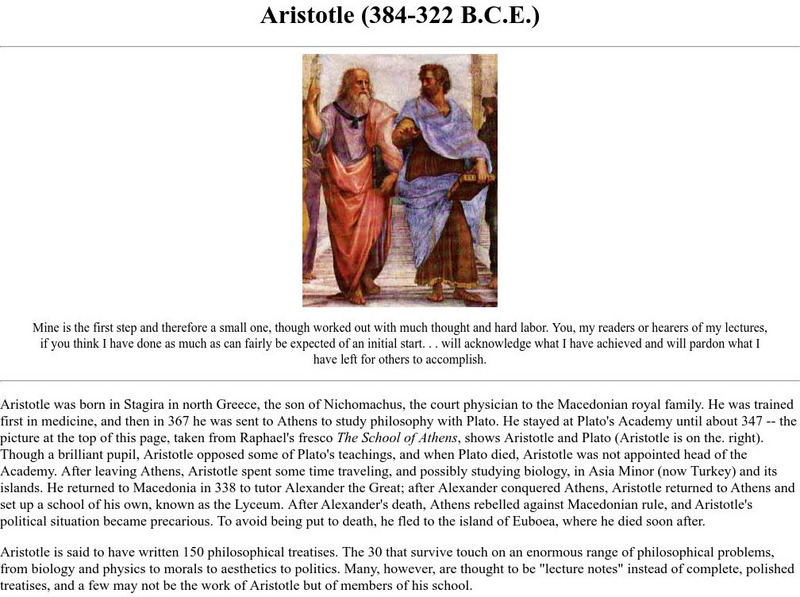
Ucmp: Aristotle
The life and philosophical treatises of Aristotle (384-322 BCE) are surveyed, including his writings on biology, zoology and physics.
Internet History Sourcebooks Project
Fordham University: Modern History Sourcebook: Principles of Natural Philosophy
This site from Fordham University is an exerpt from Newton's famous "Principia."