Hi, what do you want to do?






Science Struck
Science Struck: Basics of Quantum Mechanics for Dummies
A good explanation of basic quantum theory.
National High Magnetic Field Laboratory
Magnet Academy: Timeline of Electricity and Magnetism: 1960 1979
Computers evolve into PCs, researchers discover one new subatomic particle after another and the space age gives our psyches and science a new context.
National High Magnetic Field Laboratory
Magnet Academy: Timeline of Electricity and Magnetism: 1910 1929
Scientists' understanding of the structure of the atom and of its component particles grows, the phone and radio become common, and the modern television is born.
Other
History of Islamic Science 3: The Time of Al Razi
In-depth look at Islamic society during the time of al-Razi. Discusses "Arabic Mathematics and Astronomy," "Muslim Alchemy and Physics," "Muslim Medicine," and several well-known individuals such as al-Mahani, inb Yusuf, al-Nairizi, ibn...
National High Magnetic Field Laboratory
Magnet Academy: Timeline of Electricity and Magnetism: 1870 1879
The telephone and first practical incandescent light bulb are invented while the word "electron" enters the scientific lexicon.
National High Magnetic Field Laboratory
Magnet Academy: Timeline of Electricity and Magnetism: 1800 1819
Alessandro Volta invents the first primitive battery, discovering that electricity can be generated through chemical processes; scientists quickly seize on the new tool to invent electric lighting. Meanwhile, a profound insight into the...
National High Magnetic Field Laboratory
Magnet Academy: Timeline of Electricity and Magnetism: 1940 1959
Defense-related research leads to the computer, the world enters the atomic age and TV conquers America.

University of Florida
Florida Museum of Natural History: Physical Science
This guide focuses on four physical science topics that fascinate children and scientists alike. They are motion, magnets, sound, and light. With your guidance and support, these topics provide children with many opportunities to explore...
Science Struck
Science Struck: Mercury Element Facts
Learn about the history of mercury, its physical and chemical properties, where it is found, its uses, its toxic effects, and some interesting facts.
National High Magnetic Field Laboratory
Magnet Academy: Jack Kilby
The integrated circuit fueled the rise of microelectronics in the latter half of the twentieth century and paved the way for the Information Age. An American engineer, Jack Kilby, invented the integrated circuit in 1958, shortly after he...
Nobel Media AB
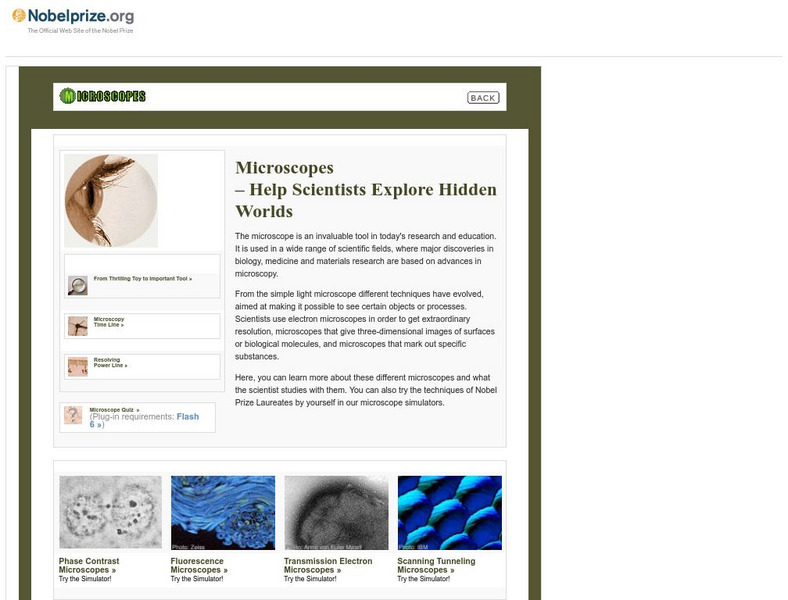
The Nobel Prize: Microscopes Help Scientists Explore Hidden Worlds
This is a site full of information about various microscopes and the objects and processes scientists study with them. Includes timelines and interactive simulations.
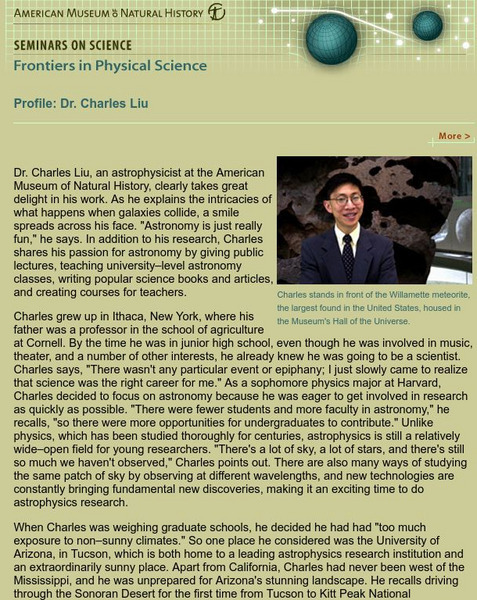
American Museum of Natural History
American Museum of Natural History: Profile: Dr. Charles Liu
A biography of Dr. Charles Liu, an astrophysicist at the American Museum of Natural History focused on his drive to become an astrophysicist.
Other
Database of Award Winning Children's Literature
This is a phenomenal resource. It allows the user to create a reading list of quality children's literature based of choices such as reading level, type of book, genre, ethnicity, gender, etc. In addition, one can determine if a book won...
Famous Scientists
Famous Scientists: Aristotle
A detailed biography of Aristotle (384-322 BC). Discusses his early life, his education, his relationship with Alexander the Great as tutor, the breadth of his work in various science disciplines, the school he established in Athens, and...
PBS
Pbs Teachers: Scientific American: Dragon Science: Time Travelers
Explore the work of archeologists and anthropologists by building a 3-D clay representation of a human skull to look for clues to a person's physical form, ethnic origin, behavioral patterns, health history and social standing.
Science Struck
Science Struck: Sequent Occupance: Definition and Some Examples
Sequent occupance refers to the imprint left on a region by successive cultures throughout its history. The concept is described here and examples of places around the world are provided.
BBC
Bbc: Vermeer and the Camera Obscura
An interesting viewpoint written by Philip Steadman on the controversial subject of Vermeer using a Camera Obscura to trace and create his paintings. There is factual evidence as well as a physical description of the Camera Obscura.
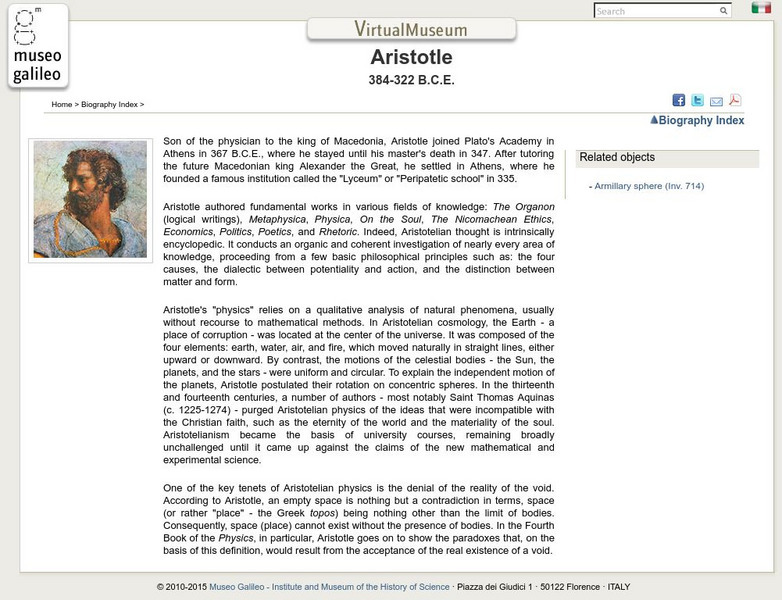
Institute and Museum of the History of Science
Museo Galileo: Aristotle 384 322 b.c.e.
A brief look at the life of Aristotle followed by a short discussion of his ideas about physics.