Hi, what do you want to do?






Utah Education Network
Uen: Classifying Objects
Fourth graders practice using a type of classification system.
Khan Academy
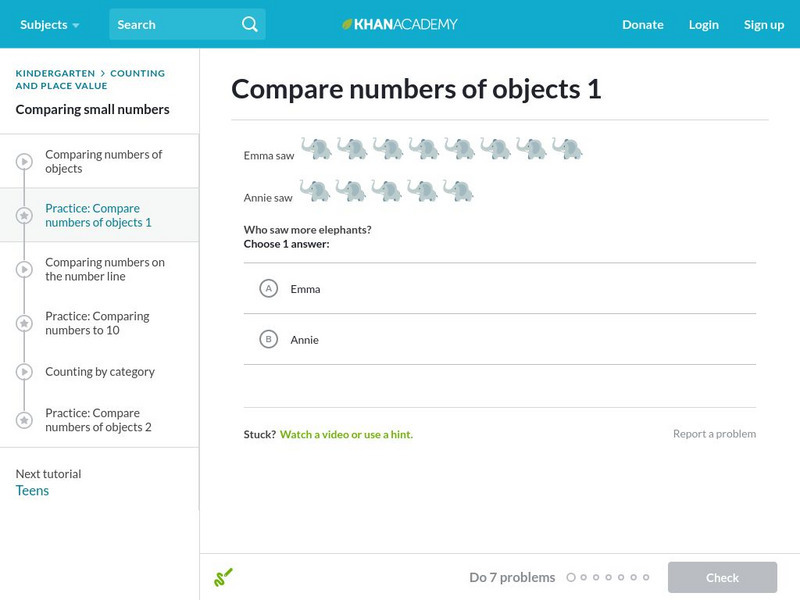
Khan Academy: Compare Numbers of Objects 1
Practice counting which group has more objects. Students receive immediate feedback and have the opportunity to try questions repeatedly, watch a video or receive hints.
Better Lesson
Better Lesson: Counting Collections: 100 Objects
First graders work to count to 100 in this rigorous counting activity. Students create a shape out of their 100 objects for a creative twist. This lesson contains a detailed plan, video explanation, discussion questions based on ability...
Illustrative Mathematics
Illustrative Mathematics: Finding Equal Groups
This activity will test how quickly students can count objects. The teacher will assemble a variety of groups of objects in a few different forms (examples included). Students will race against the clock to sort the groups of objects...
Better Lesson
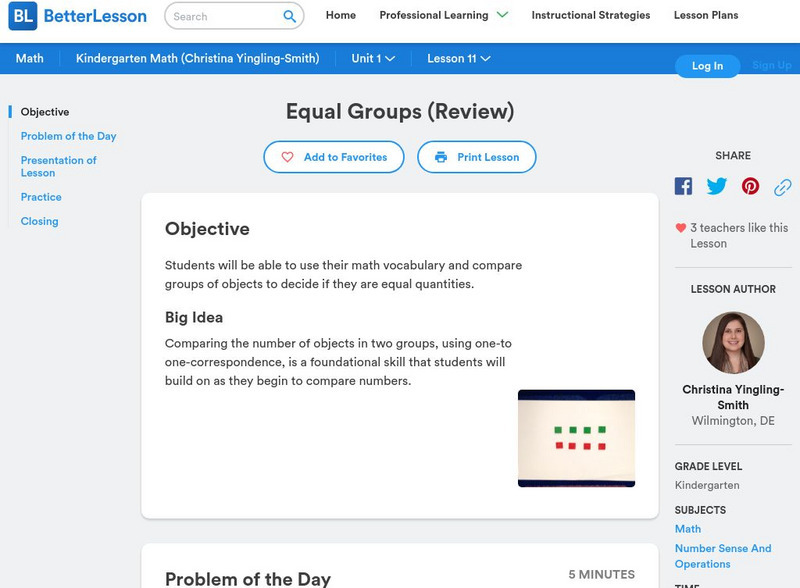
Better Lesson: Equal Groups (Review)
Comparing the number of objects in two groups, using one-to one-correspondence, is a foundational skill that students will build on as they begin to compare numbers. This lesson will allow students to practice this skill in small groups....

Better Lesson
Better Lesson: Finding Equal Groups
Learners will be able to compare groups of objects to decide if they are equal with this lesson. Included are pictures and videos of the lesson in action, worksheets, and a SMART Board resource.
Illustrative Mathematics
Illustrative Mathematics: Goody Bags
Students will practice counting with this small group activity - great for math stations! The teacher will pre-fill goodie bags with counting objects. Students count the objects, record the number on the post-it note and stick the...
Smithsonian Institution
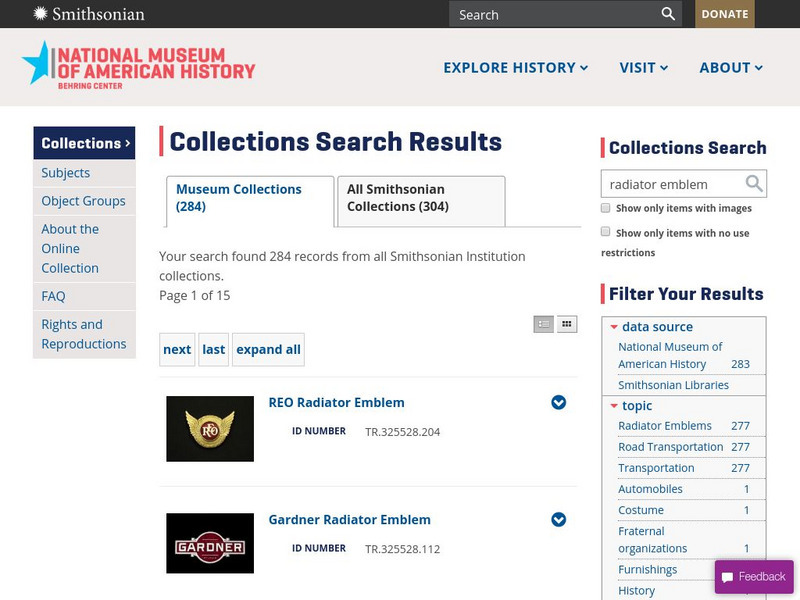
National Museum of American History: What Is an Emblem?
This tour divides the Smithsonian's collection of 278 radiator emblems into different groupings to demonstrate how similar objects can be interpreted to emphasize certain themes and relationships. The exhibition uses the radiator emblems...
TeachEngineering
Teach Engineering: Touch and Discover
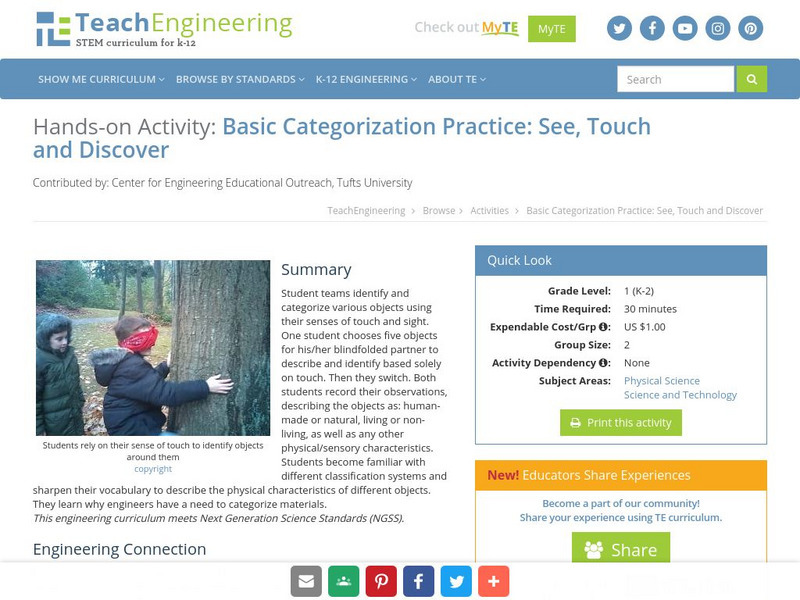
Students work in pairs or small groups to identify and categorize various objects. One student is blindfolded and the other student chooses five objects for their partner to identify. The blindfolded student has to describe and try to...
HotChalk
Hot Chalk: Lesson Plans Page: Birdseye View, Mapping
Lesson that helps young scholars understand that maps show a "birds-eye view" of a place. Students stand above a teacher-made model and discuss how the objects in the model looked from above. Then young scholars draw objects from a...
Success Link
Success Link: Flying Into Spring
Here are two lesson plans that apply geometric concepts to design objects. The first involves students as a group following step by step instructions on making a kite. After the review of geometry vocabulary, in cooperative groups the...
Better Lesson
Better Lesson: I Am Five! Exploring the Number Five
Students will be able to identify the number five, identify groups with five objects and represent the number five.
Other
Pre K Pages: Sorting Activities for Preschool
This article contains activities and ideas for teaching sorting skills in preschool, pre-k, or kindergarten classrooms. Teach children to sort using various attributes.
Science and Mathematics Initiative for Learning Enhancement (SMILE)
Smile: Sound, the Vibration of Materials
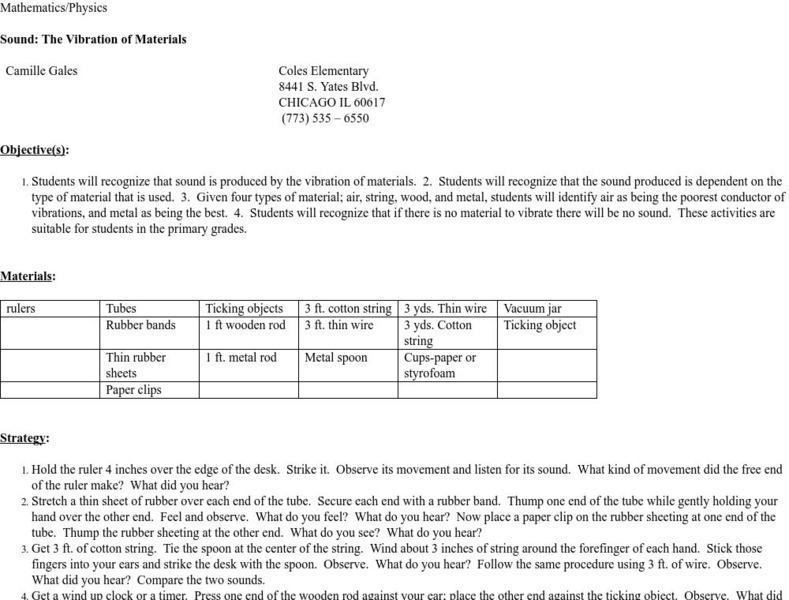
Great activity for primary and intermediate learners to learn why objects make noise. This can be organized in stations or in groups of students.