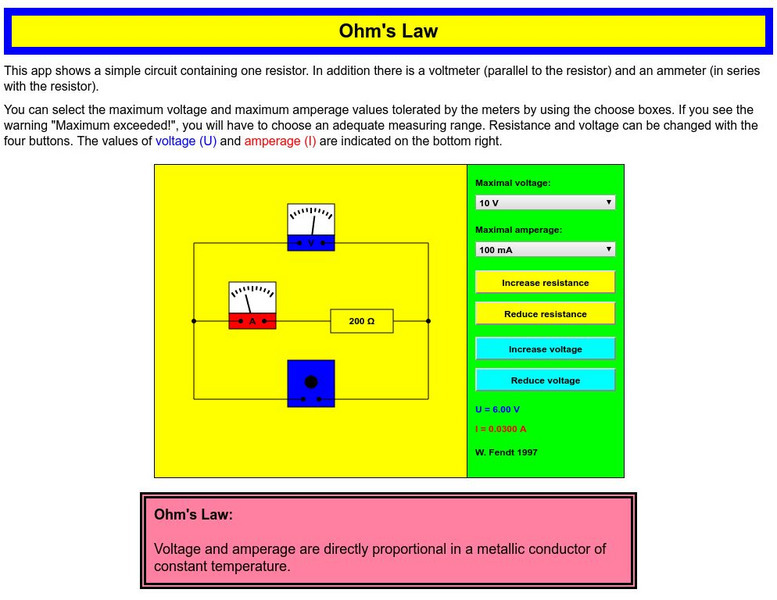
Hi, what do you want to do?






Canada Science and Technology Museum
Canada Science and Technology Museum: Background Information for Electricity
The Canada Science and Technology Museum answers some of the most common questions about electricity. For example, get the definition of electricity, the difference between alternating and direct currents, and learn how a fuse works.
Other
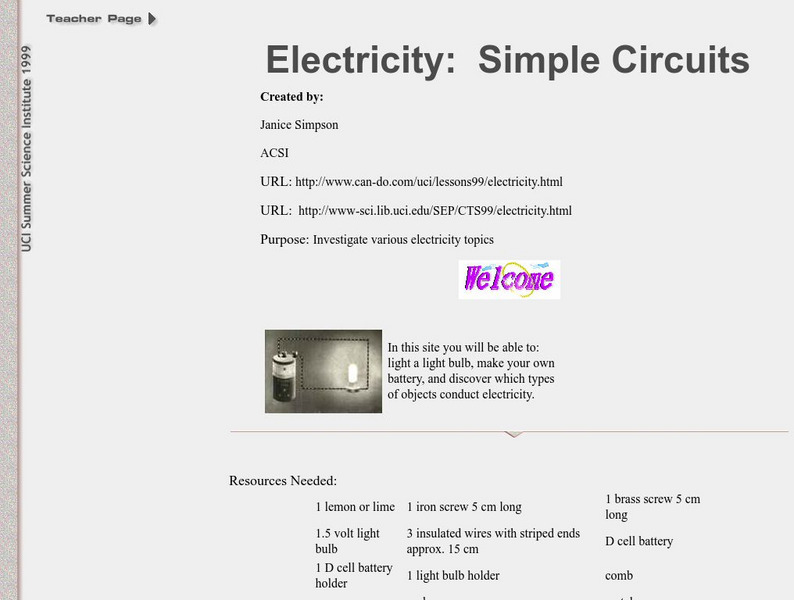
Electricity: Simple Circuits
Create your own simple electric circuit. Using simple supplies build your own battery and investigate conductivity. You can also construct a crossword puzzle with electrical vocabulary words.
Concord Consortium
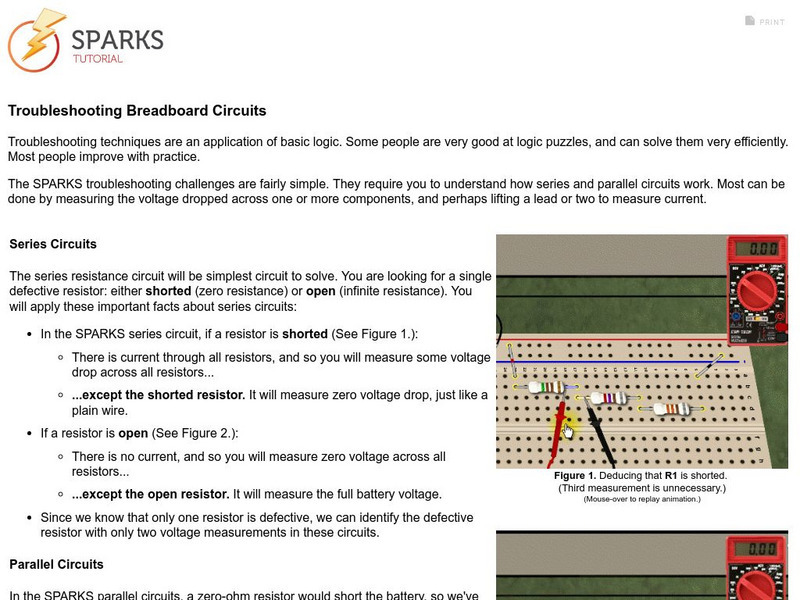
Concord Consortium: Troubleshooting Breadboard Circuits
Try these SPARKS troubleshooting breadboard circuit challenges.
TeachEngineering
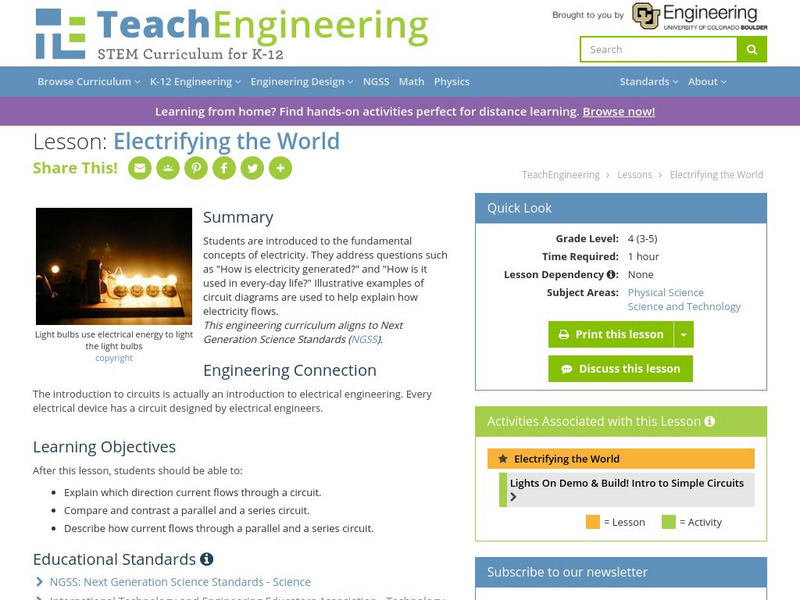
Teach Engineering: Electrifying the World
This lesson introduces students to the fundamental concepts of electricity. This is accomplished by addressing questions such as "How is electricity generated," and "How is it used in every-day life?" The lesson also includes...
Science4Fun
Science4 Fun: Resistors, Capacitors, and Inductors
Electric circuits are used to provide a path to electric current. They commonly use three basic electrical components, which are resistors, capacitors, and insulators. They affect the electric current and changes the behavior of the...
Physics Aviary
Physics Aviary: Series Circuit Lab
This lab is designed to have students investigate the relationships between voltage, resistance and current in a series circuit with up to three passive components. The batteries in this simulation can be varied from ideal batteries to...
Concord Consortium
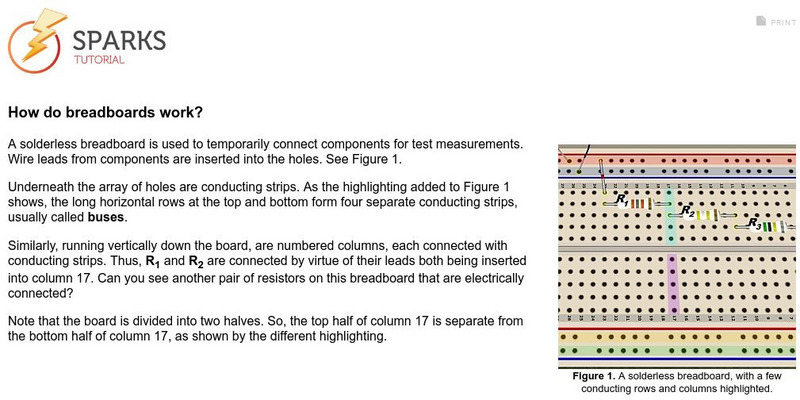
Concord Consortium: How Do Breadboards Work?
See how a breadboard electrical circuit works.

Science Buddies
Science Buddies: Which Materials Are the Best Conductors?
There are two main types of materials when it comes to electricity, conductors, and insulators. What are they made of? Find out by testing different materials in a circuit to see which ones conduct the most electricity.
Science Buddies
Science Buddies: Project Ideas: Which Materials Are the Best Conductors?
A simple science fair project to test whether electricity can flow between two things. The Science Buddies project ideas are set up consistently beginning with an abstract, objective, and introduction, followed by a section on terms,...
TeachEngineering
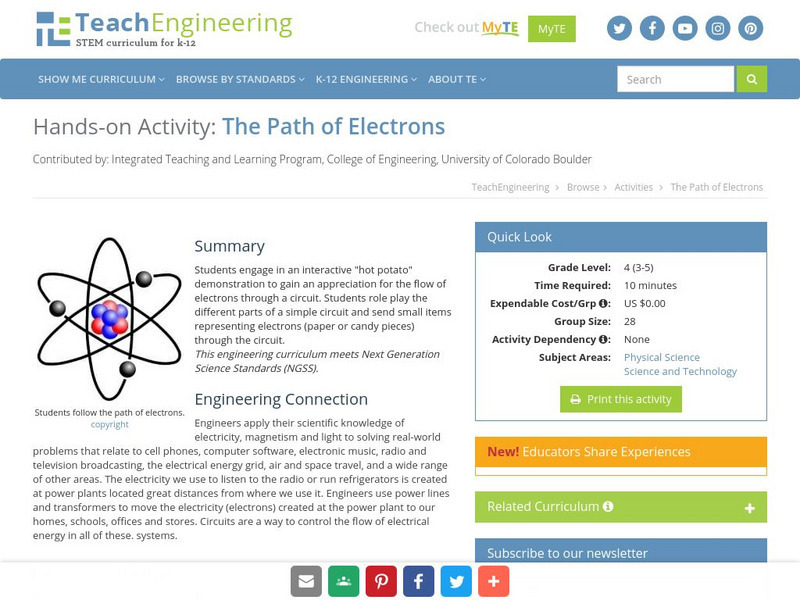
Teach Engineering: The Path of Electrons
Students engage in an interactive "hot potato" demonstration to gain an appreciation for the flow of electrons through a circuit. Students role play the different parts of a simple circuit and send small items representing electrons...
Concord Consortium
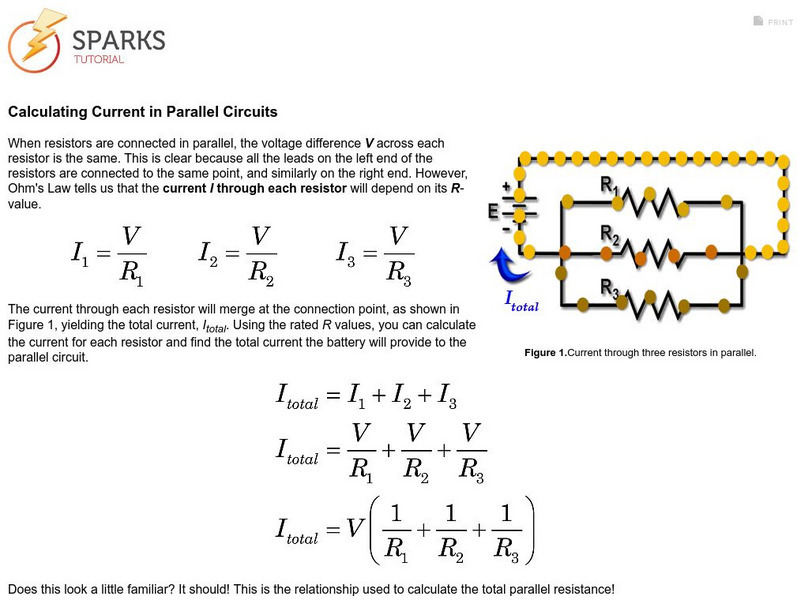
Concord Consortium: Calculating Current in Parallel Circuits
Use Ohm's Law to calculate the current in parallel circuits.
TeachEngineering
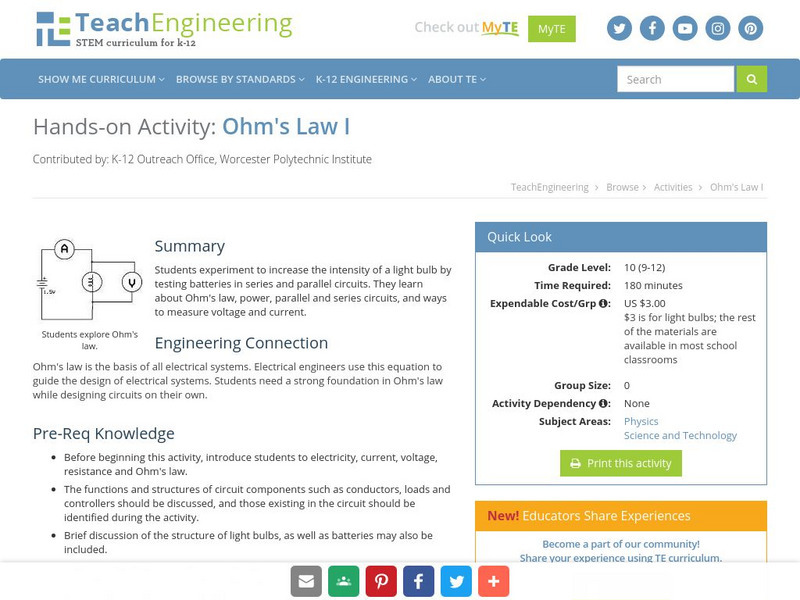
Teach Engineering: Ohm's Law I
Students will work to increase the intensity of a light bulb by testing batteries in series and parallel circuits. It analyzes Ohm's Law, power, parallel and series circuits, and ways to measure voltage and current.

Khan Academy
Khan Academy: Application of the Fundamental Laws
We solve a circuit by direct application of the fundamental laws: Apply element laws (Ohm's Law and the like) plus Kirchhoff's Laws to solve for the currents and voltages of a circuit.
Science and Mathematics Initiative for Learning Enhancement (SMILE)
Smile: Electrochemistry
A teacher lesson plan which could be easily converted into an idea for a student project or presentation. This page describes activities in which the interconversion of chemical and electrical energy are investigated. Complete activity...
Science Struck
Science Struck: Lcr Meter Working Principle and Uses
Explains what an LCR meter is and how it is used to measure the inductance, capacitance, and resistance of a circuit. Lists the different parameters of a circuit that it measures, describes two types of LCR meters, and gives definitions...
Concord Consortium
Mobile Inquiry Technology: Moving Magnets
This investigation has students examining how electric and magnetic charges are related. They will look at how an electric current is affected by the proximity of a magnet.
Science and Mathematics Initiative for Learning Enhancement (SMILE)
Smile: Electromagnets
This lesson plan contains several activities designed to help the student understand the magnetic effects of an electrical current.
TeachEngineering
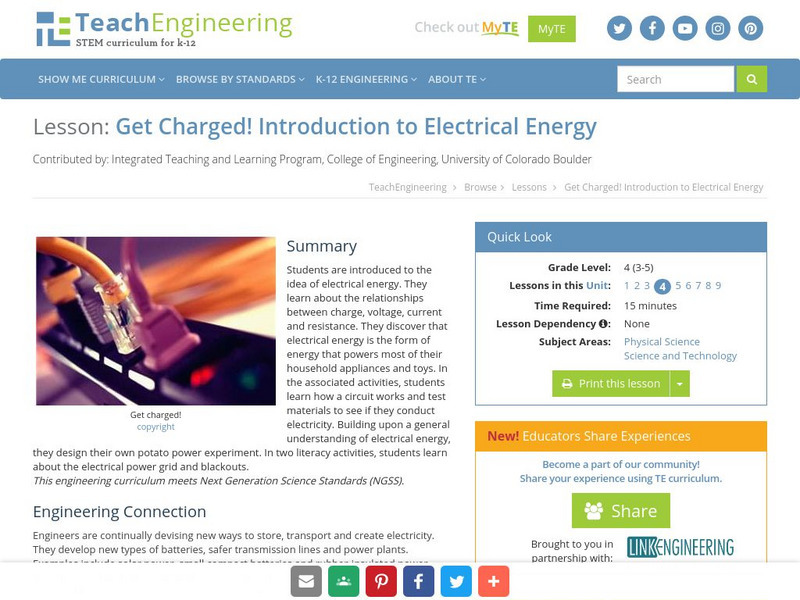
Teach Engineering: Get Charged!
Students are introduced to the idea of electrical energy. They learn about the relationships between charge, voltage, current and resistance. They discover that electrical energy is the form of energy that powers most of their household...
TeachEngineering
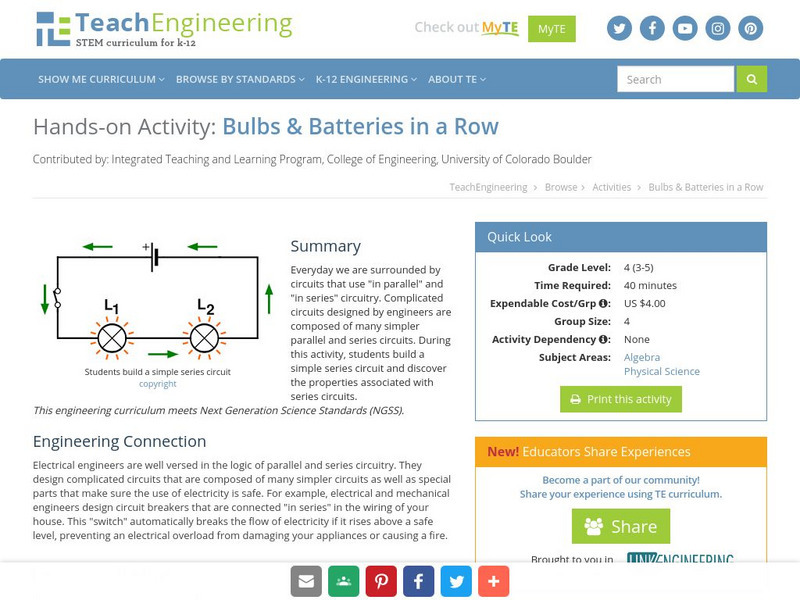
Teach Engineering: Bulbs & Batteries in a Row
Everyday we are surrounded by circuits that use "in parallel" and "in series" circuitry. Complicated circuits designed by engineers are composed of many simpler parallel and series circuits. During this activity, students build a simple...
Better Lesson
Better Lesson: The Lightbulb Just Went On!
Fourth graders discover how electricity can be converted to light energy.
University of Waterloo (Canada)
Computer Assisted Chem. Tutorial/chemistry of Batteries
A superb explanation of how a battery works. Discusses the associated chemistry which explains how a battery produces a voltage. Includes a series of "Confidence Building Questions."
Science4Fun
Science4 Fun: Conductors and Insulators
Discover what materials make good conductors and insulators.