Hi, what do you want to do?






Curated OER
Getting Started With Java-Background
Learners study the history of computers including hardware and software, binary representation of data and examine the beginnings of programming languages. They investigate the development of software and the fundamentals of...

Curated OER
Eight Things You Should Know About Online College Courses
Massive open online courses are changing the face of higher education, offering both opportunities and obstacles.

Curated OER
Introduction to Computing and Project Development
Students use a computer and math to complete a science project. They review a brief history of computers as well as information on different operating formats will be included. In addition, students complete an overview of the hardware...

Curated OER
CEENBot Soccer
Young scholars research the history and uses of the different elements in the periodic table. In this chemistry lesson, students explain the significance of an element's valence electrons. They create a multimedia presentation of an...

TED Talks
Ted: Ted Ed: A Brief History of Video Games (Part I)
Video games are everywhere these days, but where did they actually come from? The history of video games is a complicated story that involves giant computers in science labs, the founder of Chuck E. Cheese and billions of dollars in...
Other
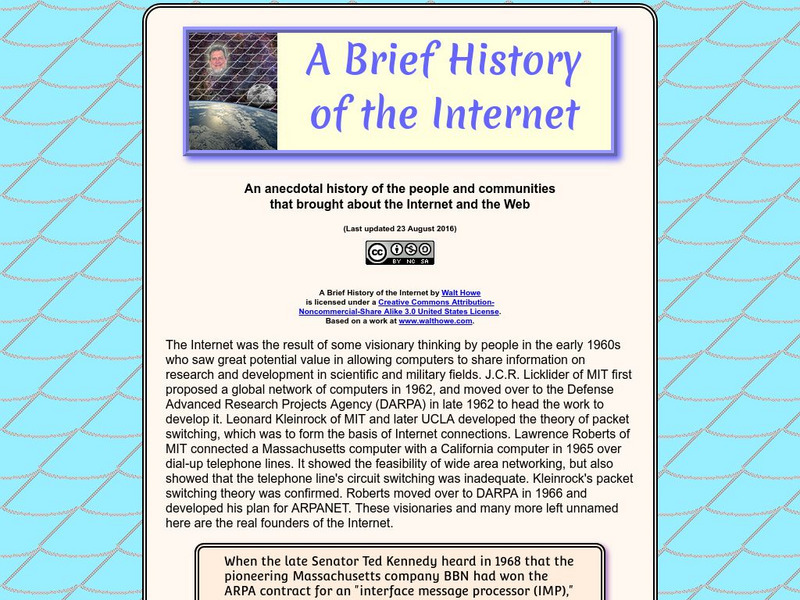
Internet Learning Tree: A Brief History of the Internet
An anecdotal history of the people and communities that brought about the internet.

Science Museum, London
Science Museum: Ada Lovelace
Some say that Ada Lovelace was the first programmer because she wrote instructions for a computing device designed by Charles Babbage. This site presents a brief history of Ada's life and the important role she played in the history of...

University of Houston
University of Houston: Engines of Our Ingenuity
The Engines of Our Ingenuity is a radio program that tells the story of how our culture is formed by human creativity. The program uses the record of history to reveal the way art, technology, and ideas have shaped us. Episode topics...

History of Computing Science
History of Computing Science: Harvard Mark I
The Harvard Mark I computer was the first large-scale automatic digital computer in the USA. This lecture provides a brief description of the Harvard Mark I computer.
History of Computing Science
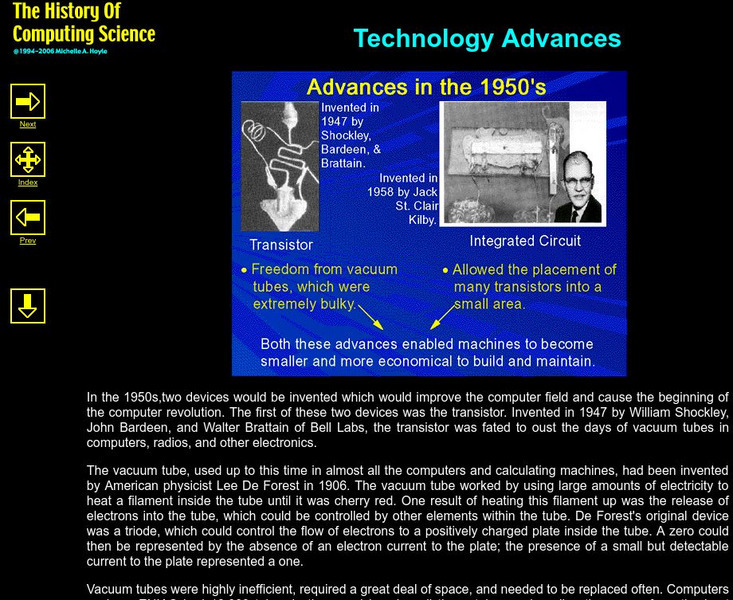
History of Computing Science: Technology Advances
The transistor and the integrated circuit were two inventions that fueled the technology explosion. This lecture presents a brief discussion of these two inventions.
History of Computing Science
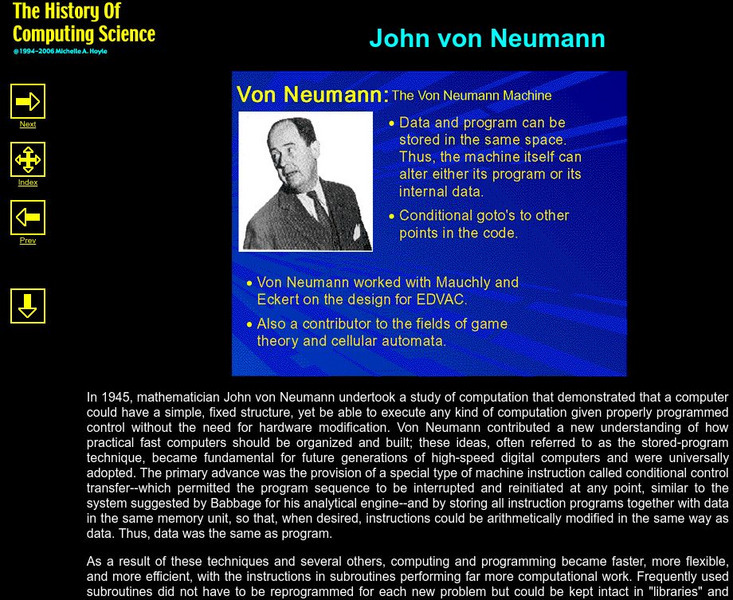
History of Computing Science: John Von Neumann
John von Neumann was a brilliant mathematician. His work impacted several fields of study. This lecture series provides a brief description of his life and contribution to computer science.
History of Computing Science
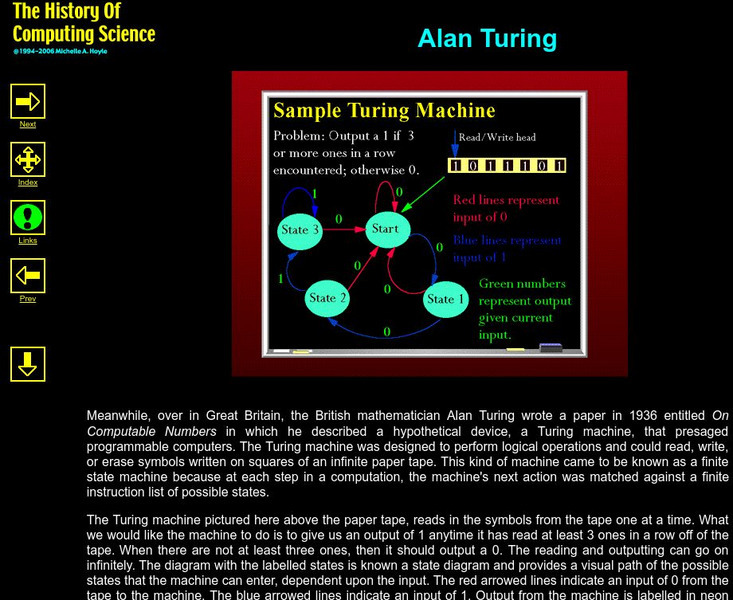
History of Computing Science: Alan Turing
Alan Turing is sometimes referred to as the father of modern computer science. This lecture series provides a brief description of his well-known contribution, the Turing Machine.

History of Computing Science
History of Computing Science: The First Mechanical Calculator
The Pascaline was the first mechanical adding machine and was developed by Blaise Pascal. This lecture series presents a brief description of the history of the machine and how it worked.

History of Computing Science
History of Computing Science: The Difference Engine
The difference engine was never built, but its design was an important step in the history of computing devices. This lecture series presents a brief description of this early mechanical computing device.
History of Computing Science
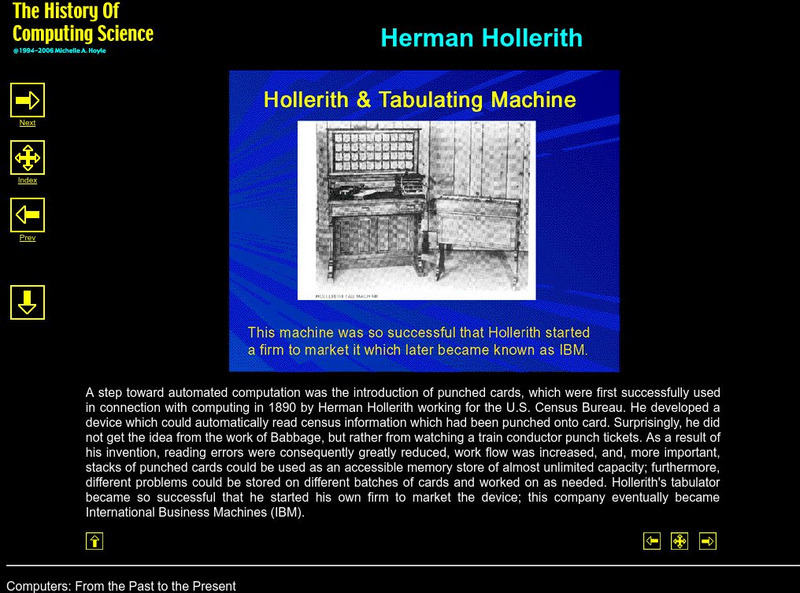
History of Computing Science: Herman Hollerith
Herman Hollerith holds a prominent place on the timeline of computer history. This lecture series presents a brief description of Hollerith's tabulating machine and the impact it eventually had on the computing world.
History of Computing Science
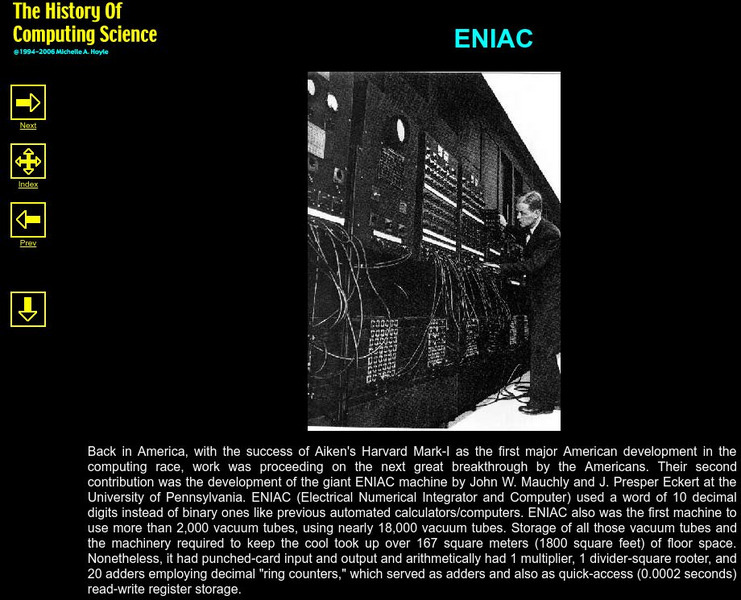
History of Computing Science: Eniac
The ENIAC (Electrical Numerical Integrator and Computer)was a large computer based on vacuum tubes and introduced in 1946. This lecture gives a brief presentation of the ENIAC.
History of Computing Science
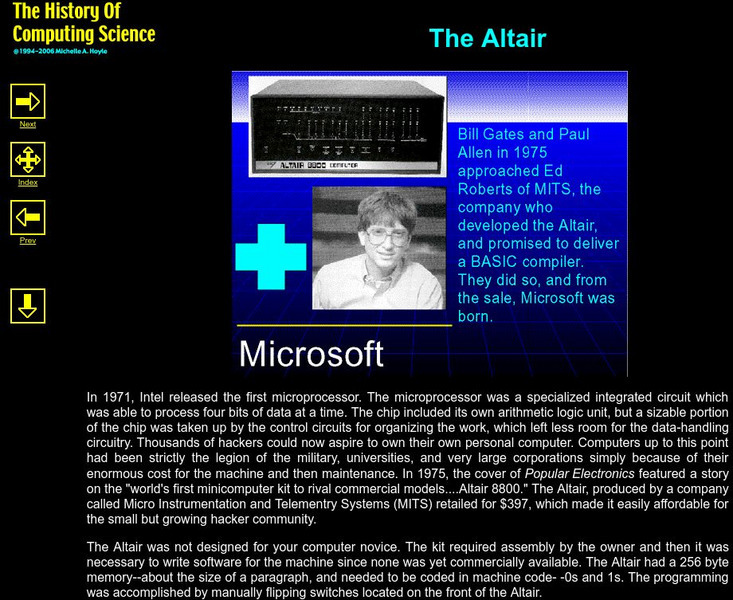
History of Computing Science: The Altair
The Altair 8800 was the first personal computer. This lecture series gives a brief description of the Altair 8800 and the impact it had on the computer industry.

History of Computing Science
History of Computing Science: Edvac
EDVAC (Electronic Discrete Variable Automatic Computer) was an early computer that was one of the first to use the binary number system to represent information. This lecture is a brief presentation of the EDVAC.

History of Computing Science
History of Computing Science: Basic & Other Languages
There are many computer programming languages in use today. This lecture series presents a brief description of the progression of programming languages.

History of Computing Science
History of Computing Science: A Primitive Calculator
The abacus is an ancient calculating tool. This lecture series presents a brief description of the abacus and its use.
History of Computing Science
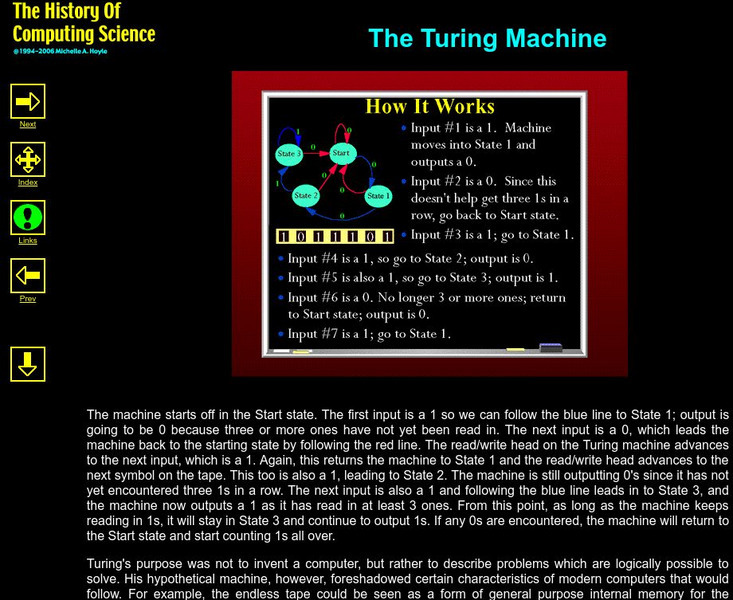
History of Computing Science: The Turing Machine
A Turing Machine is not an actual machine, but rather a symbolic system that can be used to represent any algorithm used to solve a problem. This lecture series gives a very brief description of the Turing Machine.
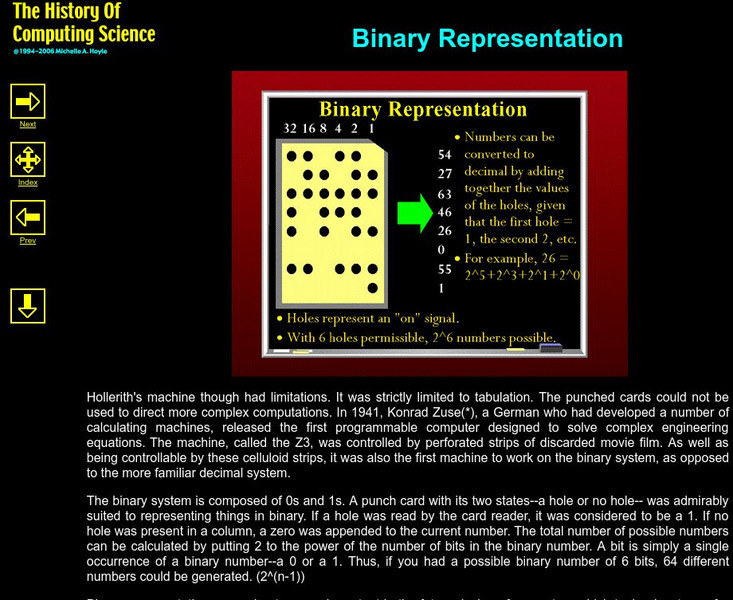
History of Computing Science
History of Computing Science: Binary Representation
The binary number system is a perfect fit for the dual-state technologies used in digital computing devices. This lecture series presents a brief description of how the two fit together.