Hi, what do you want to do?






Curated OER
Cosmic Mobiles: Recycled Art
If you have a little left over tinsel and aluminum foil, your class can create these fun moon and star mobiles. Poster board or recycled cardboard become your moon and stars; the tinsel gives them sparkle. This would be a great...

Dick Blick Art Materials
Matisse Prints du Soleil
The sun provides the link between this art and science activity. Kids use sunlight (or light from an artificial source) to produce heliographic prints on fabric or paper.

Curated OER
Dragonfly Sculptures
Art projects are great when they apply to other subjects. First study insects, their parts, and their habitats. Then have little ones create a dragonfly. They use clothes pins, raffia, pipe-cleaners, and paint to construct their...

Curated OER
Watercolor Rainbows
Who doesn't love a rainbow? Little ones adore them, so why not make rainbows the subject of your next art project. Your class can use watercolor to paint rainbows. As they do, have them identify the colors in the rainbow, talk about how...

Curated OER
SCIENTIFIC ART
Students cut out pictures from magazines and create collages that demonstrate the five senses.

Curated OER
Easy Tie Die
Perfect for summer camp, an after school program, or your classroom, these instructions will make tie-dying a breeze! Simple instructions and helpful images make tie dying a fun and easy project. Tip: Have learners predict the outcome of...

Curated OER
Paper Plate Sunflowers
A great way to recall the parts of a flower is to make one. Little learners create sunflowers out of paint and paper plates. They also discuss and label the various parts of their flowers.

Curated OER
Clothesline Sleuth
What fabrics are our clothes made of? Where do those fabrics from? Lead your pupils to discover the answers to these questions and more. Class members have a chance to play with various fabrics, invesitgating the materials and...

Global Oneness Project
Rethinking the Fabrics We Wear
What are fibersheds and what what do they have to do with environmental protections? A photo essay and audio recordings about Mimi Luebbermann, and her sheep, cause consumers to reflect on how their clothing choices can support local...

Curated OER
Wild Moving Lizard Sculpture
Lizards are amazing! After a lesson on reptiles, take a look at this set of instructions. You'll be able to guide your class in making a paper lizard sculpture that moves. This idea also includes variations on the paper technique used...

Curated OER
Teensy Weensy Scary Spiders
Students create "teensy weensy scary spiders" using foam balls, tissue paper, yarn, pipecleaner, scissors and glue in this Halloween art lesson for the early elementary classroom. It is suggested to begin the activity as a science...

Curated OER
Applied Science - Science and Math Lab
Learners examine fabric. For this Applied Science lesson, students look at the fibers of fabric through a microscope. Learners compare and contrast a variety of fibers.

Curated OER
Earth Day - Grow A Seed Garden
Students discover how things grow and how they can take better care of the environment in this Earth Day lesson for the elementary classroom. The activity can be accomplished in one day and left in the sun until the "beans" begin growing.

Curated OER
From Curiosity Cabinet to Museum Collection
Students study binomial nomenclature and museum-based research. They create a curiosity box, label the objects in their curiosity box , develop a classification scheme for the objects, and create a database of all objects collected by...
![Is Your Blue Really Blue? [Metamerism] Lesson Plan](http://lessonplanet.com/content/resources/thumbnails/299613/large/otq2otizlmpwzw.jpg?1315624134 "Is Your Blue Really Blue? [Metamerism] Lesson Plan")
Curated OER
Is Your Blue Really Blue? [Metamerism]
Students examine color perception and how it relates to metamerism. In this color lesson students complete a lab activity that shows them the three basic components of color perception.

Curated OER
Pizza Garden
Young scholars get involved in growing veggies so they may start eating them more!
![Is Your Blue Really Blue? [Metamerism] Lesson Plan](http://lessonplanet.com/content/resources/thumbnails/94747/large/bwluav9tywdpy2symde4mtixny0zmdywos1smnd6dxauanbn.jpg?1545052463 "Is Your Blue Really Blue? [Metamerism] Lesson Plan")
Curated OER
Is Your Blue Really Blue? [Metamerism]
Pupils learn fundamentals about color perception, and explain the phenomenon called "metamerism". Students learn the three basic components of color perception: light source, illuminated colored object, and the light detector.
University of Manchester
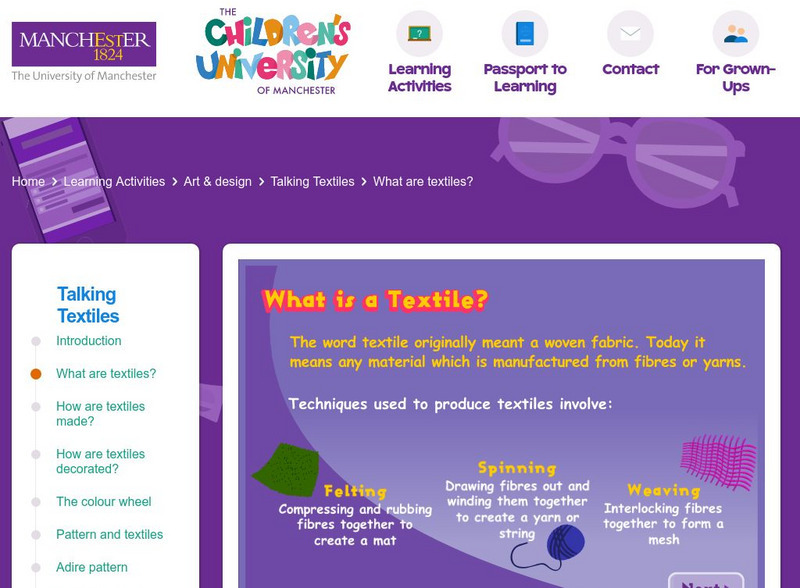
Children's University of Manchester: Talking Textiles: What Are Textiles?
Interactive exploration of different objects made with textiles, a useful investigation of the properties of different types of fabrics.
University of Manchester
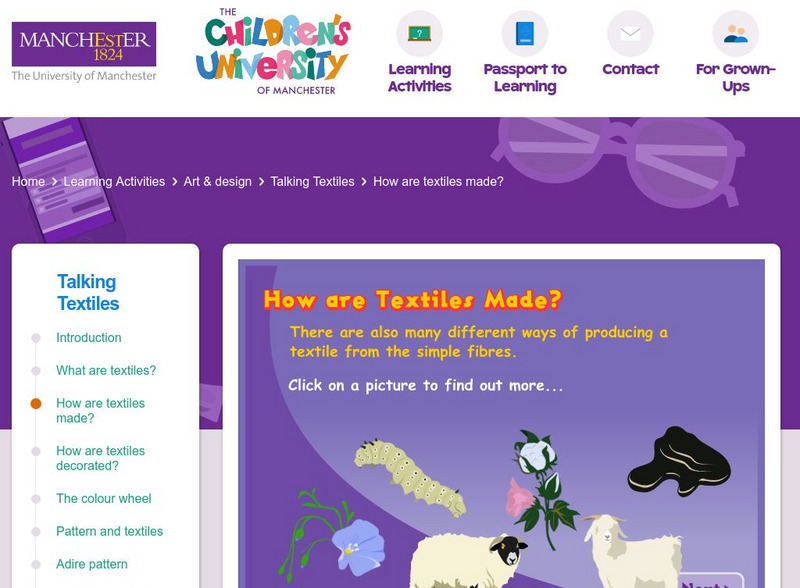
Children's University of Manchester: Talking Textiles: How Are Textiles Made?
Interactive exploration of textiles and cloth derived from plants, animals, and petrochemicals.