Hi, what do you want to do?





Next Vista for Learning
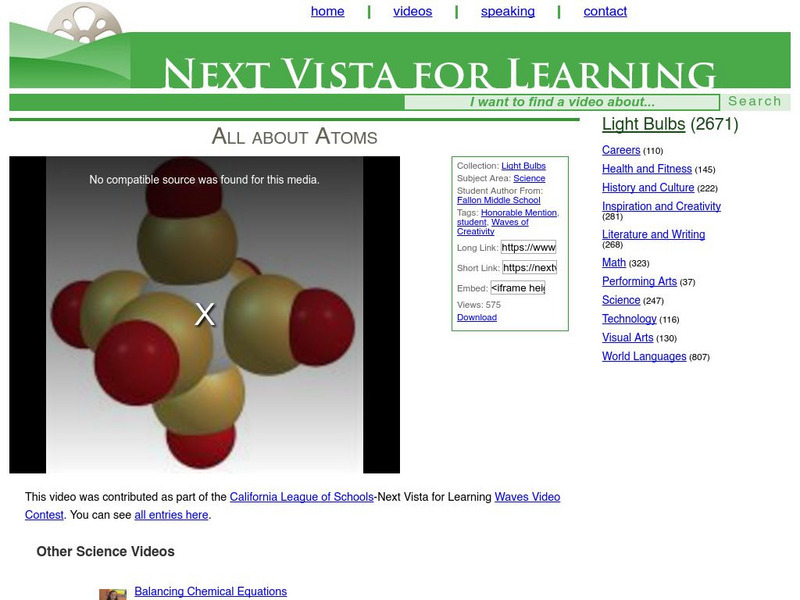
Next Vista for Learning: All About Atoms
This video explores atoms! Learn how all matter is composed of atoms. Also learn about the sub particles that make up atoms. Also get a lesson on how to read the periodic table which contains information about different types of atoms....

Next Vista for Learning
Next Vista for Learning: Bohr Model of the Atom
This video takes you inside the atom to learn about the subatomic particles present and their location. Also learn about what the atomic number and mass number tell you about the number of protons, neutrons, and electrons. [1:35]
Next Vista for Learning
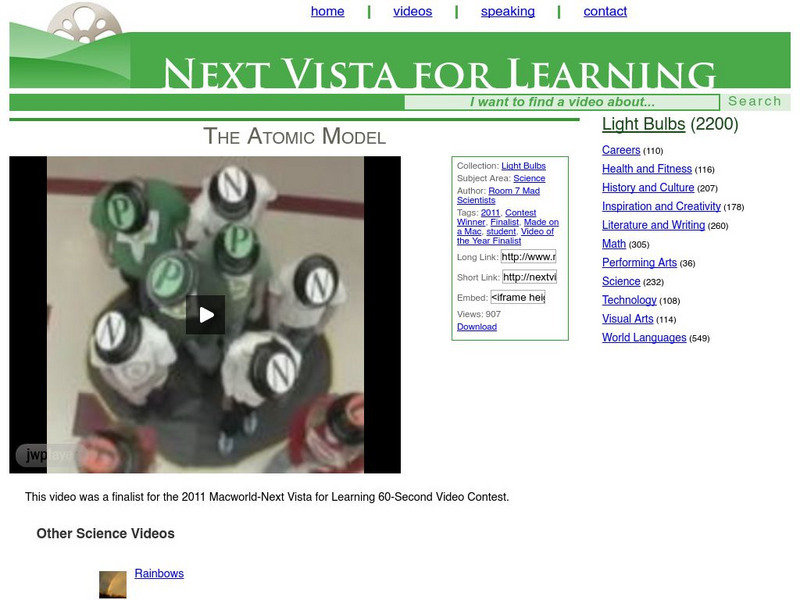
Next Vista for Learning: The Atomic Model
Learn the three sub-particles that make up an atom in this video. Video gives a visualization to what an atom, the basic building of matter, looks like. [1:15]
Sophia Learning
Sophia: Development of the Early Atomic Theory: Lesson 4
This lesson will briefly summarize the early history of the atomic theory including Democritus, John Dalton, JJ Thomson, and Ernest Rutherford.. It is 4 of 4 in the series titled "Development of the Early Atomic Theory."

Sophia Learning
Sophia: John Dalton: Lesson 3
This lesson reviews Dalton's Atomic Theory and explains each of the points.. It is 3 of 3 in the series titled "John Dalton."
Sophia Learning
Sophia: Mixed Conversion Problems: Lesson 1
This lesson explains how to approach practice problems when trying to determine what final quantity is being asked for. It is 1 of 2 in the series titled "Mixed Conversion Problems."

Sophia Learning
Sophia: Molecules: Lesson 3
This lesson will provide an understanding of the basic chemistry of molecules. It is 3 of 4 in the series titled "Molecules."
Sophia Learning
Sophia: Subatomic Particles: The Electron: Lesson 1
This lesson will explain that electrons are negatively charged particles with negligible mass and are found in pairs in orbitals surrounding the nucleus of an atom. It is 1 of 3 in the series titled "Subatomic Particles: The Electron."

Sophia Learning
Sophia: Subatomic Particles: The Neutron: Lesson 1
This lesson will explain that neutrons are particles in the nucleus that have no charge and a mass of one amu. It is 1 of 3 in the series titled "Subatomic Particles: The Neutron."

Sophia Learning
Sophia: Subatomic Particles: The Proton: Lesson 3
This lesson will explain that protons are positively charged particles having a mass of one amu and are found in the nucleus of the atom. It is 3 of 3 in the series titled "Subatomic Particles: The Proton."

Sophia Learning
Sophia: Subatomic Particles: The Proton: Lesson 1
This lesson will explain that protons are positively charged particles having a mass of one amu and are found in the nucleus of the atom. It is 1 of 3 in the series titled "Subatomic Particles: The Proton."

Sophia Learning
Sophia: The Atom: Lesson 1
This lesson will illustrate that an atom is mostly empty space and has a positively charged, massive core (containing both protons and neutrons called the nucleus) surrounded by negatively charged electrons. It is 1 of 3 in the series...
Sophia Learning
Sophia: Chemical Equation: Definition: Lesson 1
This lesson will define a balanced chemical equation. It is 1 of 2 in the series titled "Chemical Equation: Definition."

Sophia Learning
Sophia: Atomic Radius: Lesson 1
This lesson will define atomic radius. It is 1 of 3 in the series titled "Atomic Radius."
Sophia Learning
Sophia: Chemical Equation: Vocabulary: Lesson 2
This lesson will explain the general format of a chemical equation including products, reactants, arrow notation, and states of matter. It is 2 of 2 in the series titled "Chemical Equation: Vocabulary."
Bozeman Science
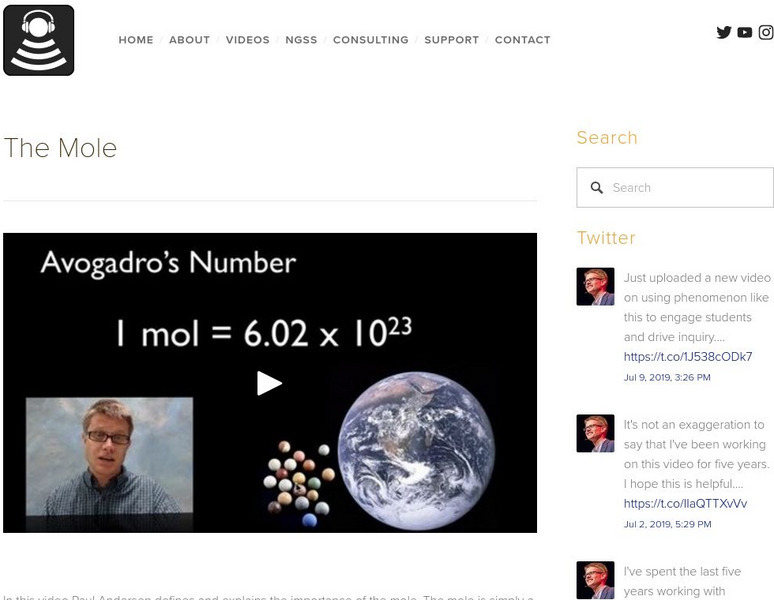
Bozeman Science: Ap Chemistry: The Mole
In this video, Paul Andersen defines and explains the importance of the mole. The mole is simply a number (like a dozen) used to express the massive number of atoms in matter. It serves as a bridge between the mass of a compound and the...
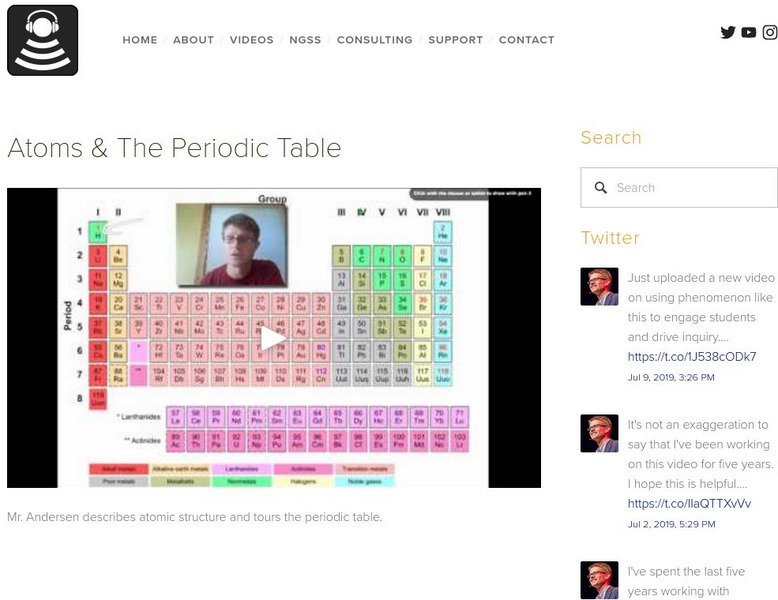
Bozeman Science
Bozeman Science: Atoms & the Periodic Table
Mr. Andersen describes atomic structure and tours the periodic table. [9:15]