Hi, what do you want to do?






Crash Course
Genetic Traits: Nature? Nurture? Not That Simple: Crash Course Biology #32
It’s not nature versus nurture—it’s both! In this episode of Crash Course Biology, we’ll explore how complex interactions between genes and the environment shape all sorts of traits, from human skin color to honeybees’ “royal jelly.”
Crash Course
Intro to Genetics: Why Your Cat Looks Like That: Crash Course Biology #31
How do traits get passed down in our DNA? And what do genes have to do with cat fur? In this episode of Crash Course Biology, we’ll untangle the simplest patterns of inheritance, and reassure our redheaded friends—you’re not going anywhere.
Crash Course
Meiosis: Why Are All Humans Unique?: Crash Course Biology #30
Ever wonder why we aren’t exact clones of our parents, or why siblings aren’t exactly alike? The reason traces back to meiosis. In this episode of Crash Course Biology, we’ll discover how egg and sperm cells get made and learn why you’re...
Crash Course
Cellular Respiration: Do Cells Breathe?: Crash Course Biology #27
You know ‘em, you love ‘em. They’re the powerhouse of the cell: mitochondria. They produce the ATP molecules that we use to do everything from talk to our friends to run a marathon. In this episode of Crash Course Biology, we’re taking a...
Crash Course
Chemical Reactions in Biology: Crash Course Biology #26
Cells need energy to power the chemical reactions that keep their microscopic cities running, and most of that energy comes from a chemical called ATP. In this episode of Crash Course Biology, we’ll learn how our cells use energy, what...
Crash Course
Why Do Cells Need to Communicate?: Crash Course Biology #25
Even though it might seem like our bodies are on autopilot, there is a whole lot happening inside us to keep things moving. In this episode of Crash Course Biology, we’ll learn that our cells are in constant communication, reminding each...
Crash Course
Cell Membranes: How Does Stuff Get Into Your Cells?: Crash Course Biology #24
The cell membrane is a protein-studded phospholipid bilayer that not only protects our cells, but also regulates what goes in and out. In this episode of Crash Course Biology, we’ll look at the structure of the bilayer, learn about its...
Crash Course
A Tour of the Cell: Crash Course Biology #23
The cell is the basic unit of life, and our understanding of it has advanced as science, and the tools available to scientists, has advanced. In this episode of Crash Course Biology, we’ll take a look at the difference between...
Crash Course
Human Evolution: We Didn't Evolve From Chimps: Crash Course Biology #19
What’s a human? And how did we become humans, anyway? In this episode of Crash Course Biology, we’ll meet some of our closest relatives and trace how we evolved into the brainy, inventive, complex species we are today.
Crash Course
Biological Diversity, Butts, and the Tree of Life: Crash Course Biology #18
Everywhere you look on Earth, you’ll find wonderful and diverse living things, from tiny tardigrades to soaring sequoias. And incredibly, everything alive today, and everything that’s ever lived, is related. In this episode of Crash...
Crash Course
Microscopes: How We See What We Can't See: Crash Course Biology #22
There’s an immense world of tiny stuff within us and around us—but how do we know about it? In this episode of Crash Course Biology, we’ll discover how we see what we can’t see, thanks to the help of centuries-old tools and more recent...
Crash Course
The Unexpected Truth About Water: Crash Course Biology #21
This is a love letter to water, life’s solvent, and one of the most wonderful molecules around. In this episode of Crash Course Biology, we’ll learn about how water’s polarity and hydrogen bonding help it sustain life on a larger scale....
Crash Course
Carbon & Biological Molecules: What is Life Made Of?: Crash Course Biology #20
Despite the diverse appearance and characteristics of organisms on Earth, the chemicals that make up living things are remarkably similar, often identical. In this episode of Crash Course Biology, we’ll look at the building blocks of the...
Crash Course
Phylogeny: How We're All Related: Crash Course Biology #17
Crocodiles, and birds, and dinosaurs—oh my! While classifying organisms is nothing new, phylogeny— or, grouping organisms by their evolutionary relationships—is helping us see life in a whole new light. In this episode of Crash Course...
Crash Course
Evolutionary History: The Timeline of Life: Crash Course Biology #16
Humans may have been around for a long time, but life has existed for way longer. In this episode of Crash Course Biology, we’ll journey through deep time to uncover the history of life on Earth. We’ll explore the big, game-changing...
Crash Course
Natural Selection: Life's Way of Stayin' Alive: Crash Course Biology #13
There are lots of ways that evolution happens, and natural selection is just one of them. In this episode of Crash Course Biology, we’ll find out how this process works and shapes traits in all living things —from ginkgo trees to howler...
Crash Course
Microevolution: What's An Allele Got to Do With It?: Crash Course Biology #12
Whether we’re talking about tigers, trees, or tarantulas, evolution happens at the level of the population. In this episode of Crash Course Biology, we’ll find out how natural selection, gene flow, genetic drift, and other processes...
Crash Course
Population Ecology: How We Saved the Bald Eagle: Crash Course Biology #7
When the Bald Eagle population started to decline in the mid-20th century, scientists began to ask why. Population ecology, the study of organisms of the same species, played a big role in answering that question. In this episode of...
Crash Course
Intro to Ecology: Why Did All These Elephants Die?: Crash Course Biology #5
Ecology is the study of the interactions of living things with each other and their environment. It’s a field that not only lets us explore the interconnections between living things, but also how our environment affects us, and how we...
Crash Course
How Life is Organized: Crash Course Biology #4
Here on Earth, life is dizzyingly diverse—but it’s also surprisingly organized. A sense of order structures life and its processes, from the tiniest cell to the total sum of every living thing. In this episode of Crash Course Biology,...
Bozeman Science
AP Biology - The Final Review
The final AP Biology Review.
Cha
pters
View all
> AP
Biology
0:07
Section
: Multiple Choice<
br/>
1:00
Hardy-W
einberg<
br/> 3:23
Chi-sq
uared Test
5:29
...
Cha
pters
View all
> AP
Biology
0:07
Section
: Multiple Choice<
br/>
1:00
Hardy-W
einberg<
br/> 3:23
Chi-sq
uared Test
5:29
...
Bozeman Science
AP Bio - Final Review
Paul Andersen answers over 500 questions from 39 states and 20 countries. Good luck on the AP Biology exam.
Cha
pters
View all
> AP
Biology
0:05<
br/>
Table of Contents
:56
...
Cha
pters
View all
> AP
Biology
0:05<
br/>
Table of Contents
:56
...
Bozeman Science
The New AP Biology Exam - A User's Guide
In this video Paul Andersen describes the new AP Biology Exam. This exam will be given for the first time in May of 2013 and will be different from all previous exams. In this video Paul Andersen describes the scoring and the two parts...
Bozeman Science
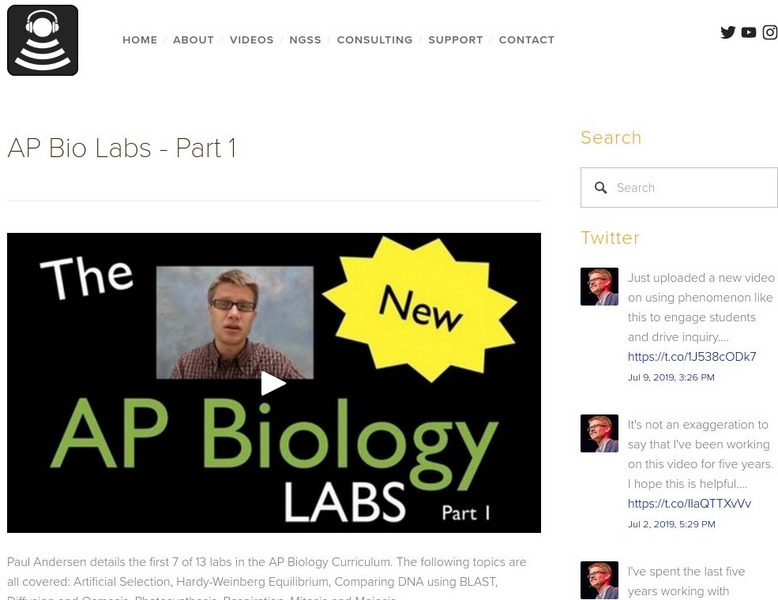
Bozeman Science: Ap Biology Labs Part 1
Paul Andersen details the first 7 of 13 labs in the AP Biology Curriculum. The following topics are all covered: Artificial Selection, Hardy-Weinberg Equilibrium, Comparing DNA using BLAST, Diffusion and Osmosis, Photosynthesis,...