Hi, what do you want to do?






Khan Academy
Organic Chemistry Naming Examples 2, Organic Chemistry
Sal continues to work through examples of more complicated carbon chains in this second video of five.

Khan Academy
More Organic Chemistry Naming Examples 1
Practice makes the concepts of naming much easier. Here, Sal runs through 5 even more complicated examples, while encouraging viewers to do the same. The main development explained here is the addition of multiple types of side chains to...

Khan Academy
Organic Chemistry Naming Examples 4
This is the fourth video in a series of five where Sal works through examples of more complicated carbon chains.

Khan Academy
Organic Chemistry Naming Examples 4, Organic Chemistry
Sal continues to work through examples of more complicated carbon chains. He presents a complicated name and attempts to work through it logically, drawing the structure. His humor makes these strategies fun and easy to watch.

Khan Academy
Organic Chemistry Naming Examples 3, Organic Chemistry
In the third of five videos, Sal continues to work through examples of more complicated carbon chains.

Khan Academy
Naming Alkenes Examples, Alkenes and Alkynes, Organic Chemistry
Sal "expands his repertoire" and starts to demonstrate the naming of long, complicated alkene chains.
Khan Academy
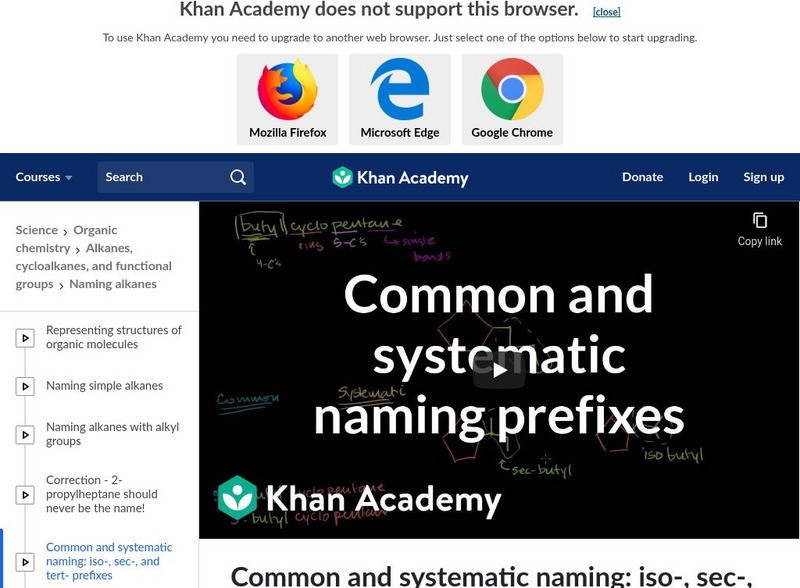
Khan Academy: Common and Systematic Naming Prefixes
There is a logical system in which to name carbon chains as described here. The naming system becomes more logical when there are more than five compounds in the chain. Understand the prefixes: iso-, sec- and tert-. [13:29]

Khan Academy
Khan Academy: Naming Alkanes: Common and Systematic Naming
Explains how to draw the structure for Butylcyclopentane in its various forms, and name them using common and systematic nomenclature with iso-, sec- and tert- prefixes. [13:33]