Hi, what do you want to do?






PBS
Why We Only Have Ten Toes (It's a Long Story)
Today, all mammals from humans to bats have five fingers or fewer. Yes, even whales, whose finger bones are hidden in their fins. Birds have four or fewer and amphibians get the best of both worlds, often having four digits on their...
PBS
Our Ancient Relative That Said 'No Thanks' To Land
Around the time that some of our fishapod relatives were crawling out of the water, others were turning around and diving right back in.
PBS
How the Egg Came First
The story of the egg spans millions of years, from the first vertebrates that dared to venture onto land to today’s mammals, including the platypus, and of course birds. Like chickens? We’re here to tell you: The egg came first.
SciShow
Why You Have to Blink to Walk
When we picture the first tetrapods, or land vertebrates, crawling out of the ocean, we probably imagine they need legs. But evolution also had to bestow another important adaptation before they could leave the water: blinking!
SciShow
A Very Handy Fish Fossil
This week, scientists discover something in a fish fossil that might give us a hand in finding our earliest land-dwelling ancestors.
SciShow
The 10 Oldest Fossils, and What They Say About Evolution
Wouldn’t it be cool to be able to point at a fossil and know that it’s the first, say, plant? Well... yeah! But it's not that easy! Scientists are always making new discoveries that throw all our old assumptions into...
Crash Course
Chordates - CrashCourse Biology
Hank introduces us to ourselves by taking us on a journey through the fascinatingly diverse phyla known as chordata. And the next time someone asks you who you are, you can give them the facts: you're a mammalian amniotic tetrapodal...
Next Animation Studio
Ozone depletion may have sparked prehistoric extinction event: study
Ozone depletion may have triggered a mass die-off of ancient fish and plants by ultraviolet ray exposure 358 million years ago.
CuriosaMente
¿Por qué el cuerpo humano tiene esa forma?
De todas las formas posibles, el cuerpo humano tiene una forma muy específica. ¿Por qué tenemos el cuerpo que tenemos? ¿Qué papel juega la evolución?
Es fascinante explorar cómo nuestra forma corporal, con todas sus...
Es fascinante explorar cómo nuestra forma corporal, con todas sus...
Guinness World Records
Building the World's Largest Tetrapod Exoskeleton: A Journey of Physical Mastery and Innovation
In this video, Jonathan Tippett, creator of the world's largest tetrapod exoskeleton, shares his journey of combining physical mastery and modern technology to create a new sport. He discusses the construction process, the machine's...
Sea Studios Foundation
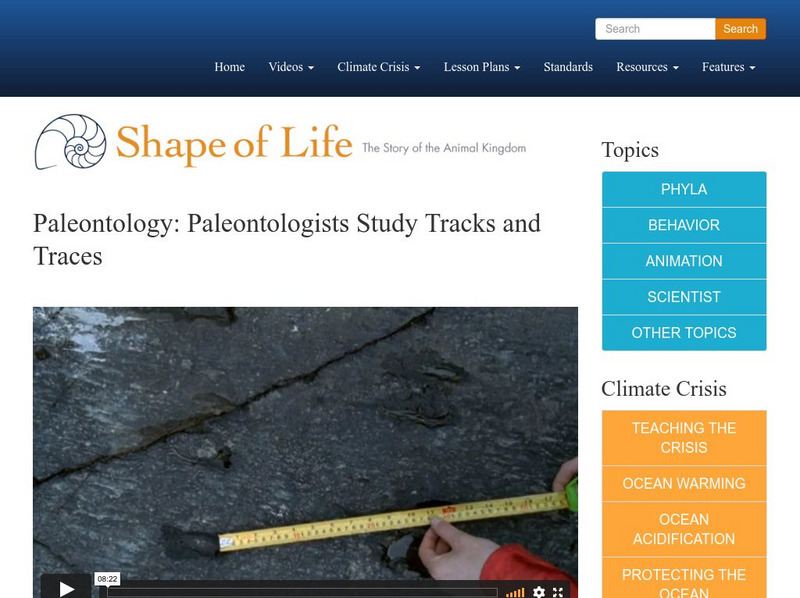
Shape of Life: Paleontology: Paleontologists Study Tracks and Traces
Jenny Clack visits a site with fossilized tracks of an early tetrapod. She and her assistant hypothesize about what the animal was doing around 370 million years ago. [8:22]