Hi, what do you want to do?






Catalyst University
Integrated Rate Laws (2/3): Second Order Calculation
Integrated Rate Laws (2/3): Second Order Calculation
Catalyst University
Determining Units for Nth-order Rate Constants
Determining Units for Nth-order Rate Constants
Catalyst University
Integrated Rate Laws (1/3): First Order Calculation
Integrated Rate Laws (1/3): First Order Calculation
FuseSchool
What Is Avogadro's Number - The Mole
Learn the basics about Avogadro's Number, as a part of chemical calculations. Avogadro’s Number or the Avogadro Constant is 6.02 X 10²³ Mol-1. It is the number of atoms per mole of the carbon-12 isotope. For atoms, the mass of Avogadro’s...
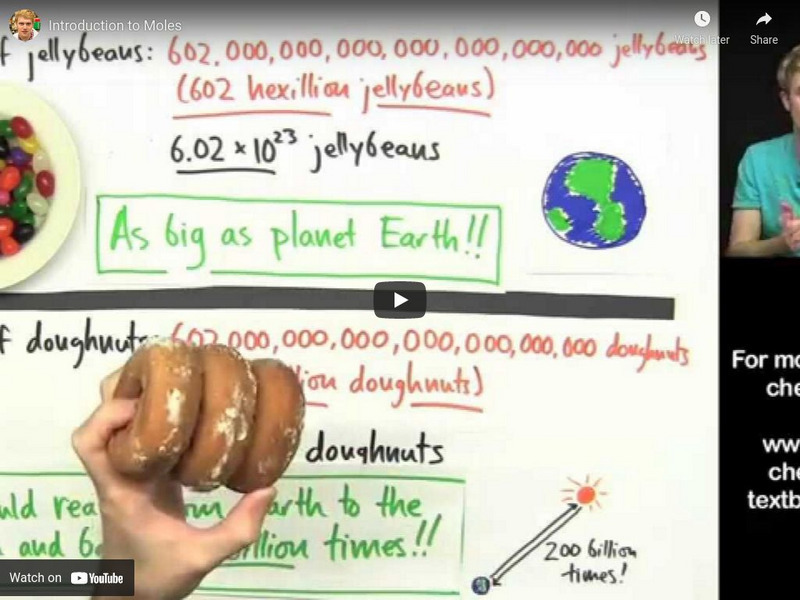
Tyler DeWitt, PhD
Science With Tyler De Witt: Introduction to Moles
A tutorial which explains what moles are and why they are important. Learn how to abbreviate the mole number (Avogadro's number) using scientific notation, and how giant this number is. [10:50]

Khan Academy
Khan Academy: Introduction to Solubility and Solubility Product Constant
Introduction to solubility, molar solubility, and solubility product constant Ksp. Example of calculating the solubility of lead(II) chloride and Ksp. [11:44]

Khan Academy
Khan Academy: Solubility and the Common Ion Effect
Calculating the molar solubility of lead(II) chloride in a 0.100 M solution of KCl using an ICE table. [8:14]