Hi, what do you want to do?






Judicial Learning Center
The Constitution and Rights
What's the right way to teach young historians about the Bill of Rights? Many an instructor has asked this question when pondering lesson plans over the US Constitution. The Constitution and Rights is a nifty resource that provides a...

University of California
Equal Rights? The Women's Movement from Suffrage to Schlafly
If you've never heard of the Equal Rights Amendment, it's probably because there isn't one in the United States Constitution. Delve into the contentious history behind the ERA, its founders and supporters, and reasons for its political...

DocsTeach
Women of Color and the Fight for Women's Suffrage
Introduce young historians to primary source analysis with a lesson that teaches them how to use a four-step process to analyze a photograph of a 1913 Suffrage Parade. Groups practice the process and share their observations with the...

James Madison Memorial Fellowship Foundation
Those "Other Rights:" The Constitution and Slavery
Did the United States Constitution uphold the institution of slavery, or did it help to destroy it? Young historians study Article 4, Section 2, Clause 3 of the Constitution and evaluate the rights of slaveowners as they compared to...

EngageNY
Mid-Unit Assessment: On-Demand Writing – Conflicting Interpretations of the 13th and 14th Amendments
The authors of the court's decision and the dissenting opinion on Plessy v. Ferguson disagreed on their interpretations of the Thirteenth and Fourteenth Amendments. Scholars set out to show how with an on-demand writing prompt. They...

Newspaper Association of America
By the Numbers: Mathematical Connections in Newspapers for Middle-Grade Students
A cross-curricular resource teaches and reinforces mathematical concepts with several activities that use parts of a newspaper. Scholars use scavenger hunts to find the different ways math is used in the paper along with using data...

K12 Reader
The Great Depression
Try out this reading passage when teaching your class about the 1920s and 1930s. After reading the text, which provides an overview of some major events in these years, learners respond to five related questions.

Scholastic
Women's Suffrage for Grades 6–8
Learners study the decisions and solutions involved in winning the right to vote. After reading background information on the fight for women's suffrage, including one woman's story, and its eventual success in the United States and...

Center for Civic Education
Orb and Effy Learn About Authority
Simplify the teaching of the US Constitution with this primary grade social studies lesson. While reading a fun story about an imaginary place called Bubble Land, children learn about the concept of authority and the importance of...

Center for History and New Media
A Look at Virginians During Reconstruction, 1865-1877
The transition between rebellion to reunification was not smooth after the Civil War. Young historians compare primary and secondary source documents in a study of the Reconstruction era in Virginia, noting the rights that were not...

EngageNY
Studying Author’s Craft: Carlotta’s Journey
The longest journey begins with a single step. Scholars analyze the details of Carlotta Walls LaNier's journey through the desegregation of schools in the United States. They continue reading the author's memoir, A Mighty Long Way and...

ProCon
National Anthem Protests
San Francisco 49ers quarterback Colin Kaepernick refused to stand for the National Anthem in 2016 as a form of protest. Were his actions appropriate? Using the provided website, pupils attempt to decide for themselves by reading the main...

EngageNY
End of Unit Assessment: Making Connections between Song Lyrics and Texts
For the end-of-unit assessment, scholars engage in small group Socratic seminars to connect the lyrics of two songs to texts they read and studied. They discuss how the songs "Ain't Gonna Let Nobody Turn Me Around" and "Lift Every Voice...

Shmoop
Coordinate Proofs
How do you know you know? Prove it! The guide goes through several examples and includes a link to a video to teach learners how to work through coordinate proofs. The goal is to prove that different shapes are indeed that shape.

Illustrative Mathematics
Right Triangles Inscribed in Circles II
So many times the characteristics of triangles are presented as a vocabulary-type of lesson, but in this activity they are key to unraveling a proof. A unique attack on proving that an inscribed angle that subtends a diameter must be a...
Annenberg Foundation
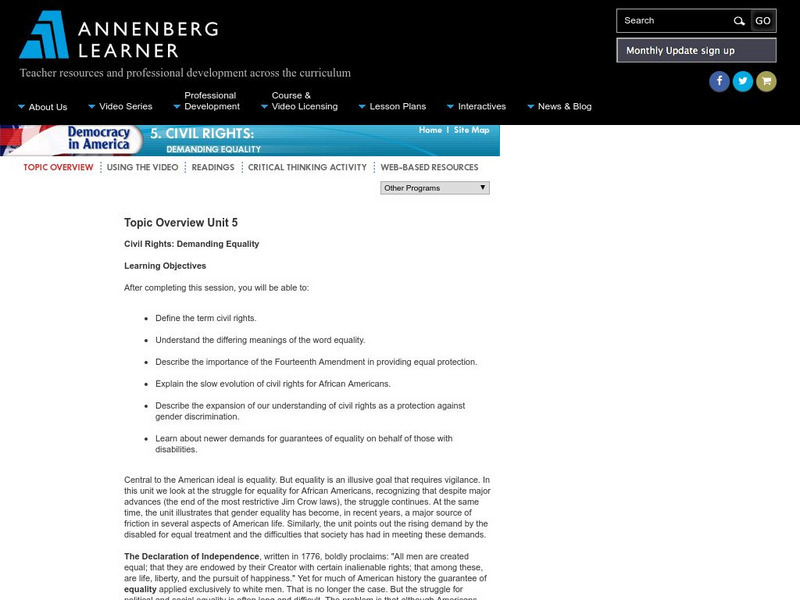
Annenberg Learner: Civil Rights: Demanding Equality
Teach the history of Civil Rights using this comprehensive learning module. Trace the movement from the 14th Amendment to modern times. The focus is on African American rights but also touches on women and disabled American's rights....
Other
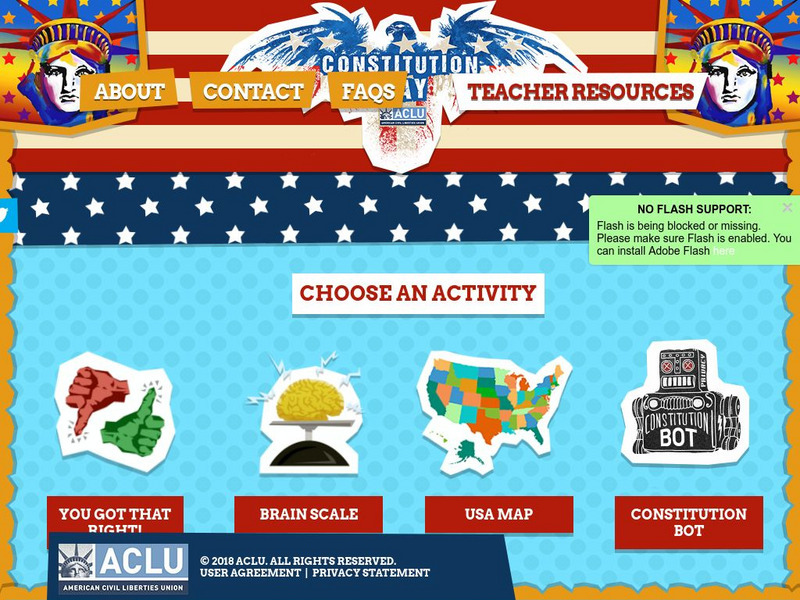
American Civil Liberties Union: Constitution Day Activities
Six activities teach students about the U.S. Constitution. Learn about checks and balances, the Bill of Rights, some of the history of the document, and how each of the states became a state. The site also provides teacher resources,...