Hi, what do you want to do?






Curated Video
Relative Pronouns & Adverbs Made Easy | EasyTeaching
Relative clauses usually begin with a relative pronoun or a relative adverb. In this lesson, we break down the concept of relative pronouns and adverbs in English grammar and look at how to use 'who', 'whose', 'which', 'that', 'where',...
Curated Video
Relative Pronouns: When and Why to Omit Them | EasyTeaching
Relative clauses often begin with a relative pronoun. Like in these two sentences. Sometimes the relative pronoun can be left out.In this lesson, we’re going to look at when and why the relative pronoun can be left out.
Curated Video
Planning the introduction of a persuasive letter, using inspiration from a text
Pupil outcome: I can plan the introduction of a persuasive letter, using inspiration from the text ‘Front Desk’. Key learning points: - The introduction must clearly communicate why the author is writing to the recipient. - This...
Curated Video
Identifying linguistic features and persuasive techniques
Pupil outcome: I can identify linguistic features and persuasive techniques in a formal persuasive letter. Key learning points: - The purpose of a persuasive letter is to persuade or convince the reader to change their mind or behaviour....
Curated Video
Writing a setting description based on 'How To Train Your Dragon'
Pupil outcome: I can use a plan to write a setting description based on ‘How To Train Your Dragon’. Key learning points: - The setting description describes where the narrative takes place. - Adverbial detail can be used to enhance text...
Curated Video
Editing a persuasive letter about school uniform
Pupil outcome: I can edit a persuasive letter about school uniform. Key learning points: - Editing is the process of improving writing to ensure text flow and overall quality. - Editing involves making improvements to a piece of writing...
Curated Video
Analysing the poem ‘When We Two Parted’ by Lord Byron
Pupil outcome: I can explore how Byron uses language to show the speaker's multifaceted feelings about their illicit affair. Key learning points: - Byron uses an extended metaphor to compare the end of the affair to the loss of a loved...
Curated Video
Substitute, Please!
Mr. Griot focuses on subject, object, and relative pronouns and demonstrates how these function in a sentence.
Learn French With Alexa
GCSE French Speaking: Do you have a pet?
In this video we look at this statement: As-tu un animal ? - Do you have a pet? (AQA Theme 1 - Identity and culture, Topic 1 - Me, my family and friends):
Learn German with Herr Antrim
Can ChatGPT really teach you German?
Are you struggling to find fun and innovative ways to learn German? Traditional language learning methods got you feeling bored and uninspired? Look no further! In this video, we'll show you how to use ChatGPT, an AI language model...
Learn German with Herr Antrim
German Genitive Case Master Class - Everything You Will Ever Need to Know
Join me for a live lesson about the genitive case in German. Learn everything you will ever need to know in this hour long master class. This lesson includes the genitive case as used with possession, genitive prepositions,...
Curated Video
Correct Usage of Who and Whom in Questions
In this video, the teacher explains the correct usage of the relative pronouns who and whom. They provide examples and guide the students through practice exercises to help them understand when to use each pronoun correctly. The teacher...

Ereading Worksheets
Types of Pronouns | Parts of Speech App
Get ready for an abundance of information with a video all about pronouns! Go beyond subject and object pronouns to study different types of pronouns—personal, demonstrative, indefinite, reflexive, interrogative, possessive,...
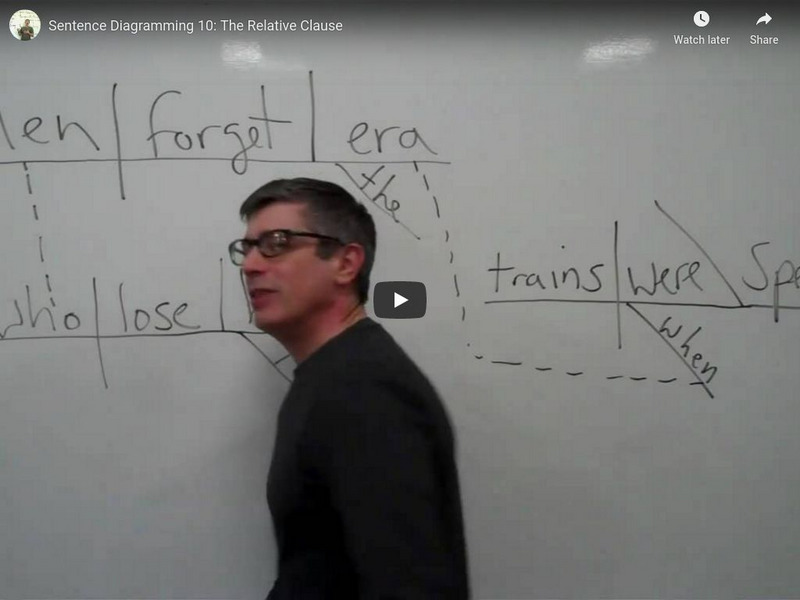
Yossarian the Grammarian
Yossarian the Grammarian:sentence Diagramming 10: The Relative Clause
This video lesson from Yossarian the Grammarian demonstrates how to diagram a sentence that contains a relative clause.
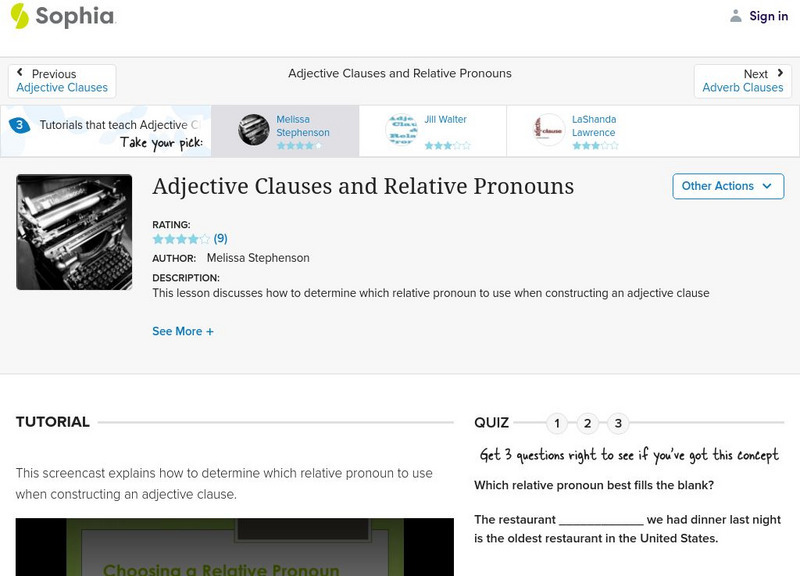
Sophia Learning
Sophia: Adjective Clauses and Relative Pronouns
This screencast defines adjective clauses and relative pronouns. It provides a chart showing which relative pronoun to use with subjective, objective, and possessive case based on what the pronoun is referencing.
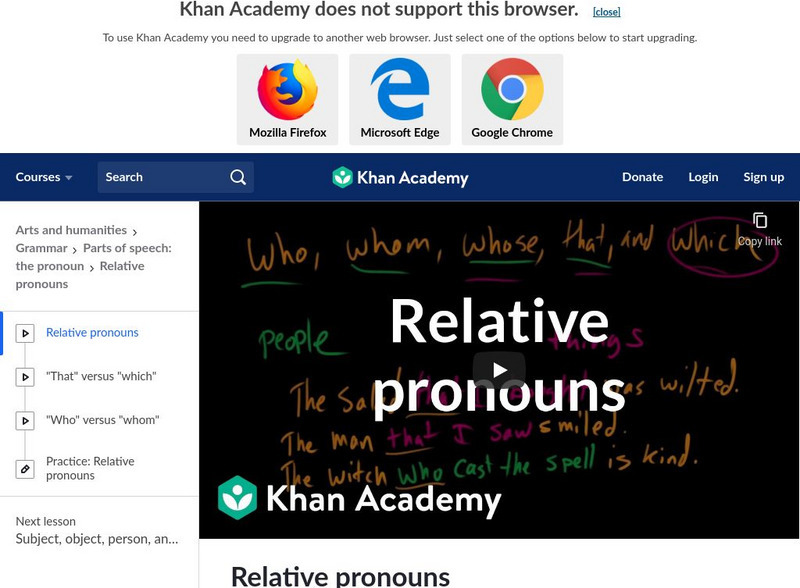
Khan Academy
Khan Academy: Relative Pronouns
A video [1:56] explaining relative pronouns and how they connect clauses.

Khan Academy
Khan Academy: Relative Clauses
A relative pronoun is a word like "that" or "which" or "who", so a relative clause is a clause that begins with a relative pronoun. In the sentence "The dragon who breathed blue fire has retired," "who breathed blue fire" is a relative...

Khan Academy
Khan Academy: Relative Pronouns
We use the relative pronouns to connect clauses together, like 'the man *who sold the world* is coming over for dinner.' David, KA's Grammar Fellow, explains.