Hi, what do you want to do?






All Ears English
Four Ways to Ask Your Colleague About Their Interests - All Ears English Podcast 1744
When your colleague comes back to the office on Monday morning and they just had a great experience - doing something they love, what can you ask them about it to build the connection? find out today
Communication Coach Alex Lyon
Transition Statements for Public Speaking
Transition statements and signposts for public speaking are a great way to communicate clearly.
Every audience appreciates it when a speaker is organized and easy to follow. A great way to help listeners follow along...
Every audience appreciates it when a speaker is organized and easy to follow. A great way to help listeners follow along...
Curated Video
Adding Descriptive Details to Deepen Meaning in Writing
This video is a lesson on how to add descriptive details to writing in order to create a more vivid picture for the reader. It explains the importance of word choice, figurative language, and sensory images, and provides examples and...
The Business Professor
Hurdles to Achieving Fit in an Organization
Hurdles to Achieving Fit in an Organization
Curated Video
Using Domain-Specific Vocabulary to Clarify Your Writing
Writers explain ideas precisely by using specific words related to their topics. Let's practice clarifying our writing by replacing vague or confusing terms with domain-specific vocabulary.
Curated Video
Strengthening Your Argument with a Formal Writing Style
In this video, the teacher discusses the importance of maintaining a formal writing style in arguments to enhance credibility. They provide examples and explanations of how to revise informal language, eliminate contractions, and choose...

Lit2Go
The Bear and the Fox
When you hear the words philanthropy, respect, and tender, do you think of a bear's attitude toward man? The bear from Aesop's "The Bear and the Fox" certainly does—and the fox would beg to differ! Class members listen to an audio...

TED-Ed
Why Are Bad Words Bad?
Curse words, vulgar words, swear words, bad words. Why are some words labeled as inappropriate? Check out this short history of taboo words and their significance.
Yossarian the Grammarian
When "Society" Should Be Replaced by "People": Grammar and Usage
This video lesson from Yossarian the Grammarian explains how decide between using the word "society" and the word "people" when writing or speaking.
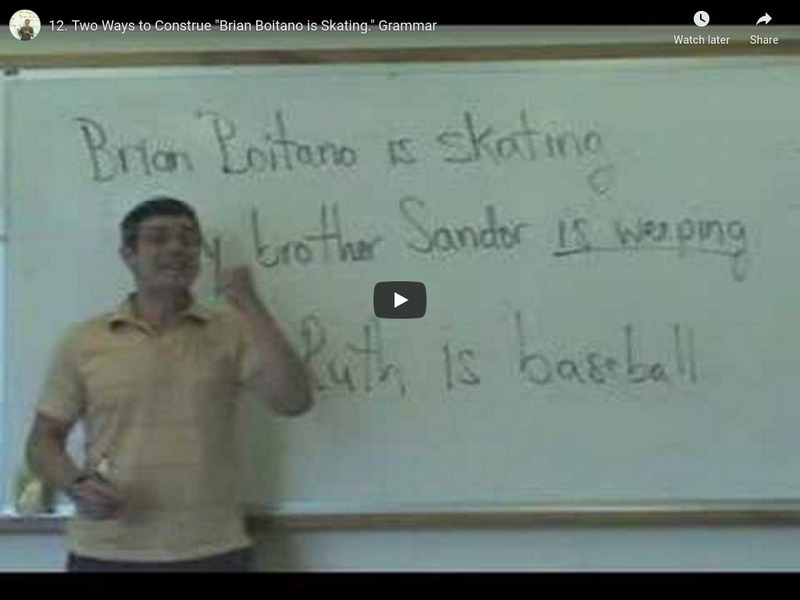
Yossarian the Grammarian
Grammar: Two Ways to Construe "Brian Boitano Is Skating"
This video lesson from Yossarian the Grammarian explains how to interpret a sentence that uses present progressive verb tense and ambiguous wording.

Turtle Diary
Turtle Diary: Homophones
This TurtleDiary interactive video lesson [1:27] features information about homophones. Games and worksheets are provided to supplement this homophones lesson

Yossarian the Grammarian
Yossarian the Grammarian: Adverbs and Ambiguity
This video lesson from Yossarian the Grammarian demonstrates how clarify and edit adverbs so that they are not ambiguous in a sentence.
Sophia Learning
Sophia: Concise Language: Stating the Obvious
A screencast explaining the importance of removing obvious information from writing and providing several examples of obvious statements that could be eliminated. [2:52]

Sophia Learning
Sophia: Connotation
This video lesson focuses on the word connotation. It defines the term and discusses the impact connotation can have on an audience. It looks at the dictionary definitions of three words: course, class, and field, and uses their synonyms...
Sophia Learning
Sophia: Strong vs. Weak Verbs
A screencast lesson explaining the difference between strong and weak verbs as well as how to replace weak verbs with stronger ones in a sentence. [4:17]
Sophia Learning
Sophia: Strong vs. Weak Verbs
A video lesson explaining the difference between strong and weak verbs and providing examples of strong verbs that could be used to replace weaker verbs. [7:24]
Sophia Learning
Sophia: The Author's Voice
Notes introducing author's voice and identifying specific techniques authors use to express their voice. Students can either read or listen to the notes. W.11-12.1d Tone/Style
Sophia Learning
Sophia: Using Strong Verbs
A video lesson defining a strong verb and explaining how to create strong verbs within a written text by changing passive voice to active voice, eliminating unnecessary qualifiers, and reducing phrases to a single word. [7:24]

Education Development Center
Tv411: Video: What's a Thesaurus?
This video explains how to use a thesaurus and what information it gives you. [3:09]

Imagine Learning Classroom
Learn Zillion: Use Vivid Verbs
Use vivid verbs the reader can "see." [7:34]

ABCkidTV
You Tube: How to Write for Your Audience Writing Video for Kids
This video [4:04] will help you learn how to write for your audience in narrative, informational, and persuasive writing. You'll learn about writing style, formal and informal word choice, and tone.
PBS
Pbs: Work Keys Reading for Information: Level 3
In this video, viewers watch as a class dissects a poem and discusses the author's word choice.

Imagine Learning Classroom
Learn Zillion: Eliminate Wordiness and Redundancy
Choose language that expresses ideas precisely and concisely, recognizing and eliminating wordiness and redundancy. [7:44]

Sophia Learning
Sophia: Slang
A tutorial introducing the use of slang. Audio [1:07] is also available.