Hi, what do you want to do?






Weird History
Weirdest Facts About King Tut
More than almost any other ancient ruler, facts about King Tut, the boy who led an empire and was buried in a tomb stuffed with gold and artifacts, have been hard to deduce. Who was this young man given the responsibility of carrying...

TED-Ed
Did the Amazons Really Exist?
Who were the warriors most feared by the Egyptians, Greeks, Persians Central Asians, and Chinese? The mighty women called Amazons, that’s who. Secondary viewers learn that the understanding of the Amazons, who were originally assumed to...

TED-Ed
Did Ancient Troy Really Exist?
Because the monsters Scylla, Charybdis, and Polyphemus in Homer's Odyssey are fictional, scholars may assume the Iliad is also entirely fictional. A carefully researched video describes Heinrich Schliemann's discovery of the...

TED-Ed
Explore Cave Paintings in This 360° Animated Cave
What do virtual reality and cave paintings have in common? Scholars ponder this question while examining a 360-degree-view video about 40,000 year old French cave paintings. Rich extension materials allow inquiry into deeper...

Crash Course
Theories of Myth: Crash Course World Mythology #12
The 12th installment from the 41-part Crash Course World Mythology series addresses the topic of interpreting myths. Viewers learn all about the theories of myths according to philosophers like Plato, Tertullian, and Clement.

Crash Course
Floods in the Ancient Near East: Crash Course World Mythology #16
What do floods signify in ancient mythology? Pupils explore the topic of flooding with the 16th installment in the Crash Course World Mythology video series. Scholars analyze the Epic of Gilgamesh, Noah's Ark, and a Zoroastrian flood...

Crash Course
The Presocratics: Crash Course History of Science #2
How did early scientists arrive at the notion that everything was made of atoms? Meet the Presocratics during the second installment in an engaging History of Science series. Viewers discover how these pioneers developed a model for...

TED-Ed
Why is Herodotus called “The Father of History”?
Rather than simply listing what happened, Herodotus sought to find out the why of events. Rather than simply labeling Herodotus The Father of History, here's a video that explains why he was given this title.

TED-Ed
What Can You Learn From Ancient Skeletons?
Skeletons may not be able to speak, but they can still tell us a lot. High schoolers watch a short video about the ways biological anthropologists can use a skeleton's bone structure to determine age, gender, place of birth, and social...

TED-Ed
Who Was Confucius?
2500 years ago Confucius said, "Do not inflict upon others that which you yourself would not want." Bryan W. Van's video introduces viewers to this wise Chinese philosopher.

Curated OER
Dinosaur Supremacy
With very little water, watch how a particular type of dinosaur has learned to adapt to the dry environment. This video displays other impressive reptiles from our past. Watch to observe these ancient creatures!
Khan Academy
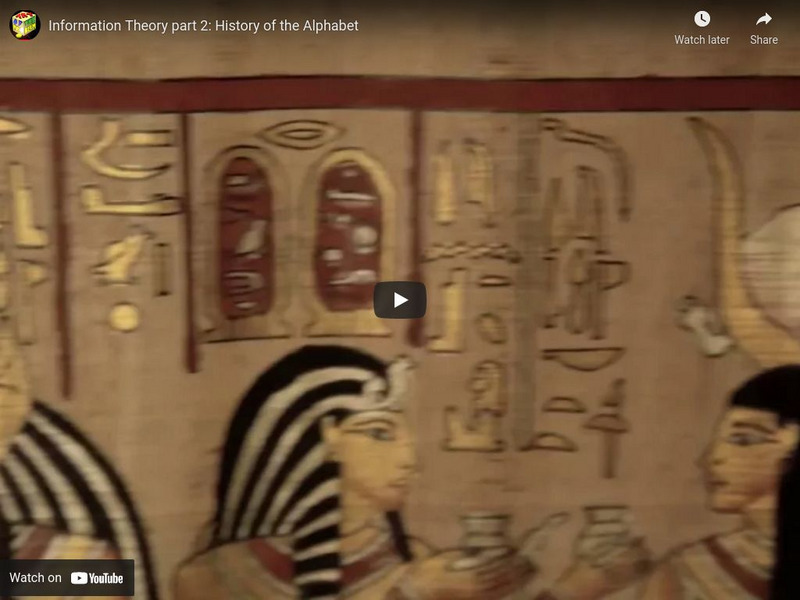
Khan Academy: Journey Into Information Theory: Ancient History: The Alphabet
History of the Alphabet. This video introduces the Hieroglyphic, Cuneiform, Hieratic, Demotic & Phoenician writing systems.