Hi, what do you want to do?






Ancient Lights Media
Starch and Cellulose
Plant Physiology and Chemistry Set: 4. This clip offers a brief look at the roles and chemical structures of the glucose polymers starch and cellulose.
msvgo
Redox Reactions in Titrations
It explains the redox reaction on the basis of titrations. It discusses about permanganametry, dichrometry and Iodometry
FuseSchool
What Are The Reactions Of Halogens
Learn the basics about the reactions of halogens, when learning about the periodic table as a part of properties of matter. Group 7 of the periodic table is the halogens. The reaction between diatomic chlorine gas and cold sodium...
Professor Dave Explains
Carbohydrates Part 2: Polysaccharides
Now that we know about simple sugars, we need to know about how these polymerize to form long polysaccharide chains, like cellulose, starch, and glycogen. Check it out!
Learning Mole
Nutrition in Food
This kitchen science video lesson is all about nutrition in food. Students will love this engaging and interactive video as they learn about science they can do at home.
Curated Video
Introduction to Natural Polymers: From Sugars to DNA
The video provides an overview of natural polymers found in all living things. The video explains that sugars are carbohydrates and can be linked together to form polysaccharides in condensation reactions, with examples of starch and...
Curated Video
The Nutritional Value of Popcorn
Popcorn is a snack made from a unique type of corn that pops when heated. Its three main components - the endosperm, germ, and pericarp - work together to create that satisfying popping sensation that people love. With its low calorie...
FuseSchool
Digestion By Enzymes
In this video we examine the process of digesting our food. We shall see how biological catalysts called enzymes break these food molecules apart and why they are necessary. Think of our food molecules as a train of trucks all coupled...
FuseSchool
Digestive enzymes
In this video, we’re going to look at the enzymes involved in digestion in more detail.
Next Animation Studio
How biodegradable corn plastic is made
This video illustrates how plastic is made from corn. Corn plastic is a kind of polylactide, or PLA, plastic. Polylactides are made from the resin of corn and other plants. Polylactides are biodegradable but also more fragile and...
Visual Learning Systems
Understanding Carbohydrates and Fiber
The video explains the importance of carbohydrates in our diet. It discusses the two basic types of carbohydrates, simple and complex, and their chemical structures. The video also explains the role of carbohydrates as the body's main...

American Chemical Society
Fact or Fiction: Uncooked Rice Is Bad for Birds
Rice is made of starches that absorb moisture, but is it enough to be harmful to birds? In true myth-buster form, a video lesson explains the science that disproves the thought that rice is bad for birds. The episode compares the...

Steve Spangler Science
Chemical Magic - Think Ink - Cool Science Experiment
This is a classic chemical reaction to use in your science class. Starch and iodine mix to cause a color change. Discuss with aspiring chemists the chemical and physical changes that occur as you demonstrate.

Curated OER
Health: Digestive System 101
Colorful pictures and animation accompany a thorough explanation of the digestive process. Each anatomical part of the digestive system is explained as well as the chemical signals that are affiliated with digestion and absorption....

Curated OER
Chemical Magic - Think Ink!
This is a classic chemical reaction to use in your science class. Starch and iodine mix to cause a color change. Discuss with aspiring chemists the chemical and physical changes that occur as you demonstrate.
Bozeman Science
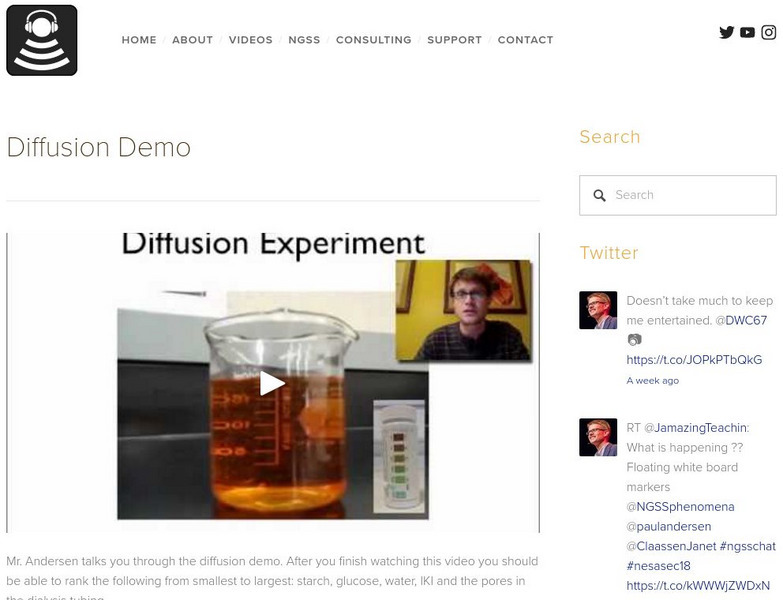
Bozeman Science: Diffusion Demo
Mr. Andersen talks you through the diffusion demo. After you finish watching this video you should be able to rank the following from smallest to largest: starch, glucose, water, IKI and the pores in the dialysis tubing.