Hi, what do you want to do?





Read Works
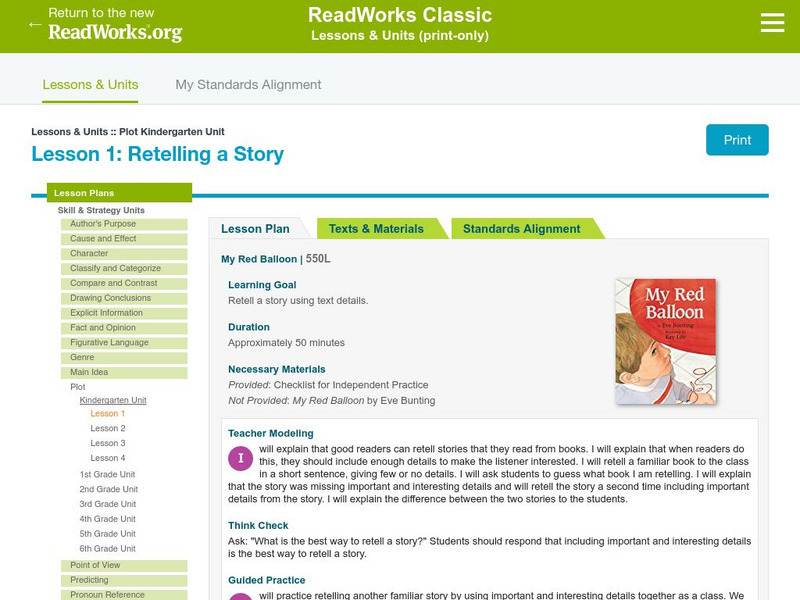
Read Works: Plot Kindergarten Unit: Retelling a Story
[Free Registration/Login Required] Teach retelling a story using plot elements through explanation, guided practice, and independent practice as students develop the skill. The text, My Red Balloon by Eve Bunting, must be provided by the...
Annenberg Foundation
Annenberg Learner: Literary Visions
A series of 24 instructional videos, each about 30 minutes in length, designed to teach literary analysis. Topics include Responding to Literature, The Elements of Short Fiction, Tone and Style in Short fiction, The Elements of Poetry,...
Caro Clarke
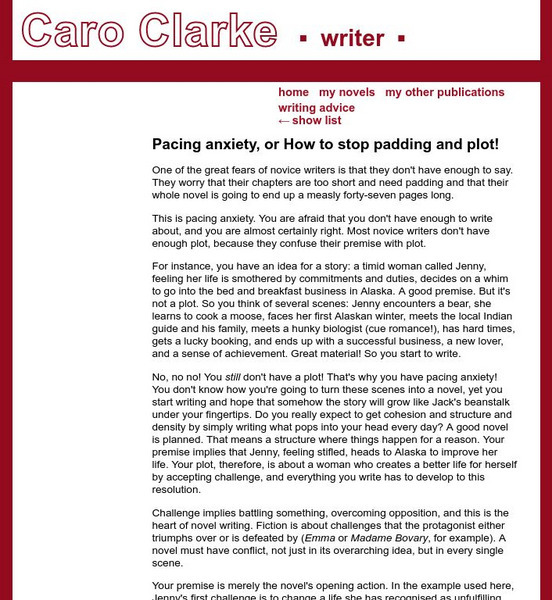
Caro Clarke: Pacing Anxiety, or How to Stop Padding and Plot!
This is the seventh installment of a series giving advice to the author who is new to writing novels. This article focuses on how to take your characters and use them and their conflicts to develop the plot of your story. W.9-10.3b...
Caro Clarke
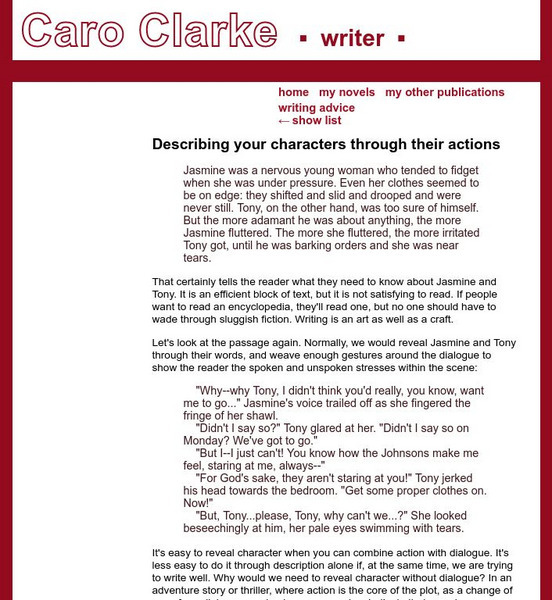
Describing Your Characters Through Their Actions
This is the tenth in a series of articles designed to help the new novel author. This article focuses on how to develop characters through their actions instead of simply relying on dialogue and description of thoughts. W.11-12.3d...
Other
Storytelling in the Classroom
There are several steps to becoming a storyteller. Find out what they are and be on your way to becoming a storyteller here! Learn how to find good stories to tell, and how to tell them to an audience effectively.
Houghton Mifflin Harcourt
Houghton Mifflin Harcourt: Cliffs Notes: Julius Caesar: Play Summary
A summary of the play The Tragedy of Julius Caesar.
Other
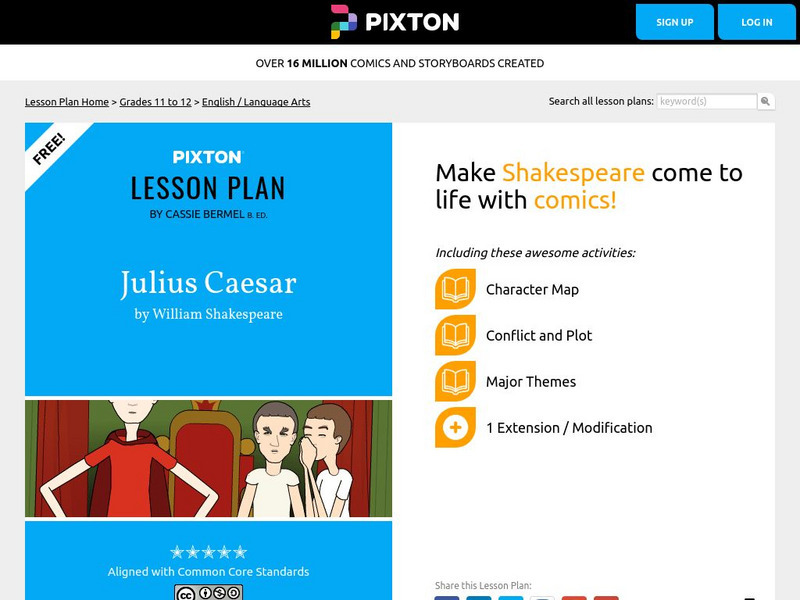
Pixton: Julius Caesar by William Shakespeare
This lesson on The Tragedy of Julius Caesar is available with a free trial registration. Students use the provided illustrated characters and props to explore character, plot, and theme.
Texas Education Agency
Texas Gateway: Isolated Scenes and Plot Support (English Ii Reading)
Analyze various scenes in several works of fiction to see how those scenes affect the plot as a whole.

Khan Academy
Khan Academy: Coordinate Plane Word Problems (Quadrant 1 Challenging)
Try some coordinate plane word problems focusing on quadrant 1. Miss the problem, and Kahn offers some tutorials for help.
Khan Academy
Khan Academy: Quadrilateral Problems on the Coordinate Plane
A set of four practice problems finding the points of quadrilaterals on a coordinate plane.

ReadWriteThink
Read Write Think: Plot Structure: A Literary Elements Mini Lesson
Contains plans for two lessons that ask students to apply Freytag's Pyramid (also known as Freytag's Triangle) to pieces of writing, oral storytelling, and television shows. In addition to objectives and standards, this instructional...
Quizlet
Quizlet: Story Elements (1St Grade): Test
Students will be asked 10 questions about story elements on this test. Six multiple choice and five true/false questions appear on this assessment. A printable version of this assessment is also available. Picture cures are provided next...

Quizlet
Quizlet: Story Elements (1St Grade) Match
This interactive game of "Match" assesses students' knowledge of story element definitions. Students will match the correct definition of a story element to its corresponding definition. Picture cues are provided on this review resource.
Quizlet
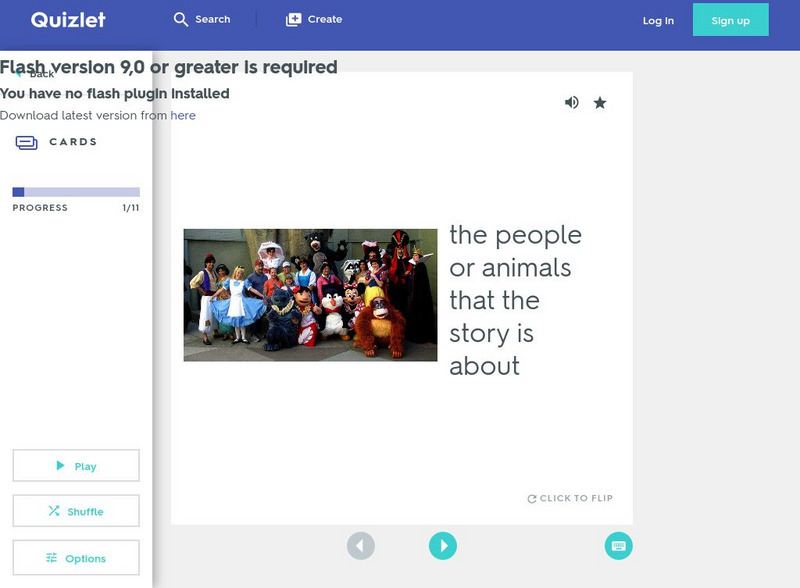
Quizlet: Story Elements (1St Grade): Flashcards
These interactive flashcards provide definitions for different story elements. Engaging picture cues are provided for each flashcard, and students can play the audio to hear the words and definitions read aloud.
Better Lesson
Better Lesson: rl.k.3 With Prompting and Support, Identify Characters, Settings,
This landing page provides different lesson plan choices on teaching RL.K.3 With prompting and support, identify characters, settings,
Quizlet
Quizlet: R.3 Analyze How and Why Individuals, Events, or Ideas, Develop/interact
Please align to CCSS.ELA-Literacy.CCRA.R.3 Analyze how and why individuals, events, and ideas develop and interact over the course of a text.
Other
Writing world.com: Writing Dialogue for Children
A good site for teachers and writers looking to write for children, or teach children how to write dialogue. Includes tips and guidelines.
Other
Writing World: Four Ways to Bring Settings to Life
A great resource outlining four major ways to make settings appear more real and genuine in fiction. Deals with themes such as motion, experience, mood, and the senses. W.11-12.3d Sensory/precise lang narratives
Texas Education Agency
Texas Gateway: Analyze Linear Plot Developments in Literary Texts/fiction
[Accessible by TX Educators. Free Registration/Login Required] In this lesson, you will learn how to recognize conflict, analyze linear plot, and determine how the conflict is resolved.
Texas Education Agency
Texas Gateway: Isolated Scenes and Plot Support
Plots have momentum or a forward motion. In this lesson, we will isolate and discuss specific plot scenes from several works of fiction. You will learn how each scene moves the plot forward toward the resolution.

Success Link
Success Link: Characters, Setting, Plot, Conclusion, and Summarizing a Story
This lesson plan offers a step-by-step procedure for teaching young scholars how to identify story elements and to summarize a story. It explains how to use a "Who Am I" activity, as well as a linkage activity in identifying characters...
Other
Fiction Factor: The Importance of Setting
An interesting article concerning the importance of setting to any piece of fiction. Gives good information about how setting affects characters and "world-building."

Florida Center for Reading Research
Florida Center for Reading Research: Narrative Text Structure: Retell Wheel
A lesson plan in which students read a narrative text and then turn a question wheel to answer questions about the characters, setting, conflict, and plot. Materials are included.[PDF]