Hi, what do you want to do?






EarthEcho International
Youth in Action: Students Investigate Ocean Acidification and Salmon Decline in the Puget Sound
High School students from Seattle, WA, and Bainbridge, WA, area schools worked throughout the summer of 2015 on a seasonal pH monitoring project in Puget Sound. Through their citizen science efforts, a long-term partnership with the...
Professor Dave Explains
Topography and Types of Sediments
Now that we've learned about the layers of the ocean, let's focus on the floor. How did oceanographers learn about the composition of the ocean floor? What is sediment? How do different types of sediment get to the ocean and what...
EarthEcho International
STEM Career Closeup: Shellfish Biologist
Washington’s Puget Sound provides a look into the future of coastal habitats across the world, due to the natural cycle of upwelling that occurs here. Join Philippe Cousteau as explores the links between the organisms that we rarely...
Curated Video
Understanding the Powerful Waves of Tsunamis
Learn about the causes of tsunamis, their characteristics, and the destruction they can cause. Tsunamis are a form of natural disaster where a huge wave or waves form. Understand the importance of preparing for these powerful storms, as...
TMW Media
The Great Sardine Run: Reflecting on the sardine run event
How can you become an oceanographer? Who controls hunt for sardines, the dolphins or the sharks? What type of sharks are seen hunting for sardines?<br/>
The Great Sardine Run, Part 4
The Great Sardine Run, Part 4
Physics Girl
How science explains monster waves
Rogue waves - enormous, spontaneous surface waves in the open ocean - were once the tall tales of sailors. They are waves that reach 2-3x taller than the largest average waves in the area, reaching heights of 75 – 100ft. With the help of...

TED-Ed
How Do Ocean Currents Work?
Find out what puts the motion in the ocean with a short video about how ocean currents work. An animated video uses the story of little yellow ducky bathtub toys to show how currents flow through the world's oceans.

American Chemical Society
How Bacteria Make It Rain (with Kim Prather)
Scientists question how the oceans and the atmosphere get along. An installment in a longer science series investigates this relationship and current research exploring the types of materials that oceans release into the atmosphere....

TED-Ed
How Oceanographers Found the Titanic
The sinking of the Titanic is one of the most tragic and remembered events in history. A first of her time, Titanic was considered unsinkable, but the night of April 15, 1912, would prove otherwise. Seventy-three years later in...

SciShow Kids
Let's Learn the Ocean Zones!
How many zones are in the ocean and how did they get their names? Join the dolphin scientists in their exploration of the different zones in the ocean and the kinds of animals living in them.

Be Smart
El Niño and Why It's so Hard to Predict the Weather
Learn how conditions in the Pacific Ocean result in El Niño, how El Niño changes weather patterns, and why it's difficult to predict what effect El Niño will have in any given year. Welcome to Chaos Theory.

TED-Ed
The Surprising (And Invisible) Signatures of Sea Creatures
Airplanes resulted from observations of birds flying. What inventions could be inspired by watching sea creatures move? Viewers are challenged to consider how bio-observation might lead them to design something to overcome...

PBS
Pbs Learning Media: Guess How Whales Hear!
This video segment explores how one marine biologist used the scientific process to discover how whales hear. [5:58]
Google
Google Earth: Ocean
Explore the ocean with Google Earth. This interactive site shows you the ocean seafloor, deep sea vents, and hope spots. The website begins with a short introduction video allowing you to become familiar with the tool. Google Earth must...
Science Friday Initiative
Science Friday: Changing Climate Means Changing Oceans
From acidification and warming temperatures, to sea-level rise and sea-ice loss, Ira Flatow and guests look at how the oceans are changing with changes in climate.

PBS
Pbs Kids Design Squad: Underwater Robot
An oceanographic engineer at Woods Hole, Amy helps build and operate torpedo-shaped robots to map terrain under water. [1:04]

Khan Academy
Khan Academy: What's Going On: Create Carbon Dioxide Gas That Diffuses Into Liq
Learn about passive diffusion and discover how this chemical process relates to big changes in our oceans. [4:12]

Khan Academy
Khan Academy: Intro: Simple Experiment Illustrates Ocean Acidification in a Cup
Human activity is having an enormous impact on our natural environment, including making our oceans more acidic. This hands-on science snack, Ocean Acidification in a Cup, models the chemical process that's occurring around us and helps...
Science Friday Initiative
Science Friday: Sylvia Earle: 'The World Is Blue'
Ira talks with ocean explorer Sylvia Earle about the state of the world's oceans, and what actions need to be taken to protect them from catastrophic damage.

PBS
Pbs Teachers: Real Scientists: Ocean Scientist
Learn how an ocean scientist is using "robotunas" to find efficient new ways to get boats, ships and submarines moving along, without using a regular propeller.
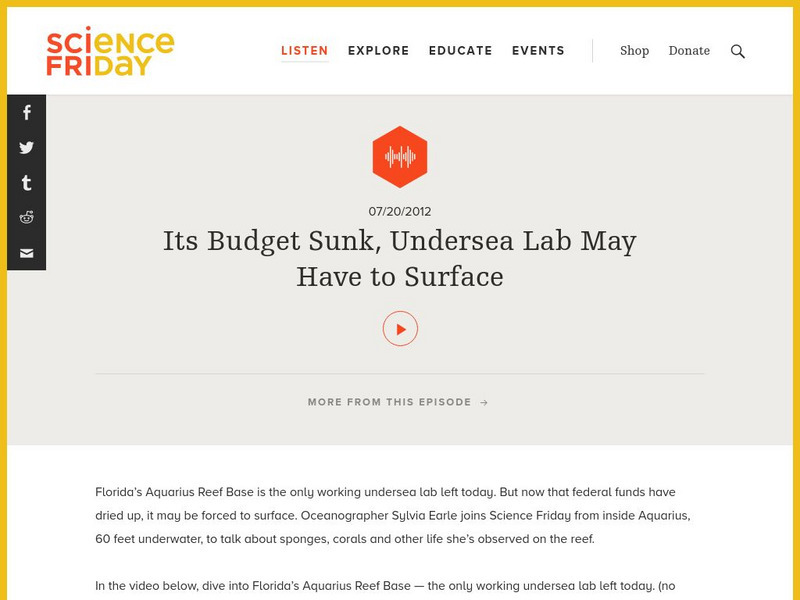
Science Friday Initiative
Science Friday: Its Budget Sunk, Undersea Lab May Have to Surface
Now that federal funds have dried up, Florida's Aquarius undersea lab faces an uncertain future.
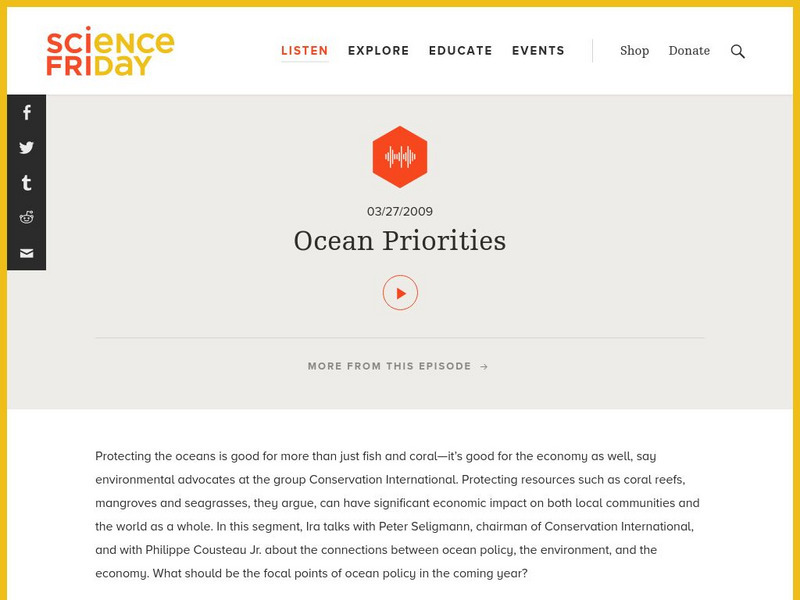
Science Friday Initiative
Science Friday: Ocean Priorities
Ira talks with Peter Seligmann, chairman of Conservation International, and with Philippe Cousteau Jr. about the connections between ocean policy, the environment, and the economy.
Science Friday Initiative
Science Friday: Remembering Nereus, Explorer of Ocean Depths
The robotic deep-sea submersible Nereus was destroyed while diving over six miles beneath the surface in the Kermadec Trench.
Science Friday Initiative
Science Friday: Exploring the Deepest, Darkest Spots on Earth
James Cameron, Sylvia Earle, and John McCosker talk about the sights and creatures of the deep ocean. [46 mins. 38 secs.]