Hi, what do you want to do?






AllTime 10s
10 Hidden Signs You're Going To Live Past 100 Years Old
Want to be wrinkly and grey haired for the majority of your life? well here's some signs that you could be just that! Here's 10 hidden signs that you're going to live past 100 year old!
Brainwaves Video Anthology
Living a Purposeful Life: The Path of Purposeful Aging
Richard Leider, author of "Who Do You Want to Be When You Grow Old? The Path of Purposeful Aging," explores the concept of transitioning from adulthood to elderhood with a focus on living a purposeful life. Through the lens of purpose,...
Barcroft Media
26-Year-Old Model Wears Her 'Wrinkles' With Pride: BORN DIFFERENT
A 26-YEAR-OLD woman with a rare condition that makes her look decades older is challenging beauty standards by becoming a model. Hoping to break into the modelling industry, Sara Geurts from Minneapolis, Minnesota, is determined to carve...

TED-Ed
Could We Cure Aging During Your Lifetime?
As human lifespans increase, more time is spent sick or in pain than ever before. A brief video introduces some research on how to reduce the amount of our lives that are disease free. Each of these methods offers some promise for a...

Bite Sci-zed
Longevity and Telomeres
Why do people age? Scholars explore the concept of telomeres and why they are so important in cells. They learn about the role of telomerase and why it is active in some cells—but not in others. The video also explains why some organisms...

Be Smart
Can We Get Older Without Aging?
There are reasons elderly people are more susceptible to diseases. A video lesson instructor discusses the changes cells endure over someone's lifespan and how that affects the likelihood of contracting a disease.

TED-Ed
The "End Of History" Illusion
If you knew you were going to change a lot but you didn’t know in what way(s), how would you make decisions about your future? A thought-provoking animation presents research that shows our expectations about the future continuing the...

Veritasium
How Long Will You Live?
Cells only divide a specific number of times before they die at the end of the division cycle. This molecular clock is the culprit of aging. A video explores the concept with a trip to New York to discuss the phenomenon with a leading...

Veritasium
How UV Causes Cancer and Aging
As the rates of skin cancer rise to become the most common type of cancer in the United States, scientists directly relate sunscreen usage to skin cancer prevention. Doctors research exactly how ultraviolet light changes cells. Viewers...

American Chemical Society
How to Make Flowers Last Longer
"Nature's first green is gold, Her hardest hue to hold. Her early leaf's a flower; But only so an hour." - Robert Frost. An engaging video in the ACS Reactions playlist explains six steps that people can take to make flowers last...

MinuteEarth
Do We Have to Get Old and Die?
They say nothing in life is guaranteed except death and taxes. But, are taxes the only one sure thing? Pupils ponder the possibility of eternal life with the ageless examples of the mole rat and jellyfish. The narrator discusses why our...

SciShow
Why We Age - And How We Can Stop It
As we get older, we age, our bodies and minds deteriorate, but this isn't true of all species. The video begins with why we age and what biological processes cause aging. Then it covers research on worms, mice, and other animals that...

Be Smart
How Science Defines A Year
How do we define a year? Science has multiple definitions depending on if you use a sidereal year, a tropical year, or an anomalous year. A helpful resource explains all three, as well as how the human body changes over the course of the...

TED-Ed
Why Do Our Bodies Age?
The physiological traits that cause our bodies to age are examined in a short, animated video.

PBS
Nova: Aging
PBS site invites users to watch a video segment on "longevity genes." Will they help us to live longer lives?

National Science Foundation
National Science Foundation: Home Sensors Enable Seniors to Live Independently
Researchers are developing smart home technologies to enhance the safety of residents and monitor their health conditions using sensors and other devices. [2:48]

Sophia Learning
Sophia: Aging and Later Years of Life
This lesson will identify the keys to successful aging and discuss the discrimination involved with ageism.

Khan Academy
Khan Academy: Biological Clock
By Artem Kirsanov. Video about the biological clock. The Nobel Prize in Physiology or Medicine 2017 was awarded for research in this topic. [2:59]

Khan Academy
Khan Academy: Suzanne Lacy: Silver Action
'It's a truly participatory work,' says artist Suzanne Lacy of her performance Silver Action, in which hundreds of women over sixty gathered within the gallery, shared their stories of activism and protest, and drew the audience in. [3:55]

Science Friday Initiative
Science Friday: Why Do People Go Gray?
It's one of the most common signs of aging -- gray hair. But exactly why does hair turn gray?
Sophia Learning
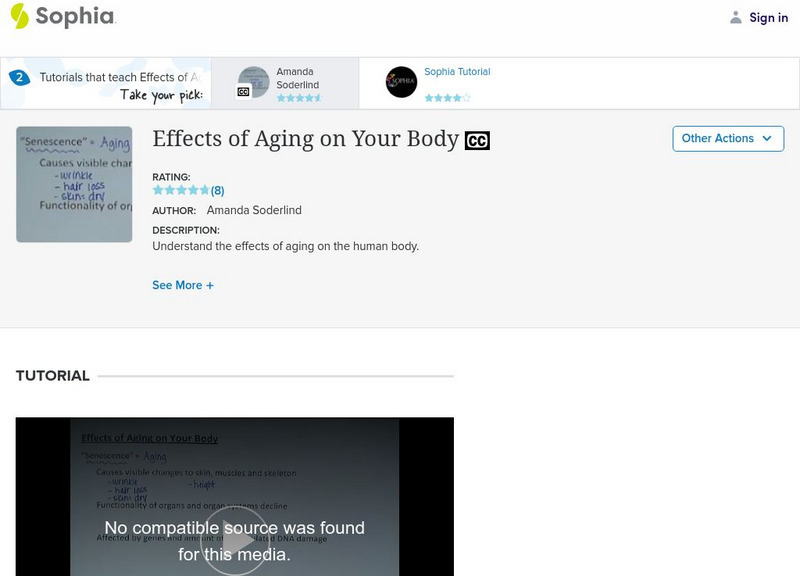
Sophia: Effects of Aging on Your Body: Lesson 2
This lesson will look at how the human body changes over time as a person ages as well as identify factors that can affect the aging process. It is 2 of 5 in the series titled "Effects of Aging on Your Body."