Hi, what do you want to do?





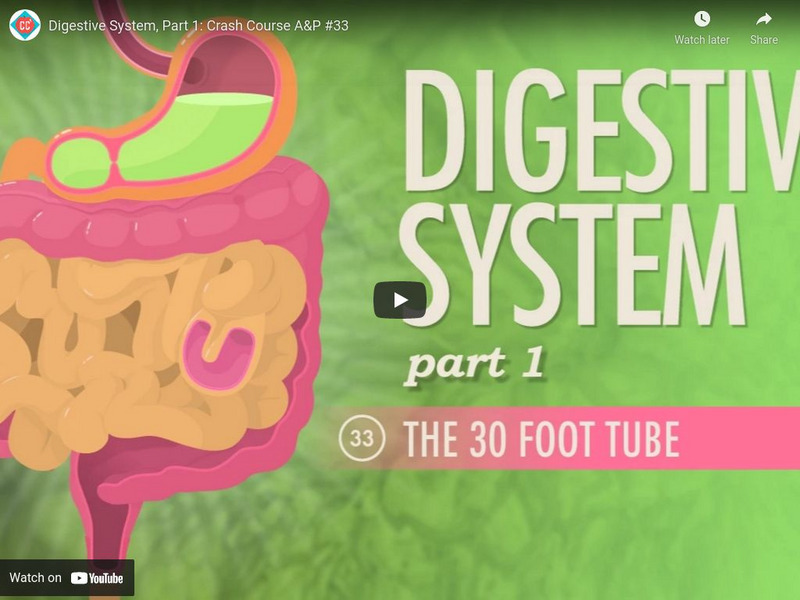
Crash Course
Crash Course A&p #33: Digestive System, Part 1
Nachos are delicious. And versatile because today they're also going to help us learn a thing or two about your digestive system. Nachos can provide us with energy and raw materials, by first ingesting something nutritious, propelling it...
Sophia Learning
Sophia: Enzymes
This narrated screencast explains the role enzymes play in cellular metabolism. [4:42]
Sophia Learning
Sophia: Enzyme Structure
Learn about enzyme structure, and the complex proteins which make up enzymes. [0:39]
Sophia Learning
Sophia: Structure and Function of Macromolecules: Enzymes
Listen to this podcast introducing the function of enzymes in the human body. [0:38]

Khan Academy
Khan Academy: Energy and Transport: Enzymes
Enzymes as catalysts for reactions in biological systems; discussion of substrates, active sites, induced fit, and activation energy. [8:12]

Khan Academy
Khan Academy: Enzyme Cofactors and Coenzymes
Learn about the proteins that can help enzymes catalyze reactions known as cofactors and coenzymes. [9:59]

Khan Academy
Khan Academy: Gibbs Free Energy and Spontaneous Reactions
A video exploring how to use Gibbs free energy to figure out if a reaction is going to be spontaneous or not which is helpful in biology. [9:18]

Khan Academy
Khan Academy: Endergonic, Exergonic, Exothermic, and Endothermic
Learn how endergonic, exergonic, exothermic, and endothermic reactions play a role in biological reactions. [11:52]

Khan Academy
Khan Academy: Six Types of Enzymes
A video reviewing over the six types of enzymes and how they catalyze reactions. Learn how you can figure out the function of an enzyme from its name. [7:03]

Khan Academy
Khan Academy: Allosteric Regulation and Feedback Loops
Video talks about how allosteric regulation can affect enzyme kinetics. [6:04]
Next Vista for Learning
Next Vista for Learning: Enzymes
A video describing how enzymes function as a reaction catalyst. The video shows how enzymes work through animated examples. [1:15]
Sophia Learning
Sophia: Enzyme Function: Lesson 1
This lesson will describe how an enzyme is used to turn substrate into product. It is 1 of 5 in the series titled "Enzyme Function."
Sophia Learning
Sophia: Enzyme Structure: Lesson 1
This lesson will describe that enzymes are made of proteins, and can be found in nature or can be synthesized synthetically. It is 1 of 4 in the series titled "Enzyme Structure."
Sophia Learning
Sophia: Induced Fit: Lesson 3
This lesson will describe the process of induced fit, and explain how enzymes use it during chemical reactions. It is 3 of 3 in the series titled "Induced Fit."
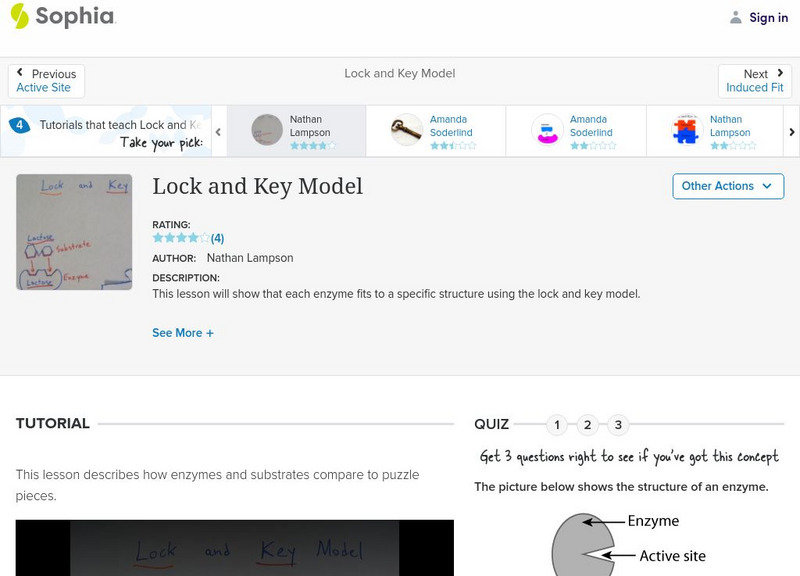
Sophia Learning
Sophia: Lock and Key Model: Lesson 1
This lesson will show that each enzyme fits to a specific structure using the lock and key model. It is 1 of 4 in the series titled "Lock and Key Model."
Sophia Learning
Sophia: Activation Energy: Lesson 5
This lesson will define activation energy and explain how to determine the amount of activation energy from an energy diagram. It is 5 of 5 in the series titled "Activation Energy."
Sophia Learning
Sophia: Active Site: Lesson 2
This lesson shows that an active site is the space on an enzyme where a substrate would attach. It is 2 of 4 in the series titled "Active Site."
Sophia Learning
Sophia: Active Site: Lesson 1
This lesson shows that an active site is the space on an enzyme where a substrate would attach. It is 1 of 4 in the series titled "Active Site."
Sophia Learning
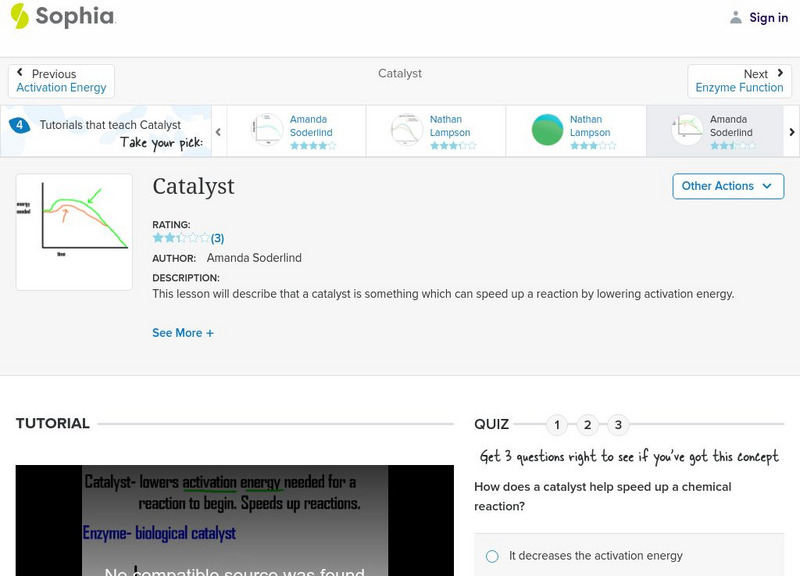
Sophia: Catalyst: Lesson 3
This lesson will describe that a catalyst is something which can speed up a reaction by lowering activation energy. It is 3 of 4 in the series titled "Catalyst."
Sophia Learning
Sophia: Competitive and Noncompetitive Inhibition: Lesson 3
This lesson will introduce the two types of inhibition found in enzyme interactions: Competitive Inhibition and Noncompetitive Inhibition. It is 3 of 4 in the series titled "Competitive and Noncompetitive Inhibition."
Sophia Learning
Sophia: Enzyme Function: Lesson 5
This lesson will describe how an enzyme is used to turn substrate into product. It is 5 of 5 in the series titled "Enzyme Function."
Bozeman Science
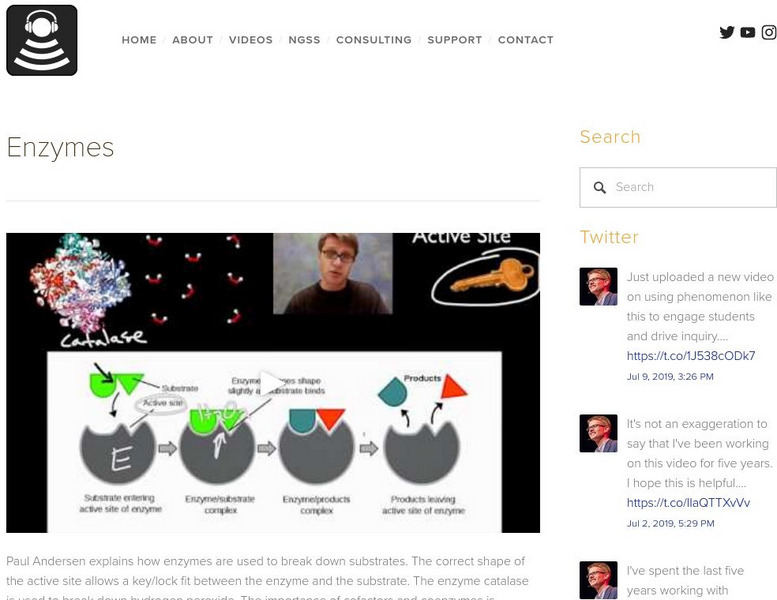
Bozeman Science: Enyzmes
Paul Andersen explains how enzymes are used to break down substrates. The correct shape of the active site allows a key/lock fit between the enzyme and the substrate. The enzyme catalase is used to break down hydrogen peroxide. The...
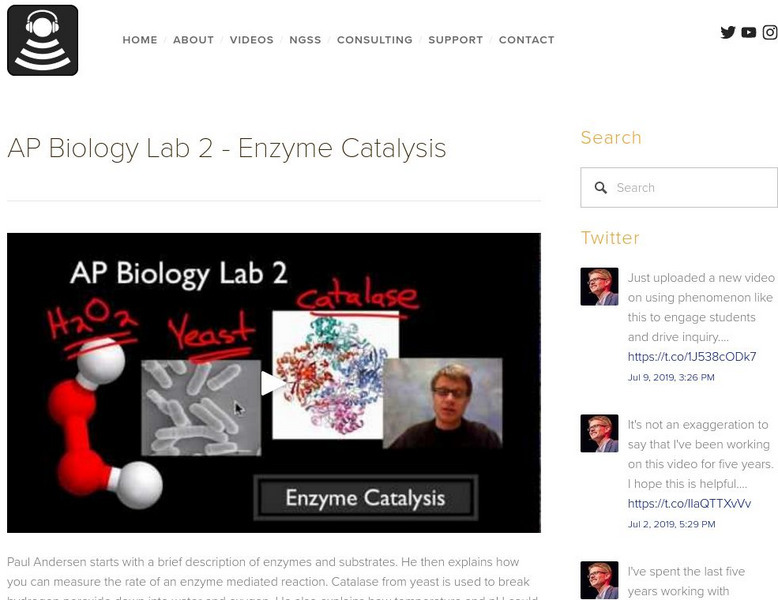
Bozeman Science
Bozeman Science: Ap Biology Lab 2 Enzyme Catalysis
Paul Andersen starts with a brief description of enzymes and substrates. He then explains how you can measure the rate of an enzyme mediated reaction. Catalase from yeast is used to break hydrogen peroxide down into water and oxygen. He...