Hi, what do you want to do?





Gilder Lehrman Institute of American History
Gilder Lehrman Institute: History Now: Wilberforce, Lincoln, and the Abolition of Slavery
[Free Registration/Login Required] Tour the online original documents that tell a story about the abolition of slavery in both the United States and England. Click on the tiny "next" above the text to go through the interactive.

CommonLit
Common Lit: Petition From the Pennsylvania Society for the Abolition of Slavery
A learning module that begins with "Petition from the Pennsylvania Society for the Abolition of Slavery" by Benjamin Franklin, accompanied by guided reading questions, assessment questions, and discussion questions. The text can be...
University of South Florida
Civil Rights and Conflict Selected Speeches: No Compromise With Evil of Slavery
A speech given by William Lloyd Garrison in 1854 in which he advocates for the abolition of slavery. The readability level, word count, and citation are provided. An audio rendition of the speech can be heard as well as downloaded in mp3...
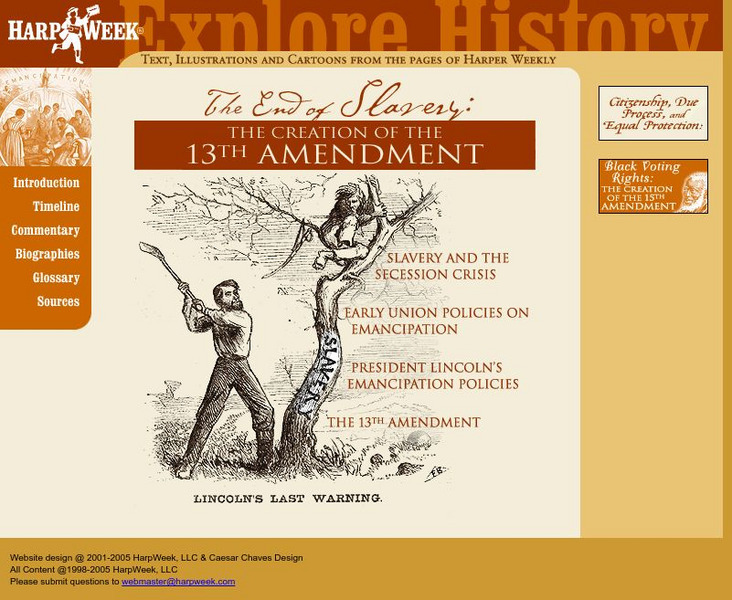
Harp Week
The End of Slavery: The Creation of the 13th Amendment
What a wonderful resource for researching the attempts to solve the issue of slavery prior to the Civil War, and the eventual ratification of the 13th Amendment. Find a timeline of legislation limiting the spread of slavery from 1787...
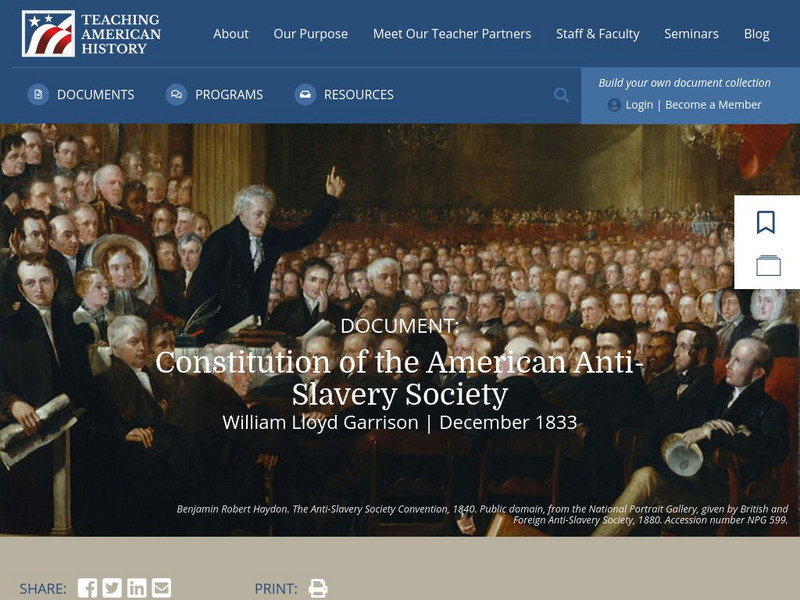
Teaching American History
Teaching American History: Manifesto: American Anti Slavery Society
Find the goals of the American Anti-Slavery Society, founded in 1833 by abolitionists in Philadelphia. The object of the group was the immediate abolition of slavery.

Library of Congress
Loc: African American Odyssey: Abolition, Anti Slavery Movements
A section of an online exhibit that deals with historically important documents about the abolition movement from its earliest Quaker beginnings in the early 18th century through 1860.
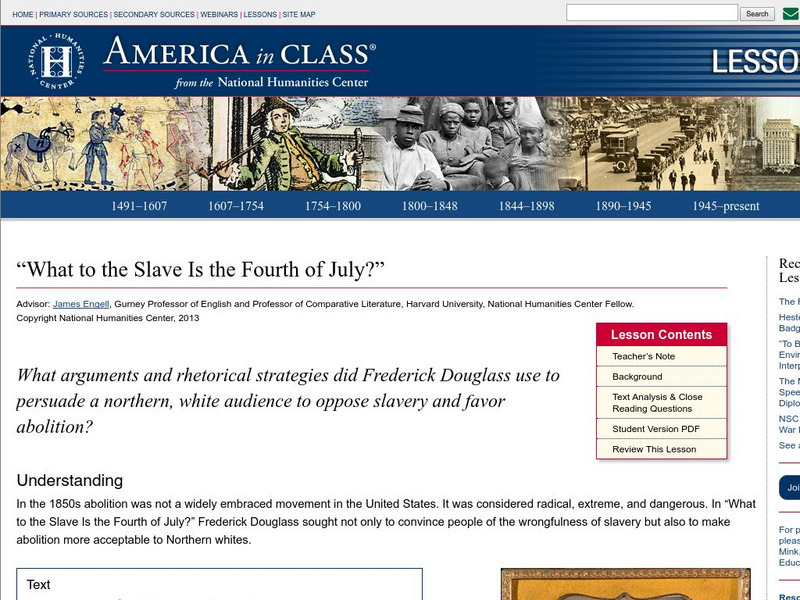
National Humanities Center
National Humanities Center: America in Class: "What to the Slave Is the Fourth of July?"
Explores the argument made by Frederick Douglass and his appeals to convince northern whites to oppose slavery and favor abolition. Lesson content includes resources for both teachers and students.
Mariners' Museum and Park
Mariners' Museum: Captive Passage: The Transatlantic Slave Trade
Online exhibition from the Mariners' Museum chronicles the plight of African slaves from the beginning of their journey when they are torn from their homeland all the way to the shores of the Americas. Caught up in the lucrative...
Understanding Slavery Initiative
Understanding Slavery Initiative: Emancipation
Although the British Parliament passed the Abolition of Slavery Act in August 1833, the trade continued, and for many years there were exceptions to abolition. Learn how the British government attempted to prevent the slave trade from...
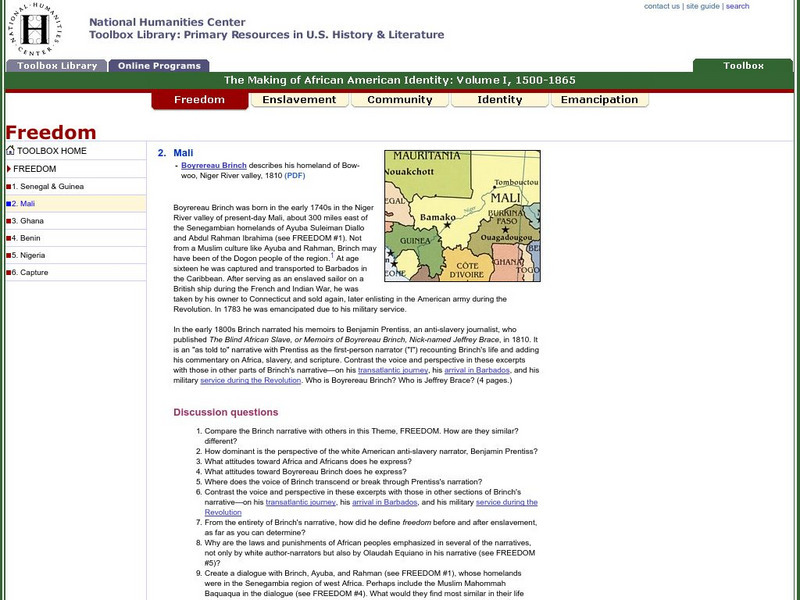
National Humanities Center
National Humanities Center: Toolbox Library: Sierra Leone, Making of African American Identity: V. 1
An eighteenth-century map, several illustrations by Europeans of Africans from Sierra Leone, and two eighteenth-century narratives depicting Sierra Leone natives through the eyes of two British physicians who describe the peoples they...

Library of Congress
Loc: African American Odyssey: Abolition, Anti Slavery Movements
This site provides primary source documents and commentary that give an overall look at many different aspects of abolition, the antislavery movement, and the rise of division between North and South. From the Library of Congress.

US National Archives
Our Documents: 13th Amendment to the u.s. Constitution: Abolition of Slavery
Take a look at an image of the constitutional amendment that put an end to slavery in the United States. Interactive image is accompanied by an overview of the amendment's inception and adoption, as well as document transcript.
British Library
British Library: Discovering Literature: Voices in the Campaign for Abolition
From the mid 18th century, Africans and people of African descent - many of them former slaves - began to write down their stories. This article describes these writings and assesses their role in the abolition of slavery.
Annenberg Foundation
Annenberg Learner: The Events of 1831: Interactive Timeline
This interactive timeline helps you examine how some of the events of 1831 were related. Significant events include slavery, abolition, evangelical revivalism, and new inventions.
E Reading Worksheets
E Reading Worksheets: Narrative of the Life of Frederick Douglass
In this learning module, students will engage in a deep study of Narrative of the Life of Frederick Douglass. Worksheets, that assess reading comprehension and inferencing skills, and map projects are provided to reinforce Fredick...
Understanding Slavery Initiative
Understanding Slavery: The Campaign for Abolition: Campaigning Against Slavery
Find out about the first mass human rights movement in history when African monarchs, enslaved Africans, freed slaves, and millions of other ordinary people campaigned against the slave trade and fought for the abolition of slavery.
A&E Television
History.com: Black History Milestones
A detailed account of the history of African Americans is presented in this article. Divided by main topics or periods of time, the coming of slavery to America is the first focus. Followed by plantation life and escapes to freedom and...
Stanford University
Beyond the Bubble: Slave Quarters
[Free Registration/Login Required] Students examine a photograph of former slave quarters in Georgia and answer questions about the living conditions of slaves. They will also observe how the fact that the photograph was taken decades...
National Humanities Center
National Humanities Center: America in Class: The Religious Roots of Abolition
A lesson that looks at the role of Christianity in the fight to abolish slavery in the United States.
Other
National Maritime Museum: Freedom: Abolition in Britain
Illustrated essay on the abolition of slavery in Britain.
Thomson Reuters
Find Law: u.s. Constitution: Thirteenth Amendment
This source provides the Thirteenth Amendment as it is worded in the U.S. Constitution. At the bottom of the page are annotations with links to information about the abolition of slavery, origin and purpose of the amendment, peonage, and...
Other
Wwhp: American Anti Slavery Society
A good review of the evolution of the support for the abolition of slavery from the first anti-slavery organization formed by the Quakers to the support for Abraham Lincoln as president. Focus is on the American Anti-Slavery Society and...

Khan Academy
Khan Academy: Ap Us History: 1844 1877: The Civil War: Emancipation Proclamation
Discusses the background to the Emancipation Proclamation and how Abraham Lincoln came to support the abolition of slavery and the difficulties that were encountered around this issue. Explains that it did not apply to all slaves as...
Cornell University
Cornell University: Library: I Will Be Heard: The 13th Amendment
Read the text of the 13th Amendment, adopted in January, 1865, even before the end of the Civil War, which ended slavery in the United States. Click on the image to see a larger picture of the document itself.