Hi, what do you want to do?






PBS
Pbs Learning Media: Crash Course Astronomy: Uranus & Neptune
We complete our planetary tour with a review of the ice giants Uranus and Neptune. Both have small rocky cores, thick mantles of ammonia, water, and methane, and atmospheres that make them look greenish and blue. Uranus has a truly weird...
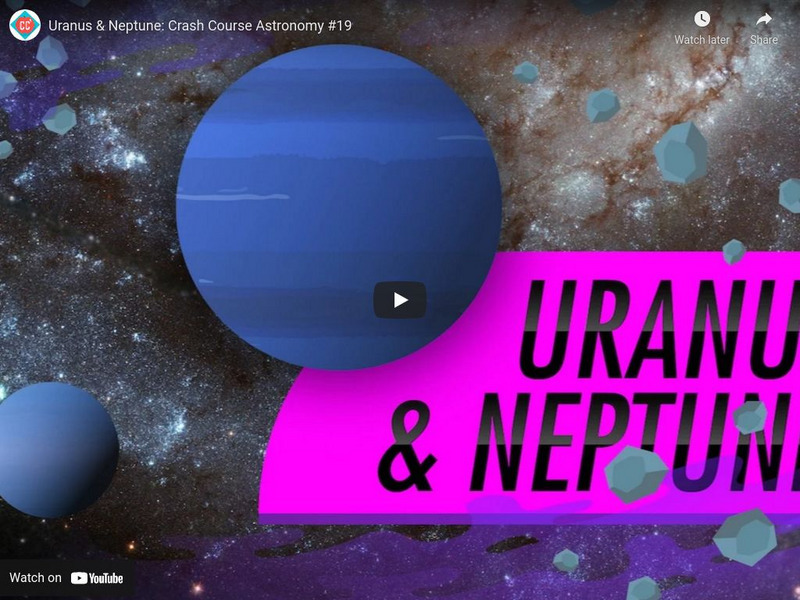
Crash Course
Crash Course Astronomy #19: Uranus and Neptune
Today we're rounding out our planetary tour with ice giants Uranus and Neptune. Both have small rocky cores, thick mantles of ammonia, water, and methane, and atmospheres that make them look greenish and blue. Uranus has a truly weird...

SciShow
Sci Show Kids: Explore the Solar System: The Gas Giants
Take a tour of the gas giants and learn important facts about these planets. Understand that Jupiter has a giant storm called Great Red Spot, Saturn has the biggest and brightest rings, how Uranus spins on its side, and Neptune's storms...

Crash Course
Crash Course Kids 43.2: Gas Giants Weather
In this episode of Crash Course Kids, Sabrina takes leads a virtual tour of the Gas Giants and shows what kind of weather happens on those planets. [4:42]
PBS
Pbs Learning Media: Crash Course Astronomy: The Oort Cloud
Out past Neptune are vast reservoirs of icy bodies that can become comets if they get poked into the inner solar system. The Kuiper Belt is a donut-shaped region beyond the planets that is aligned with the plane of the solar system. The...
Kurzgesagt
You Tube: Kurzgesagt: How to Catch a Dwarf Planet Triton
If Neptune didn't catch Triton we might have another Dwarf Planet in our Solar system -- maybe even another Planet or double system. We show how this could have happened. [2:06]
Crash Course
Crash Course Astronomy #22: The Oort Cloud
Now that we're done with the planets, asteroid belt, and comets, we're heading to the outskirts of the solar system. Out past Neptune are vast reservoirs of icy bodies that can become comets if they get poked into the inner solar system....
NASA
Nasa: Galleries: Video: What Is a Planet?
Explanation of the characteristics an object must have to be considered a planet. [7:53]

Other
#Ask Mit: Why Are Gas Giants Round?
Find out professor Anna Frebel's answer to the question, "How come our gas giants stay in a sphere, instead of the gas just floating around everywhere in space?" [3:29]
Other popular searches
- Landforms on Neptune
- The Planet Neptune
- Planet Neptune
- Average Humidity for Neptune
- Uranus and Neptune
- Humidity for Neptune
- Neptune Videos
- Water on Neptune
- Neptune Education
- Neptune Scooter
- Characteristics of Neptune
- Roman Mythology Neptune